 Sci-Tech

Việt Nam, EU and Belgium seek deeper, practical cooperation
1.
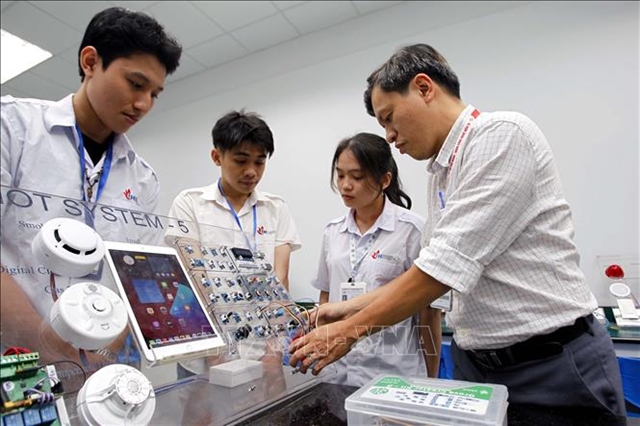 |
| A lecturer at the Industrial University of Hồ Chí Minh City instructing students on research at the university’s IoT and AI Lab. VNA/VNS Photo Thanh Vũ |
HÀ NỘI Despite a mostly complete legal framework for science and technology supported by a variety of new regulations, implementation remains hindered by several bottlenecks, experts heard at a conference in Hà Nội on Wednesday.
Most notably, fund disbursement is still falling far short of actual requirements, according to speakers and participants at the conference, which was titled 'Science, Technology, Innovation Institutions and Digital Transformation - Removing Bottlenecks and Fostering Development'.
Legal framework takes shape
In his remarks at the event, Minister of Science and Technology Vũ Hải Quân said that since the Politburo issued Resolution 57 on breakthroughs in the development of science, technology, innovation and digital transformation in late 2024, the ministry has advised the Government on submitting 10 laws to the National Assembly for approval.
It has also proposed 33 decrees and one resolution for Government issuance, while continuing to refine numerous additional decisions and guiding circulars.
According to Quân, the formulation of laws, decrees and circulars has introduced many groundbreaking possibilities. For example, regulations on strategic technologies are not only mentioned in the Law on Science, Technology and Innovation, but also specified in the amended Law on High Technology and in guiding decrees and circulars, creating a legal framework for their development.
“One notable innovation is the reference to international practices when establishing standards and incentive mechanisms for scientific and technological personnel,” the minister said.
“The Ministry of Science and Technology has studied income levels and policies in several countries in the region, such as Singapore, Thailand and Indonesia, to serve as the basis for developing regulations suitable to Việt Nam’s conditions.”
In addition, the National Foundation for Science and Technology Development (Nafosted) has been restructured to operate as a financial fund, instead of functioning under the State budget allocation mechanism as before. This change aims to increase flexibility in resource use and meet the demands of science and technology development in the new era.
Nafosted’s functions have also been expanded. Previously, it mainly supported basic research, but now it can also provide funding across multiple stages, from research and development to prototype production.
Quân said the National Technology Innovation Fund will continue to play a role in supporting tech enterprises in innovation, promoting start-up activities, and commercialising research results.
However, he noted that the promulgation of laws, decrees and circulars is only the beginning. One of the biggest obstacles is ensuring that regulations are understood, consistently applied and effectively carried out by ministries, local authorities and the business community.
“Reforms in financial mechanisms and policies cannot be implemented overnight, as the legal system is interconnected and affects many existing regulations. Breakthroughs only come gradually, ensuring consistency and feasibility during execution,” the minister said.
Existing bottlenecks
At the conference, Deputy Prime Minister Hồ Quốc Dũng said: “What we are aiming for is not simply issuing more documents or creating more policies, but more importantly, being able to measure the effectiveness of those policies. Investment resources for science and technology must be quantified by concrete results.”
“We must be able to answer very clear questions," he continued. "How many technologies have we mastered? How many products have been commercialised? How many innovative enterprises have been established and developed? How have science, technology, innovation and digital transformation contributed to the country’s economic growth? Those are the real benchmarks of the implementation of Resolution 57.”
To realise these development goals, the deputy PM proposed that four key actors in the science, technology, innovation and digital transformation ecosystem act more decisively.
The State should continue renewing management thinking about facilitating development, placing citizens and businesses at the centre, promoting decentralisation and delegation of authority along with resource allocation, and avoid shirking responsibility in public service.
Scientific research must focus on the country’s development needs and the demands of enterprises and localities, with effectiveness and commercialisation as key criteria for evaluating research outcomes.
For research institutes and universities, it is essential to strengthen practice-oriented research, promote technology transfer, commercialise research results and develop an innovation ecosystem within the academic environment.
Finally, enterprises should invest in research and development, boldly create new technology, participate more deeply in the innovation ecosystem and become the central actors in receiving, mastering and commercialising technology.
Dũng also emphasised improved efficiency of resource use for science, technology, innovation and digital transformation.
“Investment in science and technology is investment in the future. However, if resources are allocated but disbursement is delayed, opportunities for development will be lost, causing technologies, products and enterprises to form more slowly,” said the deputy PM. VNS
Sci-Tech
 Sci-Tech
 Sci-Tech
 Sci-Tech
 Sci-Tech
 Sci-Tech
 Sci-Tech
 Sci-Tech
 Sci-Tech
 Sci-Tech
 Sci-Tech
 Sci-Tech
 Sci-Tech
 Sci-Tech
 Sci-Tech