 Sci-Tech

Two Australian entertainment names revealed behind the scenes of Symphony of the Sea Season 3 in Phú Quốc
1.
 |
| Semiconductor chips made in Việt Nam. — VNA/VNS Photo |
HÀ NỘI — Việt Nam’s semiconductor industry has made notable progress, generating more than US$21 billion in revenue in 2025 while attracting over $14 billion in foreign direct investment across more than 240 projects.
The country has also built a network of around 60 integrated circuit design companies supported by a workforce of more than 7,000 engineers.
Yet behind these impressive figures lies a critical bottleneck: the ability to translate chip designs into commercially manufactured semiconductor products.
Vietnam Semiconductor Advanced Packaging (VSAP) LAB, the first fully funded Vietnamese start-up offering complete advanced packaging solutions based in Đà Nẵng, has mobilised VNĐ1.8 trillion to pursue its ambition of manufacturing chips in Việt Nam, with the facility expected to begin operations in the fourth quarter of 2026.
However, turning that ambition into commercially viable products remains an arduous journey, marked by high costs and institutional hurdles.
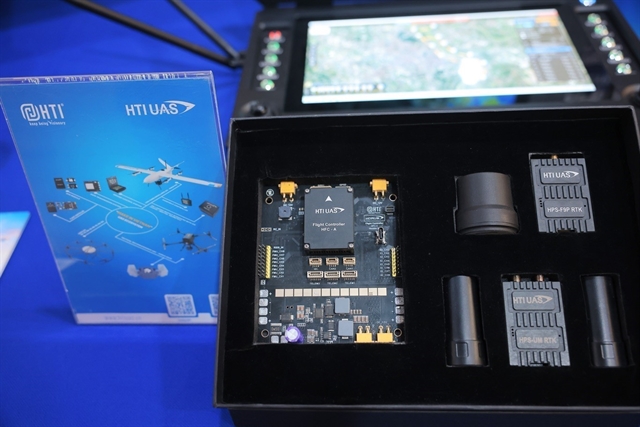
Unlike many companies that stop at contract manufacturing or producing equipment casings, VSAP LAB aims to master advanced chip packaging technologies and design specialised chips for smart wearables and unmanned aerial vehicles (UAVs).
VSAP LAB representative Nguyễn Bảo Anh said developing software solutions or 3D-printing UAV casings, as many companies currently do, is relatively straightforward. Their ambition is to create the 'brain' of these systems, embedded computers and flight controllers bearing the "Made in Việt Nam" label.
To prepare for this goal, the company has tightened its belt, saving every possible expense to invest in a production line scheduled to begin operations in the third quarter of 2026.
Despite its determination, VSAP LAB continues to face the harsh realities of the semiconductor industry, where prototype manufacturing (tape-out) and initial R&D investments require enormous capital.
According to industry estimates, each chip design costs between $30,000 and $200,000 to tape out, with waiting times ranging from 12 to 24 months.
As Việt Nam still lacks a domestic semiconductor foundry, VSAP LAB has had to take a detour by sending engineers to Singapore to use facilities at the National University of Singapore to fabricate prototype chips, validate the technology, and only then bring it back to Việt Nam for mass production.
This reliance on overseas facilities not only increases costs, but also delays the company's time to market.
The operational burden is equally daunting. A company like VSAP LAB consumes as much electricity as a small neighbourhood, around 7.5MW, creating substantial operating costs while it waits for stable orders, a policy breakthrough and Government procurement contracts.
Lacking connection
Nguyễn Khắc Lịch, director general of the Department of Digital Technology and Artificial Intelligence under the Ministry of Science and Technology, acknowledged that many promising chip designs and research outcomes from universities, research institutes and start-ups are encountering enormous difficulties when they reach the prototype manufacturing stage.
Unless this bottleneck is addressed, semiconductors — the foundation of AI, 5G, the Internet of Things and defence technologies — will remain beyond Việt Nam’s reach in terms of technological self-reliance, he said.
Beyond financial constraints, time is another major obstacle to innovation.
Associate Professor Trần Cao Vinh, vice president of Việt Nam National University HCM City, said research groups currently have to work independently, spending considerable time and resources establishing partnerships with overseas institutions in search of technical support. The absence of a national coordinating body and a domestic semiconductor foundry leaves Vietnamese researchers in a persistently reactive position.
 |
| The launch of the National Centre for Supporting Semiconductor Chip Prototyping in Hà Nội in June. —VNA/VNS Photo |
Nguyễn Bích Yến, a semiconductor expert serving on the advisory panel of the National Centre for Supporting Semiconductor Chip Prototyping, further explained the complexity of the process.
"Turning a chip design into an actual semiconductor device is a long and rigorous journey," Yến said.
"It requires seamless integration of skilled workers, electronic design automation (EDA) software and process design kits provided by foundries, as well as packaging, testing and failure analysis capabilities."
She went on to note that the shortage of industry-standard laboratories, combined with the prohibitive licensing costs of EDA software, has created a significant technical barrier, making it difficult for Vietnamese chip designs to meet the standards required for large-scale manufacturing.
As a result, many integrated circuit research projects never progress beyond computer simulation.
Minister of Science and Technology Vũ Hải Quân said no single university or enterprise can build Việt Nam's semiconductor industry alone.
"It must be a collaborative effort," he said.
According to the minister, if research institutions and businesses continue to work in isolation, semiconductor projects will remain fragmented and will never produce the high-value commercial products needed to make a meaningful contribution to the country's GDP.
Quân said the semiconductor industry and the wider strategic technologies sector are now receiving the highest level of policy priority and incentives.
A comprehensive package of incentives, including corporate income tax preferences, import tax exemptions for machinery and support for EDA software, is being rolled out to create the most favourable environment for both global technology firms and domestic enterprises to grow.
The centrepiece of this new policy ecosystem is the establishment of the Việt Nam National Multi-Project Wafer Coordination Centre.
Rather than functioning as a conventional administrative body, the centre is envisioned as a national coordination hub operating under the principles of openness, connectivity and resource sharing.
Its core mission is to carry out the multi-project wafer model, a technical approach that enables chip designs from multiple universities, research institutes and start-ups to be fabricated together on a single semiconductor wafer during the same manufacturing run.
To help turn promising chip designs into commercial products, the Government has also introduced a robust financial support roadmap.
Through the end of 2027, the State will cover 100 per cent of tape-out costs for universities, research institutes and chip design teams.
From 2028 to 2030, the programme will shift to a co-funding model, with costs shared among the Government, investment funds and private enterprises, while technical services, including testing, packaging and failure analysis, will be further expanded and upgraded.
Nguyễn Phương Tuấn, vice chairman of the National Assembly's Committee for Science, Technology and Environment, said Việt Nam hopes to have at least 100 chip design companies, one semiconductor fabrication plant and around 10 packaging and testing facilities by 2030.
It also targets annual semiconductor revenue of more than $25 billion and generating added value of 10-15 per cent. Achieving these goals will require a shift in policy from regulating inputs to evaluating technological outcomes.
He said the concept of 'Make in Việt Nam' semiconductors should also be defined based on substantive ownership. Given the global nature of semiconductor supply chains, it is unrealistic to require every stage of production to take place domestically.
Instead, the determining factor should be whether a Vietnamese legal entity owns the product requirements, architecture, design or valuable intellectual property, as well as the technical data, product roadmap and commercial responsibility.
Products that are merely assembled or packaged in Việt Nam, while key product decisions remain under the control of foreign partners, should not be regarded as genuinely Vietnamese-controlled semiconductor products, he said.
On that basis, Việt Nam should develop national semiconductor product programmes aligned with specific missions and market demand, he added. — VNS
Sci-Tech
 Sci-Tech
 Sci-Tech
 Sci-Tech
 Sci-Tech
 Sci-Tech
 Sci-Tech
 Sci-Tech
 Sci-Tech
 Sci-Tech
 Sci-Tech
 Sci-Tech
 Sci-Tech
 Sci-Tech
 Sci-Tech