 World
World
VN-Index ends lower despite liquidity hit over $1 billion
1.
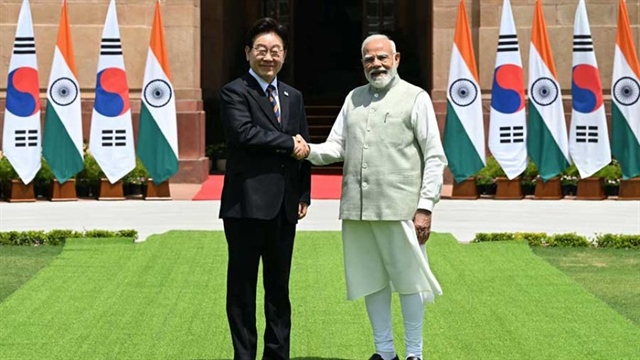 |
| India's Prime Minister Narendra Modi (right) shakes hands with South Korea's President Lee Jae Myung before their meeting at the Hyderabad House in New Delhi on Monday. — AFP/VNA Photo |
NEW DELHI — The leaders of South Korea and India have agreed to elevate bilateral ties to “a whole new level,” while acknowledging that the partnership has yet to realise its full potential, Cheong Wa Dae said.
President Lee Jae Myung and Prime Minister Narendra Modi reached the agreement during their summit at Hyderabad House in New Delhi on Monday, national security adviser Wi Sung-lac said on Tuesday.
“The two leaders assessed that although bilateral relations have developed considerably over the past decade since their elevation to a ‘special strategic partnership’ in 2015, they have still not lived up to their full potential for cooperation,” according to Wi.
“They agreed to use this meeting as an opportunity to elevate bilateral relations to a whole new level.”
During a closed-door meeting attended by a limited number of aides, Lee reiterated that South Korea-India ties have lagged behind the scale of India’s population and economic weight as one of the world’s largest economies.
“President Lee noted that, relative to India’s population and GDP, South Korea’s presence remains limited, with only about 12,000 Korean residents and some 670 Korean companies operating there, showing that bilateral ties have remained stagnant,” Wi said in a written statement on the outcome of the summit.
“(Lee) said the two countries should use today’s summit as an opportunity to pursue cooperation on an entirely different level in areas such as people-to-people exchanges, economic cooperation and security.”
Lee, Modi align visions
Lee and Modi “shared a strong conviction that the Republic of Korea and India are ideal partners in realizing each other’s national development visions,” Wi said, using South Korea’s official name.
Those visions refer to the Lee administration’s ‘great national leap forward’ and the Modi administration’s ‘Viksit Bharat 2047,’ India’s blueprint to become a fully developed country by the centenary of its independence in 2047.
Lee and Modi also concurred on stepping up coordination in response to growing global economic uncertainty.
The two leaders “agreed to work more closely together to promote mutual growth and innovation, and to overcome difficult global economic conditions at a time of mounting uncertainty caused by the Middle East war and other disruptions,” according to Wi.
“The two leaders also agreed that, grounded in their shared democratic values, it is important for the two countries to advance through cooperation across a broad range of fields,” Wi said.
Wi further explained that “the two leaders agreed to strengthen not only cooperation between Korea and India, but also inclusive cooperation with other countries in the region, in order to promote peace and stability in the Indo-Pacific.”
During the closed-door summit, Lee and Modi discussed ways to address business bottlenecks facing South Korean companies operating in India.
According to Wi, Lee gave Modi a detailed account of the difficulties raised by Korean companies already operating in India, as well as by small and medium-sized Korean firms considering future investment, including concerns voiced at a meeting with Korean residents in India on Sunday.
“Prime Minister Modi expressed his appreciation for the President’s explanation and immediately promised to create an opportunity to listen closely to the difficulties facing our companies and seek solutions,” Wi said.“Prime Minister Modi also asked that more Korean companies invest in and expand into India through that process.”
Lee calls for sweeping cooperation
During the expanded meeting following the closed-door session, the two leaders “held in-depth discussions on ways to advance strategic economic cooperation between the two countries in new strategic sectors, including shipbuilding, finance, AI and defense,” according to Wi.
Wi said Lee called for a “sweeping expansion of practical bilateral cooperation across nearly all sectors.”
The fields include the establishment of a ministerial-level Industrial Cooperation Committee, financial cooperation, support for South Korean small and medium-sized enterprises entering India, science and technology cooperation, environment and climate cooperation, defense and arms industry cooperation, cultural and people-to-people exchanges, expanded Korean-language education, and cooperation in the gaming sector.
The summit produced a set of landmark agreements, including the adoption of the Joint Strategic Vision for the Korea-India Special Strategic Partnership, a five-year roadmap aimed at strengthening bilateral ties from 2026 through 2030.
The two sides also adopted three accompanying documents: the Korea-India Comprehensive Framework for Partnership in Shipbuilding, Shipping and Maritime Logistics; the Korea-India Joint Statement on Cooperation in the Field of Sustainability; and the Joint Statement on Energy Resource Security.
According to Wi, the expanded meeting also covered “not only issues related to the Korean Peninsula, but also ways for Korea and India to contribute to global peace and stability amid rapidly shifting global conditions, including the recent situation in the Middle East.”
Lee and Modi also “exchanged views on ways to coordinate not only on securing supplies of key raw materials such as naphtha, but also more broadly as major energy importers,” Wi said.
“The two leaders also continued candid communication on their long-term national development strategies, their visions for key technologies such as AI, and the economic and social challenges facing both countries,” he added.
Lee, Modi show rapport
Wi highlighted that Lee’s state visit to India, the first in eight years by a South Korean president, “marked the full-fledged start of Korea’s Global South diplomacy and created fresh momentum for cooperation with India, a fast-growing nation of 1.4 billion people.”
Lee’s visit also “expands the scope of bilateral ties into more future-oriented and strategic fields.”
Wi further underscored that “throughout the visit to India, it was striking to see the two leaders display a deep personal rapport, like old friends meeting again after a long time.”
Their chemistry was most evident during the closed-door small-group summit, which was originally expected to last about 40 minutes but ran for more than an hour. The session, which began at 11:37am, did not conclude until 12:59pm.
According to Wi, Lee highlighted his “deep personal rapport” with Modi, drawing a parallel between their humble beginnings – his own past as a factory worker in his youth and Modi’s background as a tea seller.
Before the summit in New Delhi, Lee and Modi had met twice on the sidelines of the Group of Seven summit in Kananaskis, Canada, in June 2025 and the Group of 20 summit in South Africa in November 2025. — The Korea Herald/ANN
World
 World
World
 World
World
 World
World
 World
World
 World
World
 World
World
.jpg) World
World
 World
World
.jpg) World
World
 World
World
 World
World
 World
World
 World
World
 World
World