 World
World
Int’l cooperation helps address nuclear power workforce shortages
1.
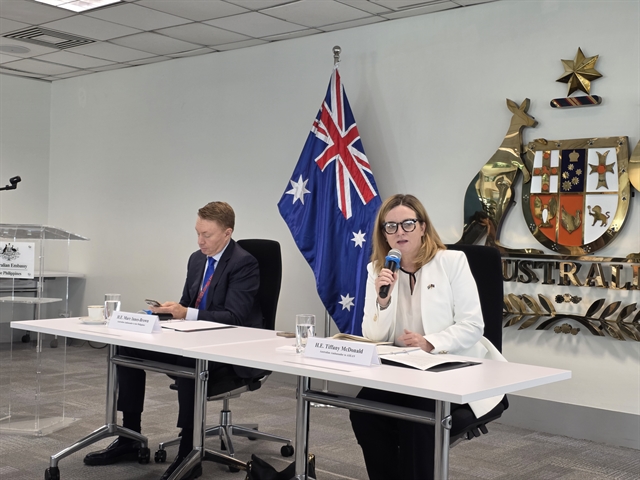 |
| Australian Ambassador to ASEAN Tiffany McDonald at a discussion with reporters from the ASEAN region in Manila, the Philippines. — VNS Photo Trọng Kiên |
MANILA — Australia sees ASEAN-led mechanisms as essential to maintaining regional stability and balance amid increasingly complex geopolitical competition, Australian Ambassador to ASEAN Tiffany McDonald told a group of ASEAN reporters during a recent meeting in Manila.
Speaking from a regional perspective, the diplomat said ASEAN platforms allow Australia to engage collectively with all 11 member states – including the bloc’s newest member, Timor-Leste.
Australia’s regional policy, she added, consistently emphasises the importance of ASEAN centrality – a principle frequently highlighted by Australian diplomatic leaders.
“You will often hear Australian diplomats, our foreign minister and our prime minister talking about wanting a region where ASEAN centrality is maintained,” McDonald said.
Canberra sees ASEAN as a driving force for shaping the rules and norms that apply in the region, particularly at a time of shifting foreign influence trends.
Australia, she noted, is invested in supporting a regional order where balance is preserved and sovereignty respected.
“What we certainly advocate for and are invested in maintaining – not least through ASEAN mechanisms – is a region where no one country dominates and no country is dominated,” she said.
The goal is to ensure countries retain the freedom to pursue their own national interests.
“We’re actively working with ASEAN to shape a region that continues to be governed by rules and norms, and where each country is free to choose how it prosecutes its own national interests.”
As the regional bloc's 60th anniversary comes next year, Australia expects ASEAN’s role in shaping the regional order to become even more pronounced, particularly as geopolitical competition intensifies, but McDonald stressed that Australia does not want regional dynamics to compel countries to align with competing powers.
“We don’t want a region where any one country has to choose,” she said.
She linked this approach to Australia’s broader regional framework built around the Three 3R which are “rules, relationships, and resilience”.
While not identifying specific foreign influence trends, the ambassador acknowledged growing strategic competition across the Indo-Pacific.
“It’s not really answering directly the idea of what is the foreign influence trend,” she said, “but I think that trend of this being a contested world – a contested space – means we have to reaffirm and redouble our commitment to maintaining rules and norms for regional resilience.”
She added that strengthening ASEAN-led cooperation remains central to ensuring long-term prosperity for both ASEAN member states and Australia.
 |
| Australian Ambassador to the Philippines Marc Innes-Brown PSM. — Photo courtesy of the Australian Embassy in the Philippines |
Australia hopes COC reaffirms UNCLOS
With regards to the highly anticipated Code of Conduct in the East Sea (internationally known as the South China Sea) (COC), which the Philippines as ASEAN Chair this year is pushing for a conclusion of negotiations between China and ASEAN within 2026, Canberra diplomats again emphasised the rules of law aspect.
"While we're not privy to the negotiations, and we don't have the details of where the current negotiations are at, but obviously we're deeply interested in it, and generally speaking, we hope that agreements enhance international observance of international rules and norms, we hope it's going to be a high quality agreement, and hopefully it reinforces the centrality of ASEAN in terms of it resolving maritime issues," Australian Ambassador to the Philippines Marc Innes-Brown PSM told the media.
The Australian representative to ASEAN remarked that in her engagements with ASEAN counterparts, she has been continuing to advocate for a Code of Conduct that is high quality, reaffirms ASEAN’s interests, but most importantly "reaffirms the primacy of the United Nations Convention on the Law of the Sea (UNCLOS)," which is the fundamental legal framework governing maritime activities worldwide.
“We know that ASEAN is negotiating with China for a Code of Conduct, and one of Australia’s primary objectives in our engagement with ASEAN is to support and encourage a unified ASEAN family,” she said.
“We want ASEAN to continue to thrive and prosper as a collection of 11 member states.”
McDonald highlighted the growing economic importance of ASEAN–Australia ties, noting that ASEAN has become Australia’s second-largest trading partner.
“It exceeded AU$195 billion in two-way trade in 2024,” she said, stressing that maritime stability remains critical to sustaining that economic relationship.
Maritime trade is particularly significant for Australia’s economy, she added.
“One in four jobs in Australia are derived from trade, so it’s incredibly important for Australia that the South China Sea and other oceans and seas continue to be governed by the United Nations Convention on the Law of the Sea.” — VNS
World
 World
World
 World
World
 World
World
 World
World
 World
World
 World
World
 World
World
 World
World
 World
World
 World
World
 World
World
 World
World
 World
World
 World
World