 Sunday/Weekend
HCM City, India seek deeper cooperation in future technologies
1.
Thùy Linh
Amid the bustle of Hà Nội's Old Quarter, where shops glow and crowds stream past, a small portrait studio at 47 Hàng Ngang Street seems to belong to another time.
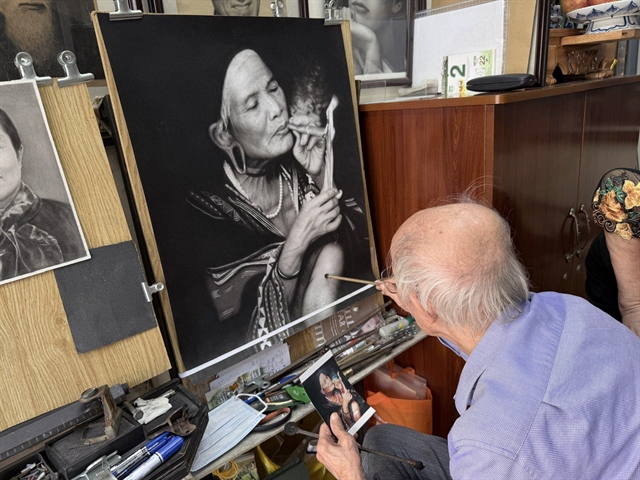
Inside, 91-year-old Nguyễn Bảo Nguyên quietly practises an art he has spent nearly seven decades perfecting: capturing the faces and spirits of people using little more than soot and a handful of simple tools.
|
| At 91, Nguyễn Bảo Nguyên continues to practise portrait drawing at his small shop on Hàng Ngang Street, faithfully preserving the craft day after day. — VNS Photo Thùy Linh |
Few would imagine that a man who has spent almost his entire life capturing the faces of others was once a physics student at the General University of Hà Nội, now Vietnam National University, Hà Nội. But sometimes, life takes a different turn because of nothing more than an illness.
Just before his graduation ceremony, Nguyên suddenly fell seriously ill, forcing him to put his studies on hold. The year he spent recovering was also a year in which his family struggled to make ends meet. Behind the young university student were ten younger siblings; a family of thirteen had to rely solely on the modest income of their father, a medical worker.
It was during that difficult period that Nguyên turned to portrait drawing. But in those days, drawing was like many other traditional crafts: people guarded their skills and kept their techniques to themselves. No one was willing to easily pass down their secrets to a young man.
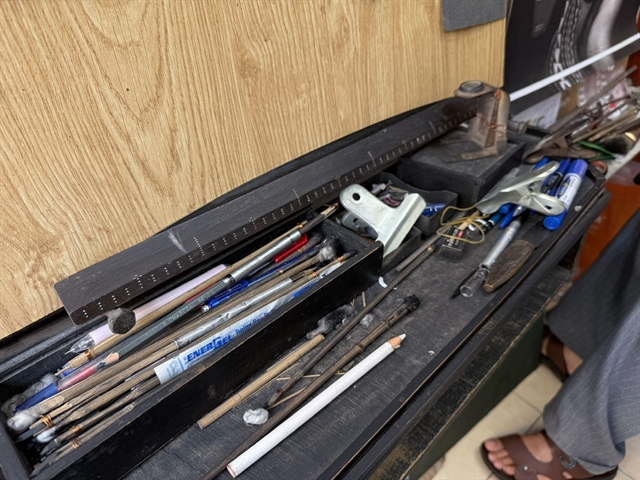
With no one to teach him, Nguyên taught himself. Using soot, toothpicks, cotton swabs, pencils and whatever simple household objects he could find, he fashioned his own tools and experimented, searching for a way to turn a thin layer of soot into a face that seemed to possess a life of its own.
|
| Simple drawing tools that have helped Nguyên capture the 'spirit' of countless faces over the years. — VNS Photo Thùy Linh |
Eventually, after saving enough money, he rented a small house on Hàng Ngang Street and opened his portrait shop. He has remained there ever since.
The spirit of a face
In the mornings, Nguyên stays at his shop on Hàng Ngang, drawing and receiving customers. In the afternoons, he returns to his small home on Trương Định Street, where he finds peace and quiet and continues working on his portraits.
To Nguyên, portraiture has never been merely about reproducing a face. It is a way for the living to remember the dead, to honour the contributions of their ancestors and to preserve a part of their spiritual and cultural life.
“Portrait drawing is about the principle of remembering where we came from and honouring those who came before us,” he says.
Perhaps because of his background in physics, Nguyên studies a face with the meticulousness of a researcher. What gives a face its spirit does not lie in any single prominent feature, but in countless small details: the bridge of the nose, the lips, the corners of the mouth, the fine lines of wrinkles and, above all, the eyes.
“The mouth has its own spirit, and the eyes have their own spirit. Take sleepy, half-closed eyes, for example,” he explains. To Nguyên, the eyes can reveal a great deal about a person.
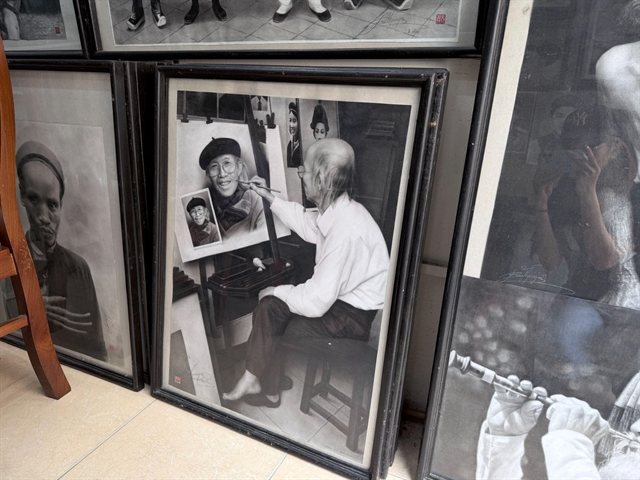
|
| A self-portrait created by Nguyên — also the work into which he has poured the most thought and feeling. — VNS Photo Thùy Linh |
Some people come to his shop without even a photograph of the loved one they want him to draw. He does not turn them away. Instead, he sits and listens: What did the face look like? What were the eyes like? The nose? The smile?
He gathers each detail from their memories, pieces them together in his mind and then sets them down on paper. For the hardest part of portraiture is not simply making a drawing look like someone. It is capturing their spirit.
Nguyên does not see his craft as merely an old technique waiting to disappear. Within the soot, he sees values that modern life can sometimes make people forget.
“Soot drawing carries many meanings,” he says.
First, it is a traditional craft. As machines become increasingly prevalent, people may once again find themselves drawn to things made by hand, natural materials bearing the distinct imprint of the person who made them.
Then there is the question of colour. After becoming accustomed to vivid colour photographs, people may find a different kind of beauty in black-and-white images. This is particularly true of ancestral portraits, where Nguyên sees the black-and-white palette as fitting with the Eastern concept of yin and yang: the deceased belonging to yin, and the living to yang.
And then there is something more practical: durability. According to Nguyên, soot portraits are less susceptible to dampness, fading and peeling than photographs printed on photographic paper. But perhaps the most enduring thing these portraits preserve is not the layer of soot on paper. It is a memory.
A lasting legacy
Nguyên is now 91. When asked whether he worries about a day when the area around Hoàn Kiếm Lake changes and the shop at 47 Hàng Ngang is no longer there, he simply smiles. It is not something he thinks much about.
“I’m old now. I may be able to work for another few years, but I can’t keep doing this forever. As for social changes, I don’t pay much attention. I don’t have that much time left in my life,” he said.
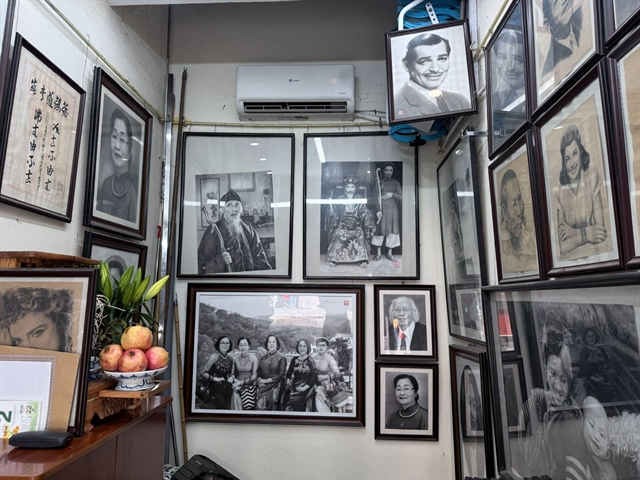
|
| The small shop on Hàng Ngang Street, only a few square metres in size, yet home to a lifetime of Hà Nội's memories. — VNS Photo Thùy Linh |
Then he says that as long as he feels his craft is still of use to society, he will continue doing it. When he can no longer manage, he will stop. “Or, if people still remember me, they can come to my house,” he added.
In fact, that has already happened. Some customers have come to Hàng Ngang only to find the shop closed, then taken a ride all the way to Trương Định in search of him.
In a Hà Nội that never stops changing, the old artisan does not seem intent on holding on to anything. He simply sits quietly before a sheet of paper, picks up his pen and draws. For nearly 70 years, those strokes of soot have passed across countless faces.
And perhaps, as long as there is still someone sitting there, patiently capturing the spirit of one person for another, a part of Hà Nội's memory has not truly disappeared. VNS
Sunday/Weekend
 Sunday/Weekend
 Sunday/Weekend
 Sunday/Weekend
 Sunday/Weekend
 Sunday/Weekend
 Sunday/Weekend
 Sunday/Weekend
 Sunday/Weekend
 Sunday/Weekend
 Sunday/Weekend
 Sunday/Weekend
 Sunday/Weekend