 Sports

Understanding skin ageing key to more effective rejuvenation, dermatologist says
1.
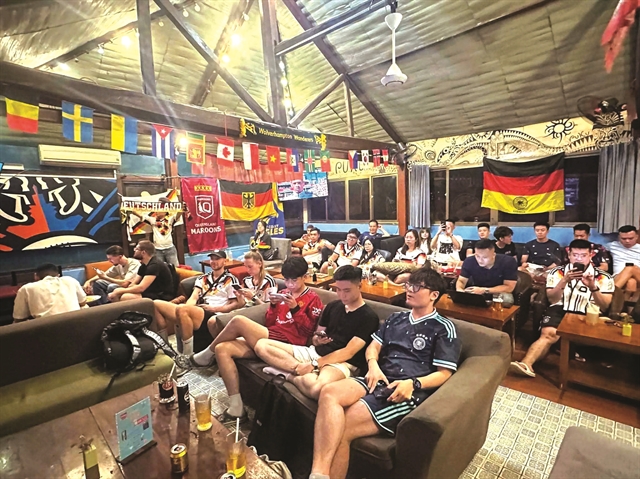 |
| People watching the late World Cup games at Puku Cafe in Hà Nội. Photo courtesy of Puku Cafe & Sports Bar |
Anh Đức
The 2026 FIFA World Cup concludes this weekend, bringing to an end a month when alarm clocks rang at 2am, cafés stayed open until dawn and offices quietly adjusted to accommodate football. In Việt Nam, inconvenient kick-off times proved no obstacle to the game's enduring appeal.
In the early hours of the morning, the sounds of cheering still echoed through Hà Nội's streets as fans celebrated every goal.
It was never supposed to be this easy. When the fixture list was published, Vietnamese fans did the maths and groaned. A tournament spread across the United States, Canada and Mexico meant one of the most punishing time differences in recent memory.
Matches typically kicked off between 11pm and 8am, Hà Nội time. There was no comfortable evening slot, no prime-time window. Following this World Cup meant choosing, every single day, between sleep, work and football.
As the World Cup draws to a close, it is clear which choice most of the country made.
Sleepless for football
On Tạ Hiện Street in Hà Nội's Old Quarter, the knockout rounds turned the street into a place that refused to acknowledge the hour. Screens stood outside every bar, plastic stools spilt onto the pavement, and jerseys of a dozen nations pressed shoulder to shoulder at 2am.
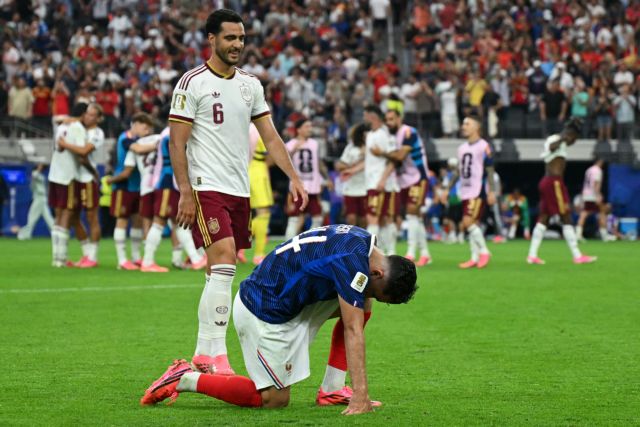
When Spain beat France in the first semi-final, celebrations rolled on until dawn. Winning fans sang and raised glasses while the heartbroken sat quietly in front of the screens, applauding their team one last time before slipping home. A few hours later, the same crowds went to work.
The morning kick-offs collided head-on with Vietnamese office hours, and the nation's workers responded with all the creativity the situation demanded. Across Hà Nội and Hồ Chí Minh City, employees shrank match windows into the corners of their computer screens, typing with one eye on a spreadsheet and the other on a striker through on goal.
Some listened to commentary through a single earphone. Others retreated to the toilets at half-time to check the score. One office worker in Hà Nội who leapt from his chair when his team scored had to invent an urgent errand on the spot, under the puzzled gaze of 10 colleagues.
In stricter workplaces, some employees simply used their annual leave, reasoning that a lost day of holiday was better than a morning of divided attention.
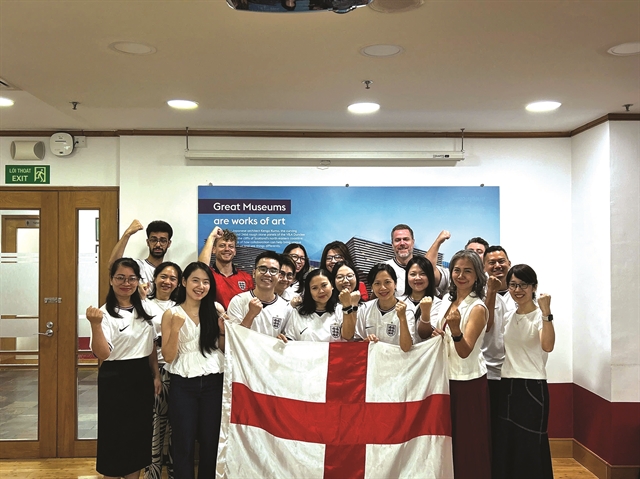 |
| Staff members of the UK Embassy in Việt Nam cheer on semifinalists England before their match against Argentina. Photo courtesy of the UK Embassy in Việt Nam |
Workplaces adapt
Many employers chose to bend rather than resist. Companies in both major cities turned meeting rooms into viewing rooms, moved internal meetings away from kick-off times and allowed staff an hour with the football before returning to their desks.
One import-export firm in Hải Phòng screened matches for its 20 staff during office hours, reasoning that a shared screen was better than 20 hidden ones. Other businesses introduced flexible clock-in times on mornings after late matches.
Human resources experts have noted that a tournament of this magnitude functions as a communal experience rather than a private indulgence, and that workplaces confident enough to accommodate it often gain more in morale than they lose productivity. This summer, many Vietnamese companies appeared to agree.
The diplomatic community was no exception. At the British Embassy in Hà Nội, where England's run to the latter stages had kept spirits high, Matthew Albon Crouch, the Agriculture, Food and Drink Attaché, described an office happily divided along national lines.
"Well, it's a mixed picture. Half of the embassy is very excited as England have progressed through the tournament, but of course the UK is made up of four nations, and we are all very competitive with each other," Crouch said.
"So our colleagues from Scotland are sad that they didn't progress further, and are cheekily telling the English at the embassy that they are supporting whoever is playing England. But really, we know they are rooting for us," he said.
As for the punishing hours, the embassy has taken them in stride.
"We have had a lot of practice with early matches. England got to the final of the Euros in 2024, so we spent many nights watching matches that start at 2am or 4am in Việt Nam," Crouch said.
"Ultimately the excitement and passion gets us through, and our ambassador is very kind and lets us start later after the matches."
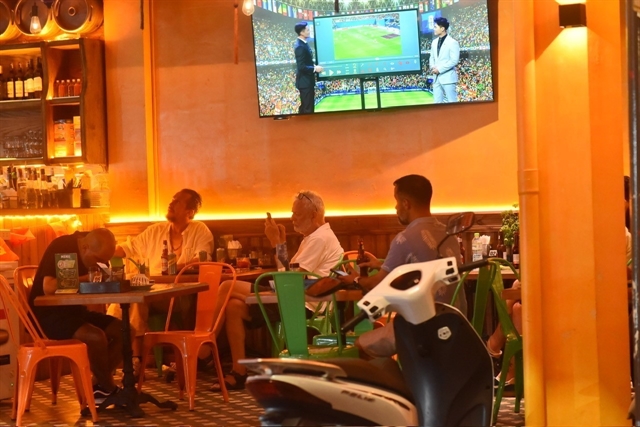 |
| Tourists watching a World Cup match at a cafe in Hà Nội. VNA/VNS Photo |
The expat dawn shift
The tournament has also revealed something about the wider foreign community living in Việt Nam. Since the group stage began, expat forums have filled with posts hunting for cafés open at 5am and compatriots to share a screen with.
In Tây Hồ Ward, one French resident arrived at a 50-square-metre café at four in the morning to find it already packed, with some 20 other foreigners waiting for kick-off.
Sports bars in the capital doubled their overnight staff, upgraded projectors and cable connections, and served crowds of anywhere from 50 to 250 depending on the fixture, with foreign customers dominating the dawn slots.
Staff at one long-standing Hà Nội sports bar said the entire service team switched to English for the morning matches to help international guests with menus and screen requests.
What struck these visitors most, by their own admission, is not the football but the way Việt Nam watches it. A French fan observed that back home, people pour into the streets only for decisive victories, whereas in Việt Nam every match, whether in the group stage or the final, becomes an excuse to gather. The habit proved contagious, and he found himself watching games that had nothing to do with France.
An American resident admitted that football ranks behind basketball and American football in his homeland, yet in Hà Nội his taxi drivers and building security guards could recite the US squad by heart.
An Australian noted that while his countrymen watch matches in their regular pubs, the Vietnamese watch everywhere: restaurants, cafés and plastic tables on the pavement. They also celebrate for considerably longer, he added.
None of it — from the street parties to the office screenings and the dawn cafés — would have been possible in this form without legal, universal access to the tournament. Vietnam Television, which acquired the full broadcasting rights including public screening rights, described the purchase as a decision of significant social importance that went beyond economic considerations. The past month has been proof of that.
Fan zones operated legally and openly across the country, including the first officially licensed public screening events in HCM City, complete with midnight concerts before kick-off at the Phú Thọ Sports Arena.
Bars and cafés showed matches without any concerns over copyright infringement. From a student with a phone to a grandmother with a television, everyone watched the same tournament, free of charge, together.
More than football
That word — together — may be the real story of this World Cup in Việt Nam.
The national team was not in it. There was no anthem to sing, no home jersey to wear. By rights, this should have been a tournament observed politely from a distance, at unsociable hours, with mild interest.
Instead, the country adopted the whole competition: Argentina sky-blue, England white and Spain red on the streets, penalty debates in office pantries, eliminations grieved at 5am with strangers on plastic stools.
The time differences that were supposed to keep fans away instead became part of the ritual: the alarm set for 1.45am, the instant noodles at half-time, and the bleary-eyed solidarity of an office where nobody had slept, but everybody had seen the goal.
This weekend, the final will kick off at yet another inconvenient hour, and once again the lights will stay on in Tạ Hiện, in the cafés of Tây Hồ, and in living rooms from Hà Tĩnh to the Mekong Delta. Then it will be over, and the country will finally catch up on a month of missing sleep, at least until the next gathering. VNS
Sports
 Sports
 Sports
 Sports
 Sports
 Sports
 Sports
 Sports
 Sports
 Sports
 Sports
 Sports
 Sports
.jpg) Sports
Sports
 Sports