 Society
Deputy PM urges stronger commercialisation of sci-tech research
1.
|
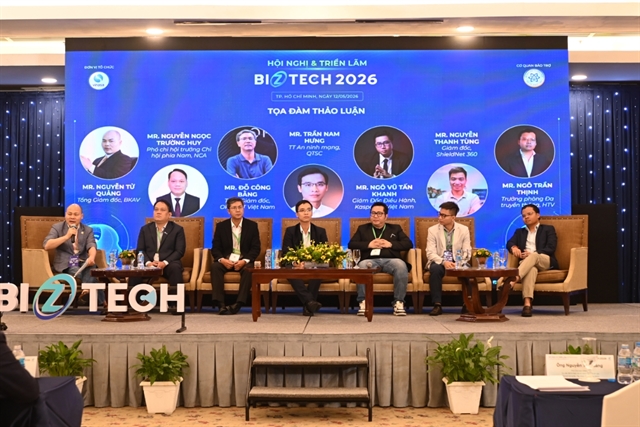
| Speakers and cybersecurity experts take part in a panel discussion on “Cybersecurity in the AI Era” during Biztech 2026 in HCM City. — VNA/VNS Photo |
HCM CITY — Artificial intelligence (AI) is rapidly becoming the new operational backbone of Vietnamese businesses, transforming sectors from finance and retail to manufacturing and logistics, while also creating a new generation of cybersecurity threats that experts warn companies are not fully prepared to confront.
The twin forces of AI-driven automation and AI-powered cybercrime were the main topics discussed at Biztech 2026, a technology conference and exhibition being held in HCM City on May 12-13 under the theme “The Agentic AI Era: Operational Automation and New Growth Drivers.”
Experts at the conference said businesses are no longer competing mainly through scale or low labour costs, but increasingly through their ability to process data quickly, automate decision-making and adapt to market changes in real time.
Technology, they said, is evolving beyond a support tool into the core operating infrastructure of enterprises.
Nguyễn Thị Thu Giang, secretary general of the Vietnam Software and IT Services Association, said AI was gradually becoming “a new operational infrastructure” for businesses.
Biztech 2026 focused on helping businesses, particularly small and medium-sized enterprises, move from reactive operations toward predictive automation through the adoption of “Agentic AI”, autonomous AI systems capable of learning, analyzing and making decisions with limited human intervention, she said.
Experts noted that digital transformation is no longer simply about purchasing software, but about building intelligent operating systems that can continuously learn, analyse and respond in real time.
The rapid development of AI, big data and automation is reshaping multiple sectors.
In finance, speakers described a shift from standalone digital payments toward “embedded finance,” in which financial services are integrated into a single digital ecosystem.
Payments are no longer viewed merely as the final stage of a transaction, but as strategic touchpoints for customer engagement and business growth.
Manufacturing is also undergoing major changes as Việt Nam’s traditional advantage of low-cost labour gradually narrows while global supply chains demand higher quality standards, faster production and greater product traceability.
Speakers said factories are being pushed to transition from rigid production models toward data-driven smart manufacturing systems powered by AI.
Applications already being deployed include predictive demand algorithms, AI assistants supporting factory workers and computer vision systems capable of detecting production defects in real time.
AI-assisted cyberattacks
Alongside the opportunities created by AI, cybersecurity experts warned that the technology is also fundamentally reshaping cyber warfare.
Nguyễn Tử Quảng, vice chairman of the Vietnam Software and IT Services Association and CEO of BKAV, said hackers could now use AI to automate attacks, learn and adapt faster, and dramatically expand the scale of cyberattacks.
He warned that businesses must shift from passive cybersecurity defence toward proactive threat hunting and predictive security strategies.
Experts also said AI is enabling cybercriminals to move beyond conventional malware and vulnerability scanning toward more sophisticated attacks capable of understanding business operations, communication styles and employee behaviour.
Hackers can now use AI to analyse email patterns, operational workflows and organisational structures to create highly convincing attacks targeting specific employees and departments, they said.
“With AI, everyone can now become a hacker,” they warned.
According to the CrowdStrike 2026 report cited at the event, AI-assisted cyberattacks surged 89 per cent while “breakout time”, the period between initial infiltration and full system compromise, has been reduced to just 29 minutes.
Đỗ Công Bằng, senior quality management director at OPSWAT Vietnam, said the growing integration between IT and operational technology systems was expanding the “attack surface” available to hackers, particularly in critical infrastructure sectors such as energy, telecommunications, healthcare and finance.
Meanwhile, Ngô Tấn Vũ Khanh, country manager of Kaspersky Vietnam, warned about threats such as prompt injection and data poisoning, techniques used to manipulate AI models or corrupt training data.
Still, experts stressed that AI is also becoming an essential defensive tool.
Modern AI systems are increasingly capable of detecting, analysing and predicting cyberattacks at high speed while processing hundreds of thousands of malware samples daily.
To reduce cybersecurity risks, specialists urged businesses to establish AI governance frameworks, identify where and how AI is being used internally, and adopt “zero trust” security architectures that continuously verify users, devices and data access.
Organised by the Vietnam Software and IT Services Association under the sponsorship of the Ministry of Science and Technology, the event gathered more than 2,000 delegates, including business executives, technology experts, manufacturers, financial institutions and digital service providers. — VNS
Society
 Society
 Society
 Society
 Society
 Society
 Society
 Society
 Society
 Society
 Society
 Society
 Society
 Society
 Society