 Society
84 individuals investigated for transnational online frauds
1.
.jpg) |
| Contractors paving asphalt along the 61.7km Quy Nhơn–Chí Thạnh Expressway, crossing Gia Lai and Đắk Lắk provinces. — VNA/VNS Photo |
HÀ NỘI — The last five years have marked a turning point for Việt Nam’s expressway network, as the country is set to achieve its target of 3,000km by the end of the year and moves steadily towards a 5,000km target by 2030.
According to the Ministry of Construction, Việt Nam brought just 89km of expressways into operation between 2001 and 2010, followed by 1,163km in the 2011–20 period. By contrast, the length of expressways invested in since 2021 alone is equivalent to the combined total of the previous decade.
By the end of 2025, around 3,513 km of expressways are expected to be completed and opened to traffic. A landmark achievement is the eastern North–South Expressway, now largely finished, with all 23 component projects across both investment phases in operation, enabling seamless travel from the north to the south.
At a seminar titled 'Momentum from 3,000km of Expressways' held yesterday, managers, transport experts and enterprises agreed that the pace of construction has been unprecedented in the history of Việt Nam’s transport sector.
The expanding expressway network is easing congestion, shortening travel times and strengthening regional connectivity, while opening new development space and boosting economic competitiveness. Infrastructure that once constrained growth is now helping to drive it.
Discussions at the event focused on lessons learned, remaining constraints and policy adjustments needed to sustain momentum.
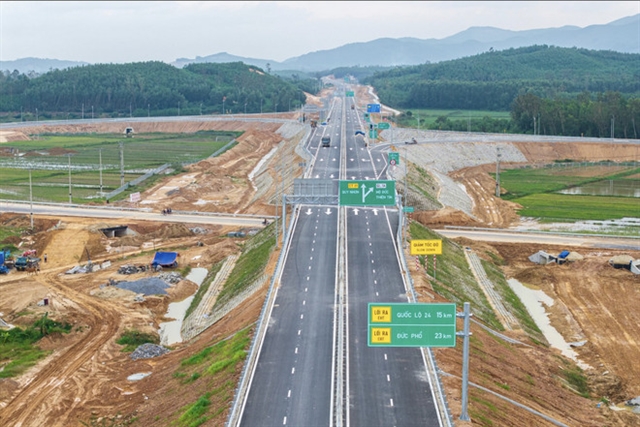 |
| The 88km Quảng Ngãi–Hoài Nhơn Expressway is ready to be fully opened to traffic ahead of its December 19 deadline. |
Lê Quyết Tiến, director of the Department of Economic and Investment Management of Construction under the Ministry of Construction, said a key breakthrough was allowing parallel implementation of investment procedures for Phase 2 of the North–South Expressway project.
Combined with special mechanisms for site clearance, quarry licensing and streamlined appraisal and design, preparation time for the project was significantly shortened.
"Close oversight by the State Steering Committee for nationally important projects helped resolve emerging problems promptly, ensuring both progress and quality," he said.
Contractors said the past five years have pushed domestic enterprises to their limits.
Phạm Văn Khôi of Phương Thành Transportation Investment and Construction Joint Stock Company said expressway projects have tested organisational capacity, financial strength and resilience.
Challenging terrain, complex geology and material shortages forced contractors to revise technical solutions and absorb additional costs to maintain progress, he said, adding that many firms chose to prioritise deadlines over profits as a matter of professional responsibility.
"Contractors want greater flexibility in applying new technologies. While Vietnamese firms are increasingly capable of adopting advanced international construction methods, regulatory barriers remain, particularly in technology trials and unit pricing," Khôi said.
Thăng Long Construction Corporation Deputy General Director Nguyễn Hải Vinh said tighter schedules have made financing the biggest challenge. Expanding construction fronts and mobilising additional machinery, labour and materials require substantial capital, pushing some firms to accept thinner margins. At the same time, pressure has accelerated learning and strengthened management capacity.
Based on his long-term experience onsite, Nguyễn Bá Đoàn of Trường Sơn Construction Corporation's Army Corps 12 highlighted materials and workers as decisive factors. Early resolution of material supply issues can allow projects to finish months ahead of plan, while shortages of engineers and skilled workers are becoming increasingly serious.
Consulting firms face similar pressure.
Phạm Hữu Sơn, chairman of the Board of Directors of the Transport Engineering Design Consulting Corporation, said rapid delivery demands have forced consultants to treat expressway projects as political tasks rather than purely commercial work.
Despite heavy workloads and consultancy fees that are among the lowest across sectors, firms must mobilise maximum resources to meet quality and progress requirements. He also pointed to limited State support and persistent material shortages.
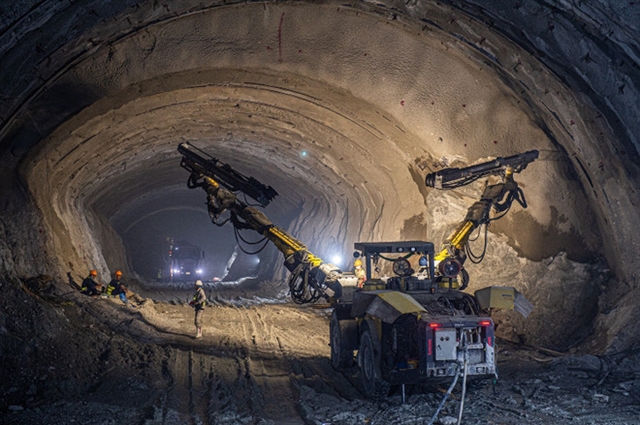 |
| Đèo Cả Group carries out the construction of a mountain tunnel on the North–South Expressway. |
Chairman of the Vietnam Association of Road Transport Infrastructure Investors, Associate Professor Trần Chủng, said achieving the 3,000km milestone by the end of 2025 reflects the growing maturity of Việt Nam’s infrastructure system.
"The application of science and technology has become a key differentiator, enabling faster delivery while maintaining standards and laying a firm foundation for the 5,000km goal by 2030," he said.
Khôi said that demand ahead is expected to be substantial. On December 19 alone, more than 240 projects are scheduled for ground-breaking or inauguration, with a total investment of about VNĐ2.2 quadrillion (US$83.5 billion).
"Workloads in the next term are forecast to be four to five times higher than in the previous one, underscoring the need for stronger training for workers and more effective mechanisms to secure local material supplies," he said. — VNS
Society
 Society
 Society
 Society
 Society
 Society
 Society
 Society
 Society
 Society
 Society
 Society
 Society
 Society
 Society