 Society

AIMCONNECT 2026 Held in Singapore, Bringing Global Automotive Leaders Together to Explore the Future of AI, Trust and Connected Mobility
1.

|
| Public Administration Service Centres at commune and ward levels across Bắc Ninh Province receive and process administrative dossiers, mainly in the areas of justice, land management and social welfare. — Photos courtesy of Bắc Ninh Province |
BẮC NINH — Bắc Ninh Province is pushing ahead with administrative reform to make procedures faster, simpler and more efficient, particularly in the justice and civil status sectors.
Justice-related procedures account for a large proportion of total administrative dossiers handled at the grassroots level. Newly issued policies, together with practical initiatives introduced by local authorities, have significantly shortened processing times and made transactions more convenient for organisations and individuals.
This is an essential factor in improving public service delivery.
At the Public Administration Service Centre of Quế Võ Ward in Bắc Ninh Province, completing a notarisation procedure now takes only about 10 minutes.
For Phan Thị Thục, a resident of Quế Võ Ward, the result was in her hand almost immediately.
“I came here to have documents notarised," she said. "Today I didn’t have to wait long at all. It was very quick and straightforward. After about 12 minutes, I had my documents ready, unlike before.”
Nguyễn Đức Quý, also from Quế Võ Ward, shared a similar experience.
“I came to apply for a personal profile certificate for my child," he said.
"Since the administrative merger, this is my first time coming here. The whole process took around 10 minutes. I submitted the documents, waited briefly and was called to collect the result. There were no difficulties at all.”

|
| Administrative reform at commune-level Public Administration Service Centres has made procedures faster, simpler and more efficient, particularly in the justice and civil status sectors. |
The shorter waiting times are largely attributed to a resolution passed by the Bắc Ninh Provincial People’s Council, which took effect on September 13, 2025. The resolution defines the scope of tasks and authority delegated by commune and ward-level People’s Committee chairpersons to civil servants for notarisation work across the province.
Under the new regulation, experienced and capable commune-level civil servants are authorised to carry out certain notarisation procedures, including certifying copies from originals of documents issued by Vietnamese or foreign agencies, certifying signatures on documents, and certifying translators’ signatures for translations between Vietnamese and foreign languages. The regulation is both specific and flexible, enabling grassroots officials to proactively handle a wide range of daily notarisation needs.
Lại Thị Thúy, an officer at the Quế Võ Ward Public Administration Service Centre, said that the reform has brought clear benefits.
“With delegated authority for signature and copy certification, procedures are processed much faster," she said.
"Citizens no longer have to wait as long as before. For officials, the time spent seeking approvals has been reduced. Previously, we often had to travel to another location to obtain leaders’ signatures, but now everything can be handled directly at the service centre."
Statistics show that notarisation alone accounts for about 84 per cent of all justice-sector administrative dossiers. The provincial resolution has therefore played a key role in accelerating administrative reform, streamlining procedures at the commune level, preventing backlogs and delays and significantly reducing waiting times for citizens.
At the same time, the responsibility of grassroots civil servants has been strengthened, requiring greater initiative in receiving and processing dossiers. Instead of concentrating workloads on commune-level People’s Committee chairpersons, the delegation mechanism distributes tasks more evenly, easing pressure while enhancing professionalism in public service delivery.
|
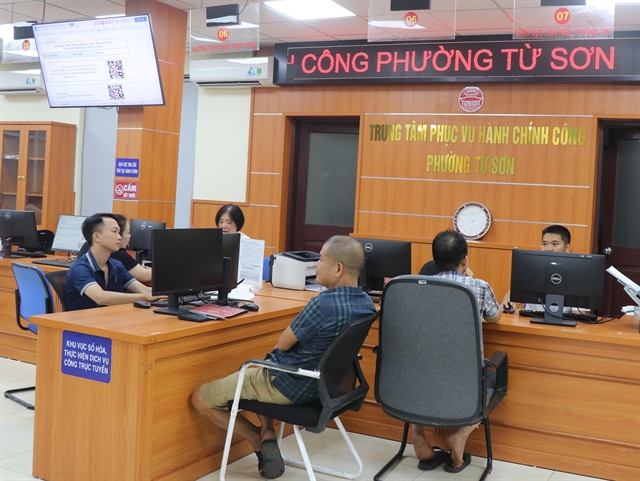
| Citizens carry out administrative procedures in Từ Sơn Ward, Bắc Ninh Province. |
According to Trần Văn Sơn, Deputy Director of the Quế Võ Ward Public Administration Service Centre, the impact has been clear.
“Since authority was delegated to the centre’s leadership, processing times have become much faster and more convenient," he said.
"Previously, citizens might have waited 30 minutes to an hour. Now, most notarisation dossiers are completed within five to ten minutes.
“People are very satisfied with both the speed and the service attitude. Each day, we handle around 250 to 270 dossiers, about 70–80 per cent of which are justice and notarisation procedures.”
|
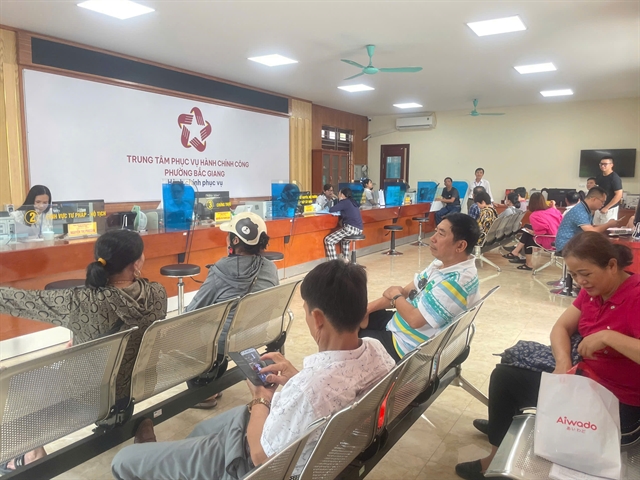
| Citizens wait for administrative procedures at the Public Administration Service Centre in Bắc Giang Ward, Bắc Ninh Province. |
Beyond notarisation, justice and civil status officials across Bắc Ninh are accelerating the shift toward electronic administrative procedures. Since October 2025, 25 essential public services closely linked to daily life and business activities have stopped accepting paper dossiers.
The full digitisation of these procedures is expected to encourage online service use among citizens and businesses.
At commune and ward-level service centres, paperless essential services now include birth registration, death registration, marriage registration, integrated birth registration with permanent residence and health insurance issuance for children under six, as well as integrated death registration, permanent residence deregistration and funeral expense support.
These procedures that are largely concentrated in the justice and civil status sectors. — VNS
Society
 Society
 Society
 Society
 Society
 Society
 Society
 Society
 Society
 Society
 Society
 Society
 Society
 Society
 Society