 Society

AIMCONNECT 2026 Held in Singapore, Bringing Global Automotive Leaders Together to Explore the Future of AI, Trust and Connected Mobility
1.
|
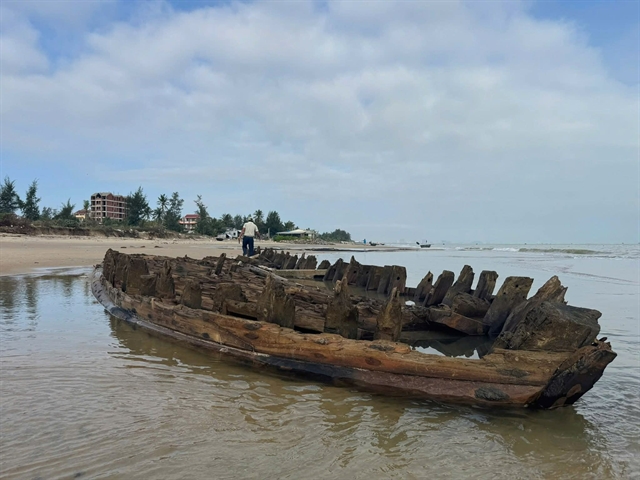
| The ancient shipwreck reappears on a beach in Hội An Tây Ward, Đà Nẵng City after the recent typhoons. — Photos courtesy of the Hội An World Cultural Heritage Conservation Centre |
ĐÀ NẴNG — Hội An World Cultural Heritage Conservation Centre on Monday reported on the preliminary information regarding an ancient shipwreck found on a beach following severe erosion caused by Storm No.13 (Typhoon Kalmaegi).
The centre has proposed an emergency excavation of the remnants of the wooden ship, believed to date back to approximately the 14th or 16th century.
Because of constant tidal shifts, the shipwreck surfaces in the morning and is submerged by afternoon. As of Monday morning, when it reappeared, parts of the vessel had already been buried by sand again compared to just two days earlier.
|
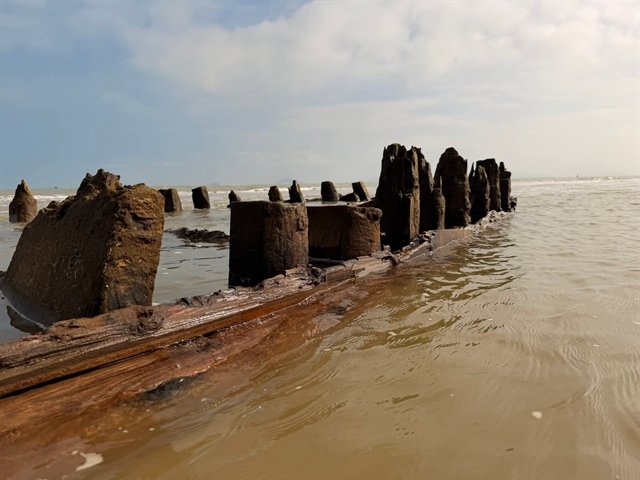
| Unpredictable tides and sand accretion make urgent intervention essential to preserve the ancient relic. |
On the previous day, the unit swiftly cordoned off the site and took professional measures to protect the scene. Without round-the-clock monitoring at the moment, the shipwreck has attracted curious visitors who inadvertently cause damage to the historical artefact.
According to locals, tides in the area have been rising and falling unpredictably. Rising water levels and sand accretion make urgent intervention essential.
|
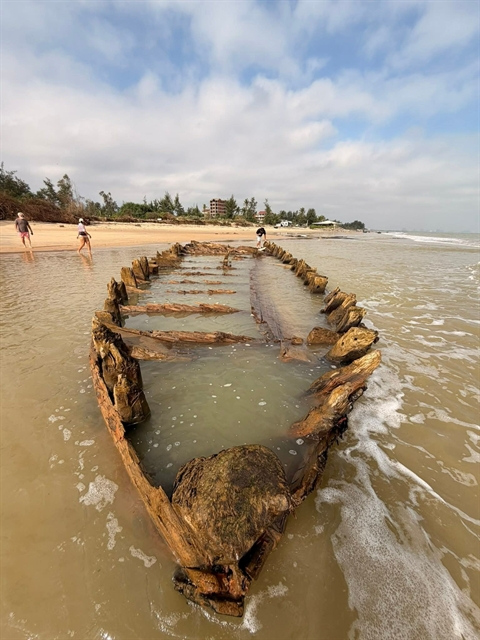
| The shipwreck is partially submerged during high tides. |
Quảng Văn Quý, deputy director of Hội An World Cultural Heritage Conservation Centre, said: “Underwater excavations are extremely challenging and require different equipment and technical approaches than on land.
“The desalination process for preserving the shipwreck is a crucial and highly specialised task that demands both time and technical expertise.”
The relic is said to be at risk of disappearing beneath the sand as it did in 2023, when it was first uncovered by sea waves before being buried again soon after. High tides and downpours at the time have prevented archaeologists from working at the site.
In 2024, a detailed survey was carried out by the Hội An World Cultural Heritage Conservation Centre in collaboration with the University of Social Sciences and Humanities (under the Việt Nam National University–HCM City) and the Quảng Nam Museum (now the Đà Nẵng Museum).
Preliminary findings revealed that the ship was large and sturdily built, made from durable hardwoods, with sealing materials used to prevent water intrusion. Its structure suggested capability for long voyages, possibly for maritime trade or naval purposes.
Although radiocarbon dating has yet to yield definitive results, based on its discovery site and similarities in structure, construction techniques and materials to previous shipwrecks found in the East Sea and Southeast Asia, experts estimate the vessel dates from the late 14th to 16th centuries.

|
| A detail on the frame of the ancient vessel. |
Heavy rains and severe coastal erosion caused by recent typhoons once again exposed the ancient ship.
On November 8, the Hội An World Cultural Heritage Conservation Centre visited the shipwreck site and recorded multiple clearly visible structural details.
The exposed section of the vessel measures over 5m in width and 17.4m in length, with compartments ranging between 88-140cm in width. Its full length likely extends further beneath the sand.
The re-appearance of this rare relic brings both excitement for researchers and urgent challenges for preservation authorities. It presents a ‘golden opportunity’ to study the role of ancient Hội An in the historic Maritime Silk Road, but it is also a race against time and nature. — VNS
Society
 Society
 Society
 Society
 Society
 Society
 Society
 Society
 Society
 Society
 Society
 Society
 Society
 Society
 Society