 Politics & Law

AIMCONNECT 2026 Held in Singapore, Bringing Global Automotive Leaders Together to Explore the Future of AI, Trust and Connected Mobility
1.
|
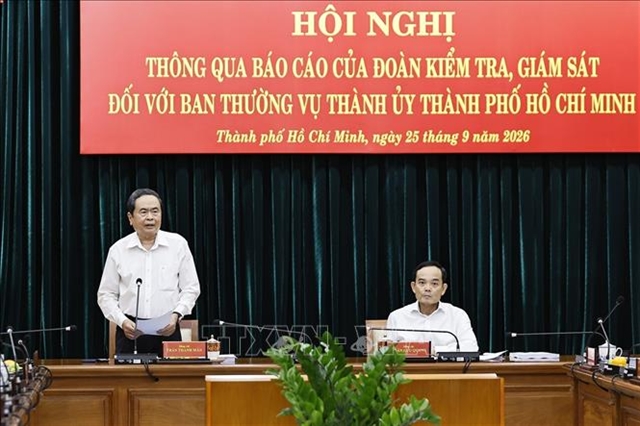
| National Assembly President Trần Thanh Mẫn addresses the conference with the Standing Board of the Party Committee of HCM City in the southern metropolis on Friday. — VNA/VNS Photo Doãn Tấn |
HCM CITY — Decentralisation must make the apparatus faster, closer to the people and more effective, but must not lead to fragmented responsibility or create wide disparities in quality among localities, Politburo member and President of the National Assembly (NA) Trần Thanh Mẫn said on Friday.
The NA President, who is head of the Inspection and Supervision Team No. 220 of the Party Central Committee’s Politburo and Secretariat, made the statement while chairing a conference in HCM City to adopt a draft report on the third round of inspection and supervision of the municipal Party Committee’s Standing Board.
He requested the municipal Party Committee to move from “having studied, disseminated and issued programmes” to determining “what changes and products have been created and what problems have been solved”.
"Each solution must be accompanied by clear targets, expected products, responsible agencies, resources, timelines, impact indicators and regular evaluation mechanisms, ensuring that resolutions are translated into substantive results and narrowing the gap between political determination and implementation capacity," he said.
Regarding personnel management and quality, the NA President acknowledged that decentralisation and delegation of authority have enabled grassroots-level agencies to be more proactive in organisational arrangements, personnel deployment and work performance.
However, he noted that some localities still face shortages of advisory personnel and specialised staff in science and technology, data and digital transformation.
He therefore called on the municipal Party Committee’s Standing Board to review the entire decentralisation mechanism based on the principle that authority must be accompanied by the conditions necessary to exercise it.
Agencies directly managing, assigning and employing personnel must bear the prime responsibility for their assessment and performance, while the municipal Party Committee’s advisory bodies should strengthen guidance, supervision and early risk warnings, he said.
NA President Mẫn also urged the city to make more substantive use of performance-based personnel assessment.
While welcoming the application of products, timelines, quality criteria and key performance indicators (KPIs), he said assessment results must be linked to personnel planning, training, appointment, commendation, screening and replacement.
"Otherwise, assessment will have limited impact on personnel decisions," he said.
He further called for stronger inspection and supervision, power control and digital transformation, noting that specialised self-inspections remain irregular in some local Party Committees, while data for monitoring and power control has yet to be fully interconnected.
HCM City has made progress in digitising documents, developing Party member databases and using electronic Party member handbooks, but digital transformation should go beyond digitising existing procedures to support governance, forecasting and early risk warning, according to Mẫn.
"Given the city’s particularly important role, the requirements for its personnel work must also be higher," he added.
"The ultimate purpose of inspection and supervision is not merely to determine whether procedures are right or wrong, but to help identify areas requiring consolidation, bottlenecks that need to be removed and issues that must be raised to build a contingent of officials with the qualities and capacity to implement the city’s development goals." — VNA/VNS
Politics & Law
 Politics & Law
 Politics & Law
 Politics & Law
 Politics & Law
 Politics & Law
 Politics & Law
 Politics & Law
 Politics & Law
 Politics & Law
 Politics & Law
 Politics & Law
 Politics & Law
 Politics & Law
 Politics & Law