 Politics & Law

AIMCONNECT 2026 Held in Singapore, Bringing Global Automotive Leaders Together to Explore the Future of AI, Trust and Connected Mobility
1.
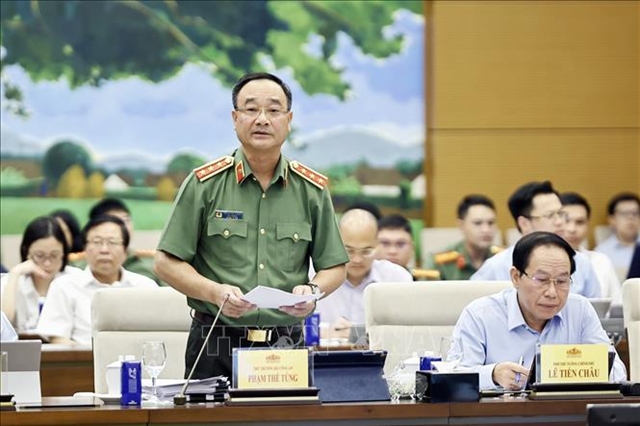 |
| Deputy Minister of Public Security and Senior Lieutenant General Phạm Thế Tùng presents the draft amendments to the Penal Code and two other bills under the ministry's jurisdiction during the sixth session of the NA Standing Committee in Hà Nội on September 25. — VNA/VNS Photo Doãn Tấn |
HÀ NỘI — The death penalty may be removed for six offences and retained for only four, according to opinions expressed by lawmakers during a discussion of draft amendments to the Penal Code on Friday.
The draft amendments were presented by Deputy Minister of Public Security and Senior Lieutenant General Phạm Thế Tùng for discussion by the National Assembly (NA) Standing Committee as its sixth session continued in Hà Nội, together with draft revisions to the Law on Organisation of Criminal Investigation Agencies and Criminal Procedure Code.
Under the draft Penal Code amendments, the use of the death penalty would be narrowed from 10 to just four offences: treason against the Fatherland, murder, terrorism and the illegal production of narcotic substances.
The penalty may soon no longer be applicable to the crimes of rioting, terrorism against the People's administration, rape of a person under 16 years old, illegal trades of narcotic substances, crimes against humanity and war crimes.
Most opinions expressed during the discussion supported the change.
In his assessment of the draft, chairman of the NA's Committee on Legal and Judicial Affairs Phan Chí Hiếu said the committee's Standing Board supports the change, but also urged careful consideration to not reduce the deterrent effect of the law.
He further suggested that if significant differences in opinion persist, the matter should be reported to relevant authorities or submitted to NA deputies for further assessment.
Another major proposed change to the Penal Code is the addition of four new, high-tech offences: illegal interception of data in transit, forgery involving information systems or electronic devices, infringement of personal data and obstruction of personal data protection activities.
Regarding the criminal liability of commercial legal entities, the draft maintains the stance that such entities are not considered "subjects of crime" in the primary sense, but are subject to criminal liability only when the criminal conduct of an individual is attributed to the entity under statutory conditions.
The draft also introduces provisions exempting individuals with specialised duties within the armed forces from criminal liability, if they cause damage while still fulfilling their duties to protect public security and order.
Regarding monetary penalties and the quantification of fines, the drafting agency has opted to review penalties for specific crime categories, rather than applying a single multiplier.
Draft amendments to the Law on the Organisation of Criminal Investigation Agencies expands investigative authority to cover other crimes as assigned by the Minister of Public Security.
Following the decision to discontinue the investigative agencies of the Supreme People's Procuracy and the Central Military Procuracy, the draft transfers the investigative authority to the Security Investigation Agencies of the Ministry of Public Security and Ministry of Defence.
It also amends regulations on the classification of crime reports, and assigns investigative tasks to mid- and high-level investigators serving as chiefs or deputy chiefs of commune-level police units.
The NA Committee on Legal and Judicial Affairs recommended that the law explicitly defines the investigative organisational structure and clarifies the scope of assignments for commune-level police forces.
On the draft amendments to the Criminal Procedure Code, Prosecutor General of the Supreme People's Procuracy Nguyễn Huy Tiến said that the draft sets forth strict regulations on account freezing measures.
It proposes to freeze only funds corresponding to potential fines, confiscation or compensation for damages to avoid unduly disrupting the operations of organisations.
In cases where freezing an account holding digital assets is not feasible, the draft permits the conversion of such assets into Vietnamese đồng or foreign currency for deposit into a temporary custody account.
The reviewing body emphasised that the application of coercive measures must safeguard the legitimate rights of independent, uninformed (bona fide) third parties, and avoid halting production or business activities. — VNS
Politics & Law
 Politics & Law
 Politics & Law
 Politics & Law
 Politics & Law
 Politics & Law
 Politics & Law
 Politics & Law
 Politics & Law
 Politics & Law
 Politics & Law
 Politics & Law
 Politics & Law
 Politics & Law
 Politics & Law