 Politics & Law

Vietnamese creators vie for honours at TikTok’s first Southeast Asia Awards
1.
|
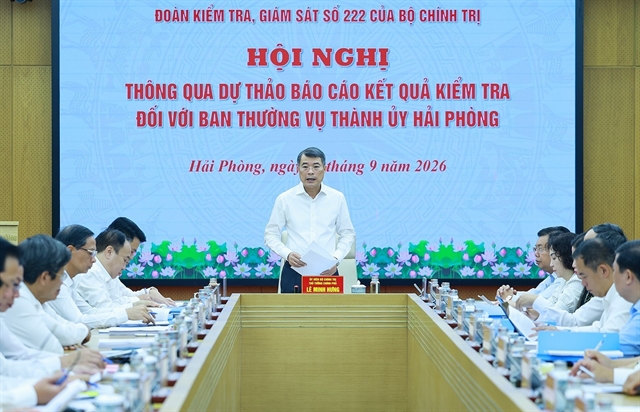
| Prime Minister Lê Minh Hưng speaks at the meeting to adopt the draft report on the performance of Hải Phòng's Party Standing Committee on Thursday. — VNA/VNS Photo |
HẢI PHÒNG — Prime Minister Lê Minh Hưng urged Hải Phòng City on Thursday to build a new generation of leaders with strategic thinking and the capacity to shape development, as a central Party inspection team wrapped up its review of the city's performance with a largely favourable assessment.
Hưng, a Politburo member who heads Politburo and Secretariat Inspection Team 222, chaired a meeting to adopt the team's draft report on the third round of its review of Hải Phòng City's Party Committee.
The inspection covered personnel policy, progress on science, technology and digital transformation, and the city's follow-through on issues flagged in two earlier rounds of scrutiny.
The team found that Hải Phòng City's leadership had pushed through meaningful reforms in how officials are trained, evaluated and promoted, with tighter checks against abuse of power in personnel decisions.
On the technology front, the city moved quickly to reorganise its digital transformation steering committee after the administrative merger and translated central directives into programmes with clear deadlines and lines of accountability.
Most of the shortcomings identified in the first two inspection rounds have since been resolved or are being addressed under specific timelines, according to the report.
Economically, the city has drawn up plans to sustain double-digit growth, backed by new development platforms including a special economic zone, a master plan for a southern coastal economic zone and a planned free trade area.
In the first nine months of the year, six industrial parks were approved and nine more broke ground, while authorities worked to clear obstacles at 91 of 151 problem-plagued projects.
The city has also adopted a digital transformation strategy for 2026-2030 and begun building 5G networks and shared data systems to support local governance, which officials said is now running smoothly under the restructured two-tier local government model.
Looking ahead, the Government leader pressed the city to more strictly evaluate officials, tying assessments more closely to specific job requirements and measurable results, and to use those evaluations to guide promotions, transfers and staffing decisions.
"Where leaders are dynamic and decisive, the work gets done well," Hưng said.
The PM called for the appointment of officials who know their localities, stay close to residents, act quickly on problems and are comfortable in a digital environment, particularly in sectors such as planning, transport, finance, urban management, education and health.
He also urged tighter oversight of Party members, stronger safeguards against internal political risks and the swift removal of underperforming officials, alongside greater accountability for heads of Party units and Government agencies.
In terms of technology, Hưng told Hải Phòng City to carry out Resolution 57 – the Politburo's flagship policy on science, innovation and digital transformation – with tangible, commercially viable results, including a 100-day action plan set by the national steering committee.
He called for the city to prioritise budget spending on innovation, commercialise locally developed technology and build interconnected databases spanning investment, land, tax, customs, labour and other sectors, while shoring up cybersecurity.
The PM set a growth target of 13 per cent for Hải Phòng City in 2026, framing it as the foundation for the 2026-2030 period, and told officials to track performance sector by sector and move quickly to clear bottlenecks facing businesses and major projects.
He urged the expansion of industries such as electronics, automobiles, machinery, metals and shipbuilding, and for accelerating infrastructure in industrial parks, particularly eco-friendly complexes.
City officials were urged to lean into the city's strength as a port hub, developing a smart green seaport and international logistics centre, deepening regional economic ties and supporting small and medium-sized domestic firms.
Other priorities Hưng outlined included fully disbursing this year's public investment budget, resolving long-stalled infrastructure projects, putting surplus State land and buildings to productive use, addressing labour shortages through recruitment and training partnerships, and speeding up social and rental housing near industrial zones.
He also called on the city to complete its master urban plan through 2050 and to carry out the Politburo's directives on healthcare, culture and education. — VNS
Politics & Law
 Politics & Law
 Politics & Law
 Politics & Law
 Politics & Law
 Politics & Law
 Politics & Law
 Politics & Law
 Politics & Law
 Politics & Law
 Politics & Law
 Politics & Law
 Politics & Law
 Politics & Law
 Politics & Law