 Politics & Law

HKSTP Partners with Leading Science and Technology Company Merck to Open a New Chapter in I&T Collaboration
1.
|
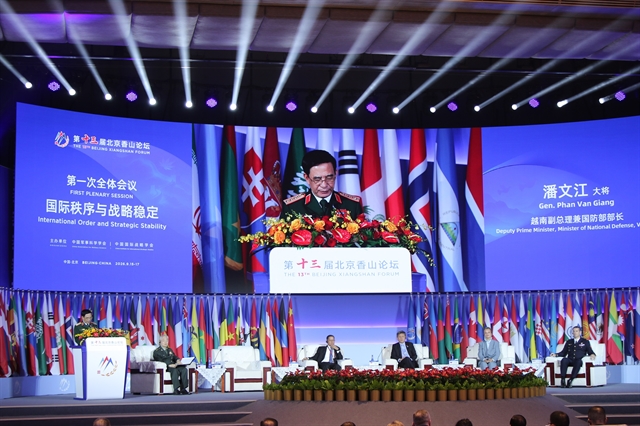
| Deputy Prime Minister and Minister of National Defence of Việt Nam General Phan Văn Giang delivered his speech at the first plenary session on international order and strategic stability at the 13th Beijing Xiangshan Forum in China on September 16. — VNA/VNS Photo |
BEIJING — Politburo member, Deputy Prime Minister and Minister of National Defence of Việt Nam General Phan Văn Giang on Wednesday called for a fair, inclusive and law-based international order, with strategic stability underpinned by mutual respect, dialogue and cooperation.
He made the remarks at the first plenary session of the 13th Beijing Xiangshan Forum on international order and strategic stability in Beijing, China.
Taking place from September 15 to 17 under the theme 'Build Consensus on Stability, Advance Security Governance Together', the forum marks the forum's 20th anniversary. This year's event brought together official delegations, experts and scholars from more than 100 countries, regions and international organisations, with around 2,000 participants attending.
In his speech, Giang said the world is undergoing "pivotal, complex and unpredictable changes," while peace and stability remain a common aspiration of the international community.
He noted that countries share hope for a fairer and more inclusive global order based on international law. However, he said armed conflicts are occurring in various parts of the world, respect for international law remains insufficient, strategic competition and bloc-building persist, and the use or threat of force, including weapons of mass destruction, is contributing to a more uncertain security environment.
The defence minister quoted Party General Secretary and State President Tô Lâm's description of the fundamental problems of the world as an "international order crisis, development model crisis and strategic trust crisis."
Giang stressed that promoting multilateralism also means working towards a fair and inclusive international order based on international law and international institutions.
Such an order requires strategic stability in which a peaceful environment is maintained and countries treat one another as equals, respect each other's legitimate interests, pursue mutually beneficial cooperation and resolve differences through dialogue.
To strengthen the foundations of the international order and build strategic stability, the defence minister highlighted four priorities.
First, countries should demonstrate goodwill and sincerity, build strategic trust and share responsibility.
"A lack of goodwill can lead to confrontation, while a lack of trust can breed suspicion," he said. "Insufficient responsibility can result in indifference to the concerns of others, becoming underlying causes of tensions, conflict and instability."
Giang highlighted the importance of major powers shouldering greater responsibility, noting that countries with greater capabilities should also assume greater responsibilities.
Regardless of whether a country is large or small, countries should respect one another's independence and legitimate interests, he said, adding that no country should seek security for itself at the expense of another country's stability or allow strategic competition to narrow the space for cooperation.
|
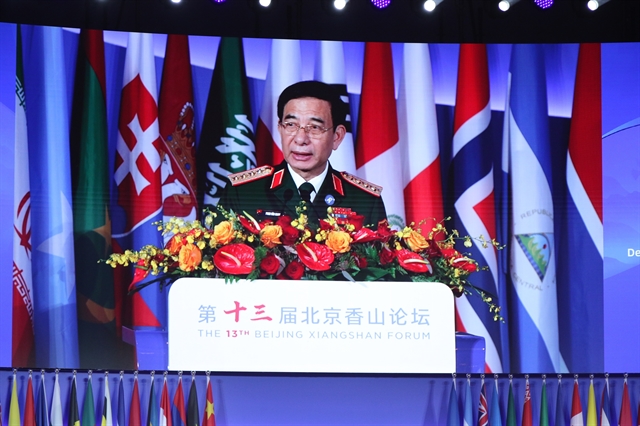
| Deputy Prime Minister and Minister of National Defence General Phan Văn Giang delivered a speech at the first plenary session of the 13th Beijing Xiangshan Forum in China on September 16. — VNA/VNS Photo |
International law, including the UN Charter, should be respected as the foundation governing relations among countries. Without such respect, it would be difficult to build a fair and inclusive international order and ensure strategic stability, he noted.
The defence minister said that multilateral mechanisms should also play a greater role, with the United Nations at the centre of global security governance.
In the Asia-Pacific, ASEAN plays a central role in shaping the regional architecture, maintaining peace and stability, preventing conflicts, promoting dialogue and building trust among countries inside and outside Southeast Asia, he said.
Regarding the East Sea (internationally known as the South China Sea), Giang reaffirmed that Việt Nam supports peaceful settlement of disputes on the basis of international law, including the 1982 UN Convention on the Law of the Sea.
He said Việt Nam respects and fully implements the Declaration on the Conduct of Parties in the East Sea, while seeking to accelerate negotiations towards an effective, substantive and feasible Code of Conduct in the East Sea.
Countries also need solidarity and consensus, as well as mutual assistance and sharing, according to Giang.
In a world facing growing volatility and increasing interdependence, no country can effectively address increasingly complex traditional and non-traditional security challenges on its own, he noted.
The general also expressed sympathy over the recent flash floods in the border area between China and Nepal.
He further announced that the third Việt Nam International Defence Expo, scheduled for December, will carry the theme 'Peace, Friendship and Cooperation for Common Development'.
The theme reflects Việt Nam's desire to work with other countries to strengthen defence cooperation and help safeguard national independence, sovereignty and territorial integrity, while contributing to peace and stability in the region and the world.
At the forum's opening ceremony, Chinese Defence Minister Dong Jun said the international security environment is currently at a fragile moment amid accelerated global changes.
According to the Chinese Ministry of National Defence, Dong called for six approaches: building consensus through a new security concept; maintaining stability through multilateralism; preventing risks with historical awareness; resolving problems through dialogue and consultation; laying a foundation through common development; and deepening cooperation through action-oriented approaches.
He said these should contribute to achieving lasting peace and universal security.
Dong also said global security governance ultimately depends on action and results. He expressed China's readiness to work with other militaries to implement the Global Security Initiative, strengthen security trust and international coordination, improve countries' capacity to jointly safeguard security, enhance governance in emerging security fields and provide more public security goods. — VNS
Politics & Law
 Politics & Law
 Politics & Law
 Politics & Law
 Politics & Law
 Politics & Law
 Politics & Law
 Politics & Law
 Politics & Law
 Politics & Law
 Politics & Law
 Politics & Law
 Politics & Law
 Politics & Law
 Politics & Law