 Politics & Law
Việt Nam, EU and Belgium seek deeper, practical cooperation
1.
|
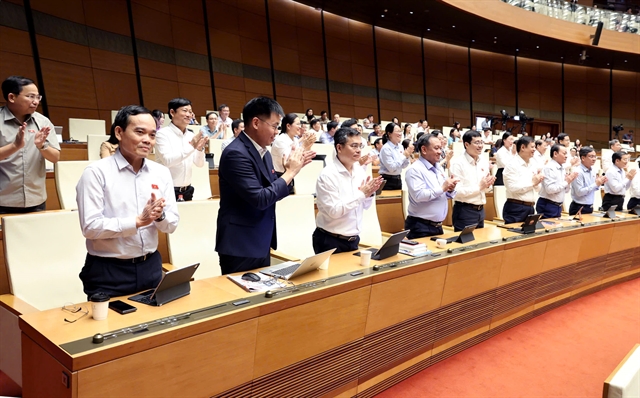
| HCM City deputies celebrate after the National Assembly passed the Urban Development Law in Hà Nội on Monday. — Photo tuoitre.vn |
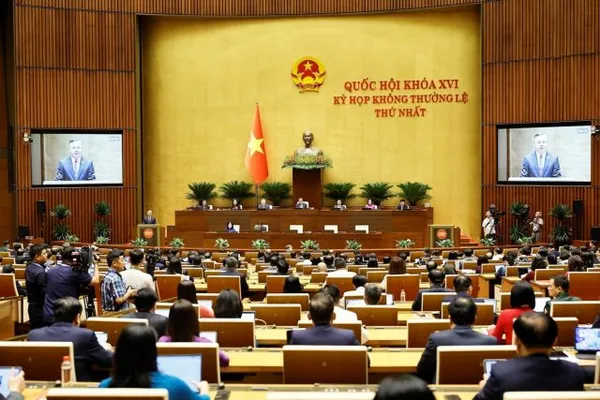
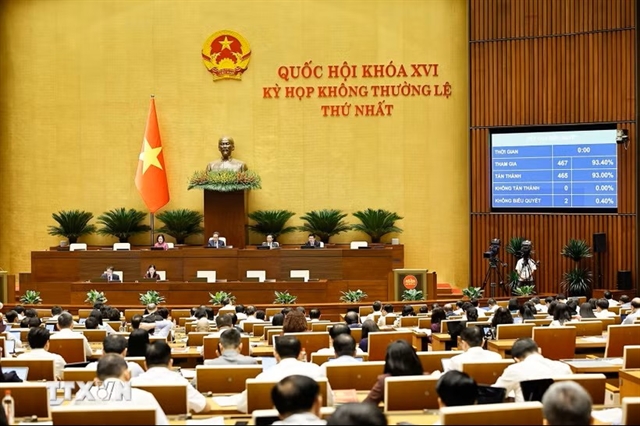
HCM CITY — The National Assembly approved on Monday the Law on Urban Development for establishing a new legal framework that grants HCM City broader authority over urban governance, investment, and financing and paving the way for more flexible development models in the country’s cities and special economic zones.
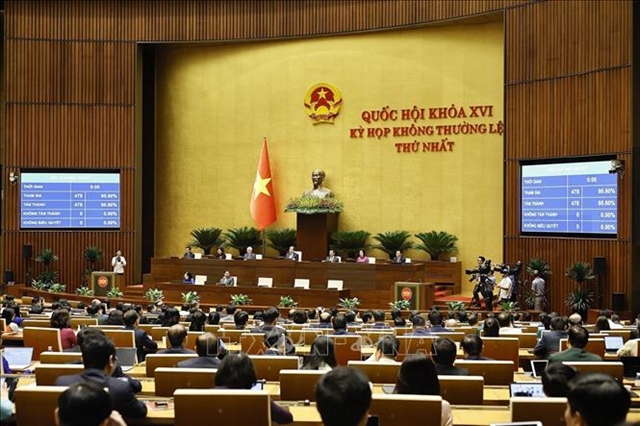
The law was adopted with 465 out of 474 deputies present voting in favour.
It will take effect on October 1, while provisions governing the issuance of legal documents under the city's new decentralised framework will come into force on September 1.
The legislation is regarded as seminal institutional reform, shifting from a system centred on administrative approvals to one that delegates greater decision-making powers to local authorities, accompanied by stronger accountability and post-implementation oversight.
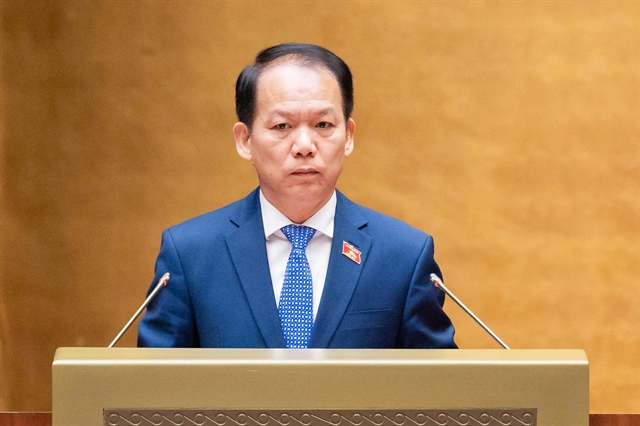
Presenting the Government's report on the bill before the vote, Minister of Justice Hoàng Thanh Tùng said the legislation builds on lessons learned from pilot mechanisms implemented in HCM City and the Capital Law, while taking into account the city's governance capacity and practical conditions.
According to the Government, the city has already identified the areas subject to decentralisation and is preparing implementing regulations to ensure the law can be applied in a transparent and effective manner.
Under the new law, the city will get expanded powers in public administration, investment, finance, and urban governance.
Its People's Council will be authorised to issue resolutions simplifying administrative procedures provided they do not add new documentation requirements or conditions or increase processing times.
The city will also be permitted to pilot new policies in areas where existing legislation does not yet have specific regulations.
Such pilot programmes may last for up to five years and be extended for an additional five-year period.
New financing and investment mechanisms
The legislation grants the city greater flexibility in mobilising capital for major infrastructure and other development projects.
The People's Council will have the authority to decide on the issuance of municipal and project bonds, including those supporting the development of Việt Nam's International Financial Centre in HCM City.
The city will also be allowed to borrow from domestic and international financial institutions, subject to national public debt safety limits.
The People's Council will be empowered to approve investment policies for certain public investment and public-private partnership projects funded by the city.
The Government expects these measures to shorten decision-making processes for strategic infrastructure projects while strengthening the city's ability to mobilise and allocate development resources.
The law also establishes legal foundations for several new urban and economic development models.
It provides mechanisms for developing free trade zones, integrated logistics hubs, high-tech parks, and emerging sectors such as the digital, creative, data, green, circular, and low-altitude economies.
For free trade zones and integrated logistics hubs, the city People's Council will be authorised to formulate management policies, investment incentives, and trade facilitation measures, while the chairman of the People's Committee can establish and adjust their boundaries, scale, and functions.
The legislation also promotes closer integration between the International Financial Centre and surrounding functional zones, including free trade areas, logistics facilities, ports, and high-tech parks.
|
| Minister of Justice Hoàng Thanh Tùng presents a report on the review, explanation and revision of the latest draft Urban Development Law before the National Assembly. — Photo tuoitre.vn |
Urban expansion, transit-oriented development
Among the notable additions made during the final stages of the legislative process have been provisions governing coastal reclamation urban areas.
The Government clarified that reclaimed urban areas would not constitute separate administrative units but remain under the jurisdiction of existing local authorities.
The new provisions aim to attract investment into large-scale reclamation projects capable of supporting housing, international tourism, free trade, financial services, innovation, entertainment, and integrated infrastructure, creating new growth poles for urban development.
The law also establishes a legal basis for transit-oriented development (TOD), promoting higher-density residential, commercial and office developments around railway and metro routes. The approach is expected to better integrate transport infrastructure with urban renewal and redevelopment projects.
In addition, the legislation encourages stronger regional coordination among major urban centres and neighbouring localities, particularly in transport infrastructure development and environmental management.
While granting greater autonomy to HCM City, the Government emphasised that the law incorporates multiple safeguards to ensure accountability.
Any local policies that differ from national regulations must undergo impact assessments and consultations with relevant stakeholders.
Pilot mechanisms are subject to time limits, while borrowing and bond issuance remain constrained by public debt management requirements.
The law also strengthens inspection, supervision and accountability mechanisms, shifting the emphasis from extensive prior approvals to enhanced post-implementation oversight and greater responsibility for public officials.
The Government expects the new legal framework to accelerate urban development in HCM City while providing a model that could later be extended to other centrally governed cities and special economic zones across the country. — VNS
Politics & Law
 Politics & Law
 Politics & Law
 Politics & Law
 Politics & Law
 Politics & Law
 Politics & Law
 Politics & Law
 Politics & Law
 Politics & Law
 Politics & Law
 Politics & Law
 Politics & Law
 Politics & Law
 Politics & Law