 Politics & Law
Hưng Yên outlines three economic zones, two development corridors
1.
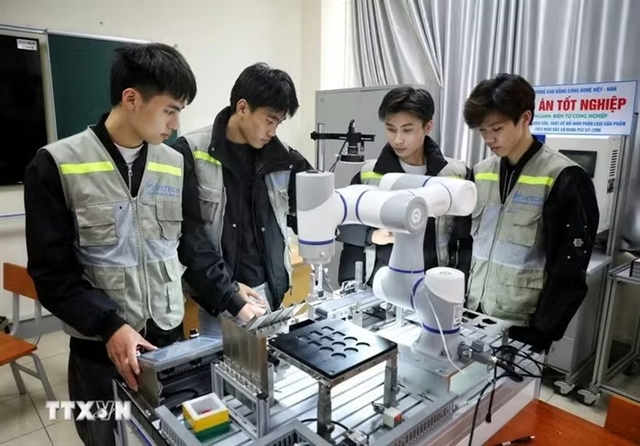 |
| Students attend a practical session in microcontroller programming at the Vietnam–Korea College of Technology in Bắc Giang province. — VNA/VNS Photo |
LAW No. 134/2025/QH15
On Artificial Intelligence
...
Chapter V
ETHICS AND RESPONSIBILITY IN ARTIFICIAL INTELLIGENCE ACTIVITIES
Article 26. National framework of artificial intelligence ethics
1. The national framework of artificial intelligence ethics shall be issued on the following principles:
a/ Ensuring safety and reliability and preventing harm to human life, health, honour, dignity, and spiritual life;
b/ Respecting human rights and citizens’ rights, and guaranteeing fairness, transparency and non-discrimination in the development and use of artificial intelligence;
c/ Promoting well-being, prosperity and sustainable development for humanity, communities, and society;
d/ Promoting innovation and social responsibility in research, development and application of artificial intelligence.
2. The national framework of artificial intelligence ethics shall be reviewed and updated periodically or when there are major changes in technology, law and management practices.
3. The national framework of artificial intelligence ethics serves as a guiding basis for formulation of standards, technical regulations, professional guidelines and policies to promote the development of safe, reliable and responsible artificial intelligence.
4. The State shall encourage organisations and individuals to apply the national framework of artificial intelligence ethics in the course of research, development, provision, deployment and use of artificial intelligence systems in order to ensure transparency, fairness, safety, and respect for human rights.
5. The Minister of Science and Technology shall issue the national framework of artificial intelligence ethics in accordance with Clause 1 of this Article.
Article 27. Ethical responsibility and impact assessment upon the application of artificial intelligence in the state management and public service provision
1. The use of artificial intelligence systems in the state management and public service provision must ensure openness, transparency and responsibility for compliance with the national framework of artificial intelligence ethics.
2. Artificial intelligence systems do not replace the authority and decision-making responsibility of decision-makers as specified by law. Decision-makers shall review and use the results provided by artificial intelligence systems.
3. Agencies operating artificial intelligence systems that are high-risk ones or have significant impacts on human rights, social justice or public interests shall prepare impact assessment reports on the use of such systems; such a report must include the identification of risks, control measures, and assurance of the ability for human supervision and intervention.
4. Agencies preparing impact assessment reports shall be held responsible for the contents, truthfulness and completeness of such reports, which shall be publicised in accordance with law, except contents classified as state secrets, business secrets or personal data.
5. The Government shall issue detailed regulations on contents of, and procedures and responsibility for, impact assessment, risk management, and supervision of the use of artificial intelligence systems in the state management and public service provision.
Chapter VI
INSPECTION, EXAMINATION, AND HANDLING OF VIOLATIONS
Article 28. Inspection and examination
1. Inspection activities in the field of artificial intelligence shall be carried out in accordance with the law on inspection.
2. Agencies and organisations assigned to perform the function of state management of artificial intelligence shall examine the compliance with law by organisations and individuals in their artificial intelligence activities.
3. In the course of inspection and examination, related organisations and individuals are obliged to provide technical dossiers, trace logs, training data, and other necessary information in order to identify causes of violations or incidents or to define responsibility; the provision of information must comply with the laws on the protection of state secrets, data, protection of personal data, and intellectual property.
4. Inspection and examination conclusions and decisions on sanctioning of administrative violations shall be publicised in accordance with law.
Article 29. Handling of violations and liability for compensation for damage
1. Organisations and individuals that commit violations of this Law and other relevant regulations concerning artificial intelligence shall, depending on the nature, severity and consequences of their violations, be sanctioned for administrative violations or examined for penal liability; if causing damage, they shall pay compensation in accordance with the civil law.
2. In case a high-risk artificial intelligence system is managed, operated and used in accordance with regulations but damage still arises, the deployer shall be liable to pay compensation to the aggrieved party. After paying compensation, the deployer may request the provider, developer, or related parties to reimburse the compensated amount if there is an agreement between the parties.
3. Liability for compensation for damage specified in Clause 2 of this Article shall be exempted in the following cases:
a/ The damage occurs entirely due to intentional fault of the aggrieved party;
b/ The damage occurs in case of force majeure events or emergency situations, unless otherwise provided by law.
4. In case an artificial intelligence system is infiltrated, unlawfully controlled by, or unlawfully interfered with by a third party, the third party shall pay compensation for damage. In case the deployer or provider is at fault for allowing the system to be infiltrated, unlawfully controlled by or interfered with, it/he/she shall be jointly liable for compensation in accordance with the civil law.
5. The Government shall issue detailed regulations on the sanctioning of administrative violations caused by artificial intelligence systems.
Chapter VII
STATE MANAGEMENT OF ARTIFICIAL INTELLIGENCE
Article 30. Contents of and responsibility for state management of artificial intelligence
1. Contents of state management of artificial intelligence include:
a/ Formulating and promulgating, and organising the implementation of, strategies, policies, programmes and legal documents on artificial intelligence;
b/ Promulgating, and organising the implementation of, standards and technical regulations on artificial intelligence;
c/ Managing, coordinating, and developing national artificial intelligence infrastructure;
d/ Managing and supervising artificial intelligence activities;
dd/ Publicly communicating and disseminating policies and laws on artificial intelligence; making statistics and reports, and conducting scientific research and international cooperation on artificial intelligence;
e/ Inspecting, examining, handling violations, and settling artificial intelligence-related disputes, complaints and denunciations.
2. Responsibility for state management of artificial intelligence:
a/ The Government shall perform the unified state management of artificial intelligence;
b/ The Ministry of Science and Technology shall act as the focal agency responsible to the Government for performing the state management of artificial intelligence nationwide;
c/ Ministries and ministerial-level agencies shall, within the ambit of their functions, tasks and powers, coordinate with the Ministry of Science and Technology in performing the state management of artificial intelligence;
d/ Provincial-level People’s Committees shall perform the state management of artificial intelligence in their localities.
Article 31. Principles for provision of information and data for state management
1. Competent state agencies, organisations and individuals assigned to perform state management activities in accordance with this Law shall ensure the confidentiality of information, data and business secrets provided during the performance of tasks, including technical dossiers, training data, source codes, and algorithms in accordance with law.
2. Requests for organisations and individuals to provide information and data must be necessary, proportionate, and suitable for the scope, purpose and contents of state management activities.
3. The security and confidentiality of provided information and data must be ensured in accordance with law.
Article 32. International cooperation
1. International cooperation in the field of artificial intelligence shall be carried out in accordance with the law on science and technology, the law on technology transfer, other relevant regulations, and treaties to which the Socialist Republic of Vietnam is a contracting party.
2. The State shall promote international cooperation on the sharing of high-performance computing infrastructure, data, human resources, scientific research, and the recognition of conformity assessment results in accordance with this Law.
Chapter VIII
IMPLEMENTATION PROVISIONS
Article 33. Annulment of a number of chapters, articles, clauses and points of Law No. 71/2025/QH15 on the Digital Technology Industry
To annul Clause 9, Article 3; Clause 7, Article 4; Clause 6, Article 12; Point dd, Clause 2, Article 34; and Chapter IV, of the Law on the Digital Technology Industry.
Article 34. Effect
This Law takes effect on March 1, 2026, except the relevant provisions of Article 35 of this Law.
Article 35. Transitional provisions
1. For artificial intelligence systems put into operation before the effective date of this Law, providers and deployers shall perform their compliance obligations specified in this Law within:
a/ Eighteen months from the effective date of this Law, for artificial intelligence systems in the fields of healthcare, education and finance;
b/ Twelve months from the effective date of this Law, for artificial intelligence systems not falling into the case specified in Point a of this Clause.
2. Within the time limits specified in Clause 1 of this Article, artificial intelligence systems may continue to operate, unless the state management agency in charge of artificial intelligence determines that such systems are likely to cause serious damage and therefore has the right to request the suspension or termination of their operation.
This Law was passed on December 10, 2025, by the 15th National Assembly of the Socialist Republic of Vietnam at its 10th session.
Chairman of the National Assembly
TRAN THANH MAN
<Source: Official Gazette Issue Nos 21-24/2026>
<See Part 1: https://vietnamnews.vn/politics-laws/1797210/law-on-artificial-intelligence-part-1.html
Part 2: https://vietnamnews.vn/politics-laws/1797660/law-on-artificial-intelligence-part-2.html>
Politics & Law
 Politics & Law
 Politics & Law
 Politics & Law
 Politics & Law
 Politics & Law
 Politics & Law
 Politics & Law
 Politics & Law
 Politics & Law
 Politics & Law
 Politics & Law
 Politics & Law
 Politics & Law
 Politics & Law