 Politics & Law

Lotte, Phát Đạt combine strengths in Thu Thiem project
1.
|
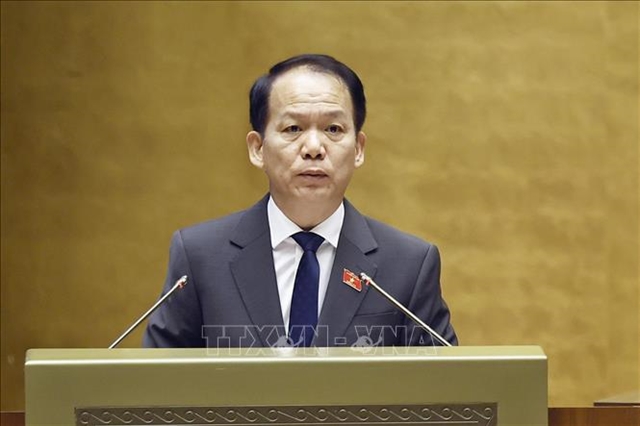
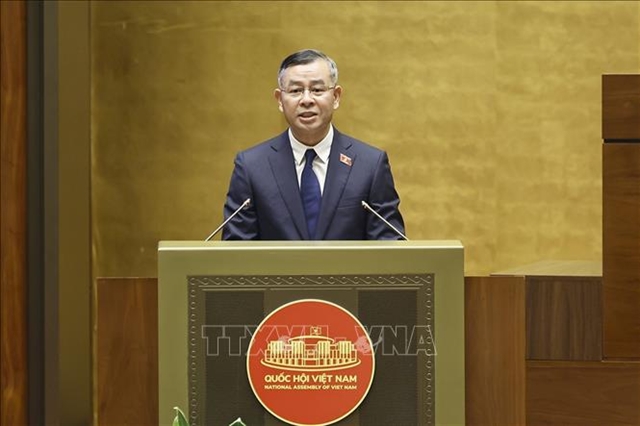
| Minister of Justice Hoàng Thanh Tùng presents a report explaining, clarifying and finalising the draft amended Law on Legal Dissemination and Education. — VNA/VNS Photo Doãn Tấn |
HÀ NỘI — The 16th National Assembly (NA) on Sunday passed the revised Law on Legal Dissemination and Education, with 466 deputies voting in favour, representing 93.2 per cent of all NA deputies.
Acting under the authorisation of the Prime Minister, Minister of Justice Hoàng Thanh Tùng presented a report explaining, clarifying and finalising the draft amended law.
Minister Tùng said that, based on feedback from NA deputies, the Government directed a comprehensive review and revision of the draft law, ensuring the requirement to renew thinking in law-making and ensure the principles of constitutionality, unity and consistency of the legal system.
The draft law has been finalised in line with the principle of placing people and enterprises at the centre, strongly innovating methods of legal dissemination and education, shifting from one-way information provision to creating an environment and favourable conditions for people and enterprises to proactively access, learn about and study the law.
This will help build a culture of respect for the law through new and effective approaches, the application of digital technology and greater multidirectional interaction.
At the same time, the draft amended law establishes a mechanism to mobilise social resources for legal dissemination and education.
Tùng reported on several major contents that had been clarified and revised.
Regarding digital transformation and the application of artificial intelligence (AI) in legal dissemination and education under Clause 5, Article 3 and Article 13 of the draft law, the minister stated that the Government had completed the provisions on implementing digital transformation and applying artificial intelligence in the work.
The draft law revises the State’s policy on legal dissemination and education and policy communication under Article 3 in the direction of prioritising and encouraging digital transformation and AI application. At the same time, it introduces policies to develop digital human resources and enhance digital skills for those engaged in the work.
Article 13 was also revised to ensure appropriateness, feasibility and a general definition of the legal status of the National Legal Portal.
Regarding specific target groups under Article 16, the draft law adds several groups, including people from poor and near-poor households, the elderly and persons who have completed their prison sentences and are reintegrating into the community.
For Vietnamese living abroad, in response to feedback from NA deputies and to institutionalise the Party’s guidelines on work with overseas Vietnamese under Politburo Resolution No. 23 dated August 2 this year, the Government has supplemented provisions in Clause 2, Article 3 on State policy, aiming to create conditions for Vietnamese residing abroad to learn about and study Vietnamese law.
Regarding policy communication under Articles 21 and 22, the Government has revised and finalised the provisions on the scope, content, forms and timing of policy communication, ensuring no duplication or overlap with the provisions on policy communication in the Law on Promulgation of Legal Documents.
These revisions will contribute to improving the quality of law-making, building social consensus and supporting law enforcement after legal documents are issued.
Regarding the Legal Dissemination and Education Coordination Councils under Article 7, the Government has revised Clause 2 to unify the establishment of the councils at the commune level. Members of the councils from the central level down to the commune level will serve on a part-time basis, without creating additional staff positions or administrative bodies.
Regarding funding for legal dissemination and education under Articles 3 and 36, the draft amended law stipulates priority funding for legal dissemination and education work for specific target groups. This provision aims to promptly institutionalise the Party’s guidelines under Politburo Resolution No. 66 and Secretariat Conclusion No. 80 on prioritising appropriate resources for legal dissemination and education work for specific target groups, ensuring consistency with the law on the State budget.
In addition to the above contents, in Report No. 601 issued on August 21 this year, the Government provided a full and detailed account of how the draft law had been clarified, explained and revised based on feedback from NA deputies.
The draft revised Law on Legal Dissemination and Education consists of 39 articles and will take effect from the beginning of March next year. — VNS
Politics & Law
 Politics & Law
 Politics & Law
 Politics & Law
 Politics & Law
 Politics & Law
 Politics & Law
 Politics & Law
 Politics & Law
 Politics & Law
 Politics & Law
 Politics & Law
 Politics & Law
 Politics & Law
 Politics & Law