 Politics & Law

Hưng Yên outlines three economic zones, two development corridors
1.
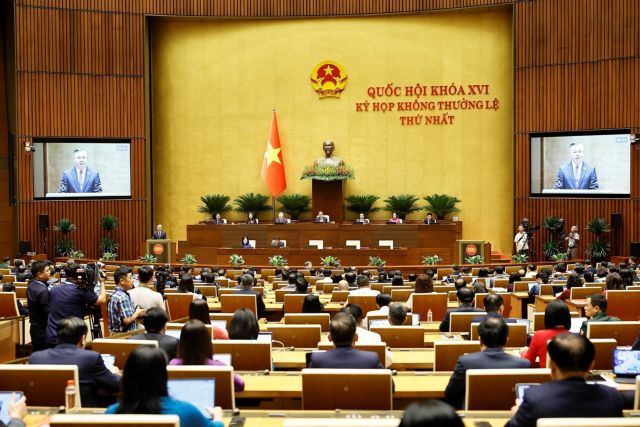 |
| The first extraordinary session of the 16th National Assembly concluded on Monday. — VNA/VNS Photo |
HÀ NỘI — The National Assembly (NA) approved a broad slate of new laws on Monday, granting HCM City and other major urban centres sweeping new development powers as lawmakers wrapped up the first extraordinary session of the 16th legislature.
The centrepiece was a new Urban Development Law, approved with 465 of the 474 NA deputies voting in favour. Spanning five chapters and 66 articles, the law lays out mechanisms and policies to promote development in special-class cities, chiefly HCM City, and special economic zones. It takes effect on October 1.
Minister of Justice Hoàng Thanh Tùng said the law puts decision-making, implementation and accountability squarely in the hands of local governments, part of a broader push to achieve the national double-digit growth target.
The law expands HCM City's People's Council authority over the city's master plan, ensuring the plan stays in line with development in any special economic zone within the city.
It also empowers the governor of the State Bank of Việt Nam to set specific requirements for foreign bank branches operating in free trade zones, a move meant to tighten control over foreign exchange and money-laundering risks while shielding domestic banks from added competition.
The Government, meanwhile, gains authority to set procedures for granting, extending, suspending and withdrawing preferential customs treatment for free trade zones and integrated logistics hubs, giving regulators a clearer legal basis for enforcement.
As for energy, the People's Council was given authority over direct power-purchase arrangements between electricity generators and buyers, including who can take part, under what conditions and with what obligations, a step officials said was needed to keep the power grid running safely and reliably as such deals expand.
Meanwhile, in a new addition, the law lays out a framework for urban development on land reclaimed from the sea, covering investment principles, incentives and obligations, decision-making authorities and rules for extracting minerals needed for such projects.
Crime-reduction targets
In the same session, lawmakers adopted an eight-article resolution on crime prevention and the performance of prosecutors, courts and enforcement agencies, with 473 of the 476 NA deputies voting in favour. The resolution takes effect on January 1, 2027.
The resolution sets targets for cutting social-order crime by 10 per cent a year, resolving all criminal tip-offs and reports within legal deadlines, solving more than 75 per cent of criminal cases overall and clearing over 90 per cent of serious and especially serious crimes.
Investigators, inspectors, State auditors, prosecutors, courts and enforcement agencies were directed to coordinate more closely to recover money and assets tied to corruption and economic crimes, with a target of recovering 60 per cent of such assets overall and at least 65 per cent during the investigation phase – a period officials consider critical, since assets grow harder to trace and reclaim the longer a case drags on.
Relics to be moved for new airport road
Lawmakers also approved a resolution allowing two historic communal houses to be relocated to make way for a new road linking Gia Bình International Airport to Hà Nội, with 427 of 453 NA deputies voting in favour.
The resolution, effective on September 20, extends the same investment mechanism already approved for the airport project itself under an earlier NA resolution to the relocation of Đông Côi Communal House in Thuận Thành Ward and Tam Sơn Communal House in Lương Tài Commune, both in Bắc Ninh City.
Minister of Culture, Sports and Tourism Lâm Thị Phương Thanh said the draft had been narrowed after some NA deputies pressed the Government to balance the demands of infrastructure development against the need to preserve the relics and the cultural life built around them.
Relics would be moved only when preserving them in place was no longer feasible, and any relocation must protect their heritage value as much as possible and involve transparent public consultation, she said.
NA deputies also pushed to keep the resolution narrowly focused on the two sites tied directly to the airport road project, rather than leaving room for the mechanism to be extended elsewhere.
The Government agreed, resulting in the dropping of a third site, Tân Trăn Temple in Lâm Thao Commune, from the resolution. Officials said they would keep studying that site in light of laws governing religious and belief practices before making a final decision on the site
New push for national publishing and media flagships
The NA also passed amendments to the Publishing Law, with 472 of 475 NA deputies in favour, covering publishing, printing and distribution activities as well as the rights and duties of those involved. The changes take effect on March 1, 2027.
The revised law commits the Government to building flagship national publishing and media organisations and to encouraging the creation of multi-platform, multi-product publishing and media conglomerates, backed by tax breaks and exemptions on land and property rents for publishers.
It also commits the Government to investing in digital infrastructure and databases for the sector, promoting the use of artificial intelligence in publishing and prioritising land allocation for publishing activities.
Thanh said lawmakers had pressed for a clearer policy spelling out who would benefit and how it would be funded, and stronger support for reading programmes aimed at ethnic and disadvantaged groups.
In response, the Government revised the relevant article to add new support for translation, copyright protection, industry promotion and workforce development, and preferential treatment for printing and distribution businesses.
The plans to build national flagship publishers and media conglomerates will be carried out through separate Government-approved projects, with those entities operating either as public service units or as wholly State-owned enterprises, the minister said.
Four tech laws streamlined
Finally, the NA unanimously approved a single law amending four existing statutes covering radio frequencies, telecommunications, electronic transactions and technology transfer, by a vote of 477 to 0.
The changes, effective on March 1, 2027, are meant to cut administrative procedures and reduce the number of business lines subject to licensing conditions, while preserving State oversight.
Under the revisions, oversight of training and licensing for maritime radio operators moves from the Ministry of Science and Technology to the Ministry of Construction, a shift that allows lawmakers to drop radio operator training and certification from the list of business lines subject to licensing conditions entirely.
Rules for domain name registration services were relaxed at the same time regulators shifted from upfront approval to after-the-fact monitoring, using digital data sharing, routine reporting and inspections to catch problems instead.
Licensing procedures for trusted digital service providers were also simplified, including how such licences are renewed or amended, with agencies now drawing on shared Government databases to verify compliance rather than requiring businesses to resubmit paperwork.
Responding to concerns raised by the NA Standing Committee that gaps could open up if rules on implementation lagged behind, the Government said it had ordered the Ministry of Science and Technology to identify everything requiring detailed regulation and move quickly to issue it, ensuring the new rules take effect alongside the law itself without interrupting enforcement. — VNS
Politics & Law
 Politics & Law
 Politics & Law
 Politics & Law
 Politics & Law
 Politics & Law
 Politics & Law
 Politics & Law
 Politics & Law
 Politics & Law
 Politics & Law
 Politics & Law
 Politics & Law
 Politics & Law
 Politics & Law