 Politics & Law
Goat meat offers a feast of choice for every diner
1.
|
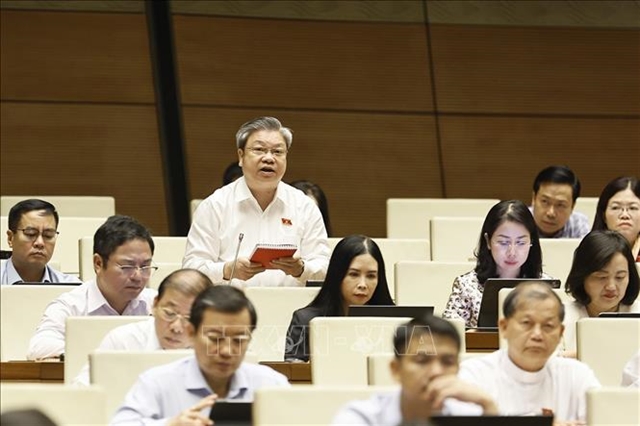
| NA Deputy Bùi Văn Dũng from Thanh Hóa Province expresses his support for integrating the programmes. — VNA/VNS Photo Doãn Tấn |
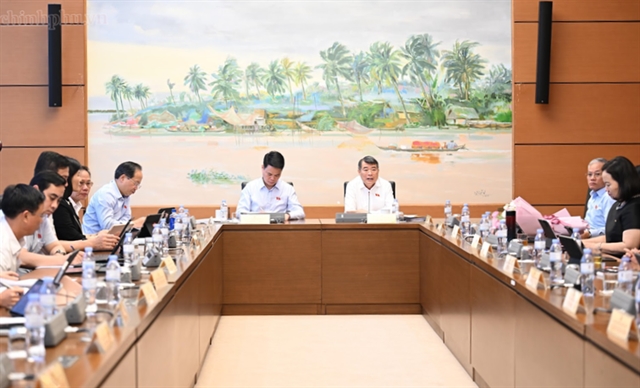
HÀ NỘI — The National Assembly (NA) during a session on Thursday morning debated an investment policy to integrate four national target programmes into a single one focused on cultural and social development, rural development, ethnic community affairs and mountainous areas for the 2026–2035 period.
The larger programme would cost an estimated VNĐ808.5 trillion (nearly US$31 billion) through 2030.
Currently, the four national target programmes comprise cultural development; modernisation and improving the quality of education and training; new-style rural area development, sustainable poverty reduction and socio-economic development in ethnic groups and mountainous areas; and healthcare, population and development.
NA Deputy Nguyễn Hữu Toàn from Lai Châu Province expressed strong support for the proposal.
“I believe this is a breakthrough step, reflecting a new way of thinking in lawmaking," Toàn said. He added that it would remove duplications, minimise costs and improve the programmes' effectiveness.
Deputy Bùi Văn Dũng from Thanh Hóa Province agreed, saying that the move should not simply be viewed as a merger of four national target programmes, but rather as an innovation in the approach to developing and governing these initiatives.
“Although the four programmes cover different areas, ultimately they all focus on the same subject, people; the same space, communities and localities; and the same goal, improving the quality of development and people’s quality of life," he said.
"Poverty is not merely a lack of income. Rural development is not merely about infrastructure. The development of ethnic community areas cannot be separated from education, healthcare, culture and livelihoods.”
Integration would help shift from a management mindset based on individual programmes and sectors to a people-centred development approach, while also addressing the fragmentation of resources, overlapping beneficiaries and procedures.
“The greatest value to be achieved is not simply combining four programmes into one, but creating an overall impact greater than the impacts of the four separate programmes,” Dũng noted.
He also pointed out that despite the advantages of integration, there is one major risk that needs to be identified from the outset: the fact that the programme’s scope is extremely broad.
If the programmes combined only their names and administrative structures, while retaining separate allocation mechanisms, funding norms, procedures and reporting systems, the number of programmes could be reduced to create a large and complex ‘super programme’ instead.
Dũng said that the core issue was how to achieve integration without losing the distinctive characteristics of each sector.
“I propose that we adhere to a principle of unifying objectives and governance, while respecting sector-specific requirements. Culture cannot be governed entirely in the same way as infrastructure investment. Education cannot be assessed in the same way as poverty reduction,” he said.
NA Deputy Nguyễn Vũ Trung from HCM City said that merging the four national target programmes would result in a clearly defined integrated national target programme focused on human development outcomes, with tangible outputs and improvements in people’s living standards serving as key benchmarks.
Trung proposed adding wording immediately after the opening provision in Article 1 stating that the merger would not just consolidate resources and management, but must also ensure the integration of objectives and tasks that share the same beneficiaries, geographical areas and expected outputs.
The suggested addition would also include a stipulation that beneficiaries, households, communities and localities be managed based on their development needs to limit the division of policies between sectors.
“A poor commune should not simultaneously have to prepare four or five separate plans covering livelihoods, nutrition, children, schools, health stations, culture and clean water. What is needed is an integrated commune development plan, a single database, one set of indicators and one focal point responsible for the results,” Trung said.
Minister of Finance Ngô Văn Tuấn said Prime Minister Lê Minh Hưng had instructed the Government to issue a resolution immediately after the NA approves the investment policy for the national target programme.
The Government resolution would integrate more than 50 guiding documents issued by relevant ministries and sectors, ensuring that the programme could be carried out in practice without delay.
Immediately afterwards, a nationwide conference would be held, with specific tasks assigned to the ministries and sectors concerned.
As for transitional arrangements, Tuấn said the draft resolution clearly stipulated that the budget estimate this year would continue to be finalised in accordance with existing regulations.
In line with the PM’s direction, the budget estimate next year would also be prepared under current regulations.
The Ministry of Finance would be responsible for consolidating resource requirements and reporting to the PM and the NA so that resources could be allocated and work carried out in a timely manner. — VNS
Politics & Law
 Politics & Law
 Politics & Law
 Politics & Law
 Politics & Law
 Politics & Law
 Politics & Law
 Politics & Law
 Politics & Law
.jpeg) Politics & Law
Politics & Law
 Politics & Law
 Politics & Law
 Politics & Law
 Politics & Law
 Politics & Law