 Economy



Việt Nam, Suriname promote substantive cooperation across multiple fields
1.

|
| Telecommunications network equipment and AI-powered camera systems developed and manufactured by Viettel Group. It is critical to turn investment into technology capabilities within Vietnamese firms. — VNA/VNS Photo Công Luật |
HÀ NỘI — Businesses have been told to strengthen research and development (R&D), build ownership of technology and intellectual property (IP) and develop stronger brands to capture a larger share of the value generated by exports.
The push comes as Việt Nam seeks to raise domestic technological capabilities under Resolution 57-NQ/TW, which sets a target for R&D spending to reach 2 per cent of gross domestic product (GDP) by 2030.
The resolution also calls for at least 3 per cent of annual state budget spending to be allocated to science and technology, innovation and digital transformation.
Experts said that technology, intellectual property and brands need to develop together to allow innovation created inside Vietnamese firms to translate into commercially valuable products and services.
Technology at core
Việt Nam has become an increasingly important manufacturing base in global supply chains, but rising exports do not translate into a corresponding share of value if companies lack core technologies, intellectual property and strong brands.
According to Trần Lê Hồng, deputy head of the Intellectual Property Office under the Ministry of Science and Technology, Việt Nam has relatively strong innovation performance although investment resources remain limited. Việt Nam ranked 44th in the 2025 Global Innovation Index, while R&D investment was cited at about 0.5 per cent of GDP.
He pointed out other gaps including high exports of technology-intensive products without a corresponding level of value retained domestically, and faster growth in the value of the national brand than in the strength of many individual Vietnamese corporate brands.
Closing the gaps would require not only mobilising more capital but also ensuring that investment builds research capabilities within Vietnamese firms and innovation is translated into technological capabilities, he said.
Hồng said policies toward foreign direct investment should also place greater emphasis on domestic linkages, substantive technology transfer and R&D.
Strengthening the ability of firms to absorb technology would be an important condition for moving up the value chain, he stressed.
But good technology alone would not be enough, Hồng said.
IP, brands
|
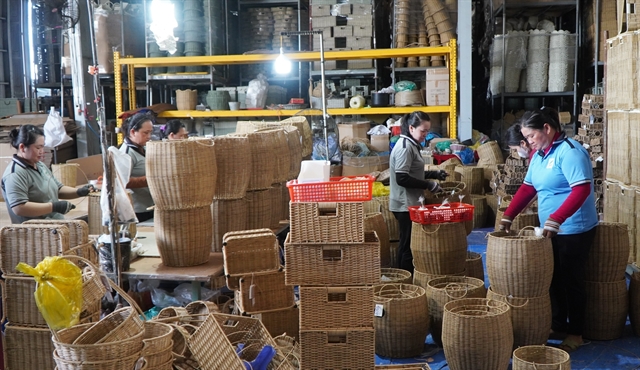
| Bình An Thịnh Import-Export Co Ltd produces handicraft products for export. Businesses need to enhance IP protection. — VNA/VNS Photo Nhựt An |
Innovation, technological capabilities, brand value and national competitiveness could not be viewed as separate elements, Hồng said.
Businesses would also need to identify and protect their technological advantages through patents, trademarks, industrial designs and other IP assets. Without IP protection, a company could remain an anonymous supplier behind another company's brand.
Citing research by Kraemer, Linden and Dedrick on the iPhone 4, Hồng said Apple retained about 58 per cent of the retail price as gross profit, while assembly labour costs in China accounted for just about 1.8 per cent.
He also cited the World Intellectual Property Organisation data that more than 90 per cent of coffee-related patents were concentrated in processing and distribution rather than cultivation.
The examples show how value can shift from production towards technology, intellectual property and branding.
According to Võ Trí Thành, director of the Institute for Brand and Competition Strategy, trust is critical foundation to build brand. Brand building cannot be separated from technology and product quality.
Hà Kiều Oanh, deputy head of the Trade Promotion Capacity Development Division at Vietnam Trade Promotion Agency, said getting products to international buyers was only the first step.
Companies must also demonstrate quality, innovation, market responsiveness and supply-chain reliability, she said.
The Ministry of Industry and Trade was developing the Vietnam National Brand Strategy to 2035, with a vision to 2045.
The state has a role in building the policy framework, strengthening capabilities, connecting resources and promoting Vietnamese brands, but companies remain responsible for investing in technology, quality and brand management, according to Oanh.
An officer of Indochina Capital said the biggest opportunity for 'Made in Vietnam' was no longer simply to participate in global supply chains but to own a greater share of them.
Việt Nam had done well in assembly and job creation, but could capture more value through investment in talent, infrastructure, R&D, technology and branding, he said. — VNS
Economy
 Economy
 Economy
 Economy
 Economy
 Economy
 Economy
 Economy
.jpg) Economy
Economy
 Economy
 Economy
 Economy
 Economy
 Economy
 Economy