 Politics & Law

Cúc Phương National Park: from conservation to sustainable development
1.
|
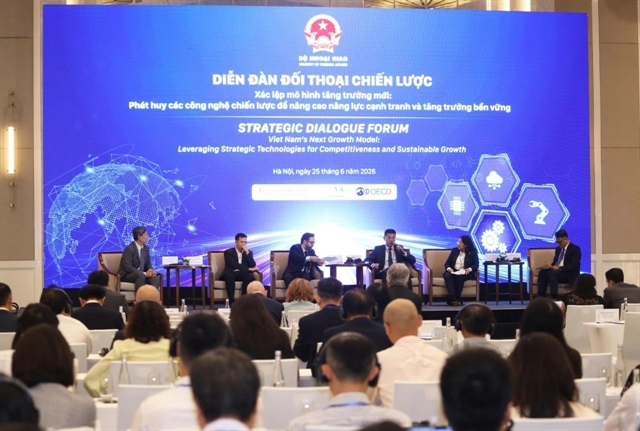
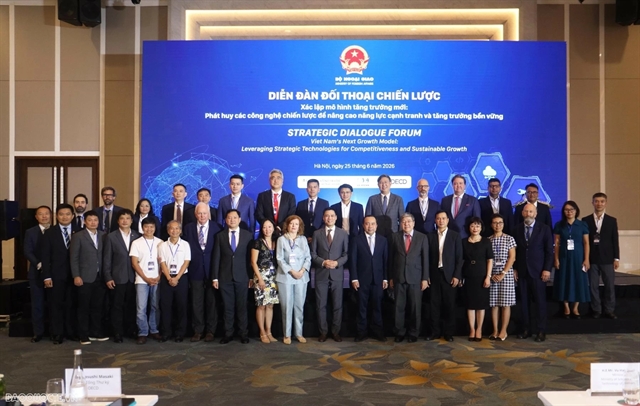
| The strategic dialogue forum titled "Việt Nam's next growth model: leveraging strategic technologies for competitiveness and sustainable growth" on Thursday. — Photo baoquocte.vn |
HÀ NỘI — The Ministry of Foreign Affairs, in partnership with the US Chamber of Commerce in ASEAN, the Organisation for Economic Cooperation and Development (OECD), and other partners, convened a strategic dialogue forum in Hà Nội on June 25, discussing the role of strategic technologies for better competitiveness and sustainable growth.
From low-cost labour to tech mastery
Minister of Science and Technology Vũ Hải Quân outlined three strategic shifts Việt Nam needs to make to sustain long-term growth, saying that the country should stop simply using technology and start truly mastering artificial intelligence (AI), semiconductors, clean energy and advanced materials; swap a resource-driven economy for one fired by innovation, knowledge and talent; and ditch cheap labour as its main calling card in favour of real technological competitiveness that lifts the country into higher-value global supply chains.
Deputy Minister of Foreign Affairs Đặng Hoàng Giang pointed out that nearly four decades after Đổi Mới (renewal), Việt Nam has become one of Asia’s fastest-growing economies, but sci-tech and innovation still haven’t become primary growth drivers. R&D spending remains modest, and shortages of skilled workers along with weak command of core technologies keep dragging on progress.
Citing the Politburo’s Resolution 57, he raised a central question: how can national policy be turned into commercially viable products, competitive services and real technological firepower?
Escaping 'assembly trap'
The OECD’s FDI qualities review of Việt Nam report, released at the forum, showed that foreign-invested enterprises make up less than 3 per cent of all firms but generate more than one-quarter of the country’s employment and nearly one-third of its total economic output.
For all that heft, the domestic value Việt Nam hangs onto from such investment stays slim. Most foreign outfits still fixate on assembly, conduct relatively little local R&D, and buy only about a quarter of their supplies from Vietnamese small and medium-sized companies. Slowing revenue growth is meanwhile squeezing profit margins.
The report called this an 'assembly trap', Việt Nam has become a magnet for factories but hasn’t held onto the knowledge, technology and new ideas that build lasting competitiveness. With total trade now hovering near 200 per cent of GDP, policymakers acknowledged that growth powered mainly by exports is running up against its limits.
New capabilities on the rise
On June 22, Realtime Robotics became the first and only company in Southeast Asia to secure the US Federal Communications Commission (FCC)’s authorisation to export Việt Nam-manufactured unmanned aerial systems to the US for both commercial and defence uses, all built on proprietary technology patented in the US.
Homegrown digital players are hitting the global stage, too. Several Vietnamese game studios now rank among the world’s top 10 developers, while fintech platform MoMo delivers digital financial services to more than half a million household-run businesses and micro-enterprises.
Forum speakers noted that over 40 per cent of current FDI is now flowing into hi-tech industries, and many domestic tech firms are growing fast by leaning aggressively into AI.
Energy surfaced as a critical bottleneck. Without reliable supplies of clean electricity, Việt Nam’s semiconductors and AI ambitions will be nearly impossible to pull off. Though policy direction is clear through the 26th UN Climate Change Conference of the Parties (COP26) commitments and the Politburo’s Resolution 55, the legal framework remains patchy to unlock billions of US dollars in private and international investment waiting on the sidelines.
Proposed reforms include introducing market-based electricity pricing, expanding the recently launched Direct Power Purchase Agreement mechanism to break state utility EVN’s single-buyer grip, pumping cash into transmission grids and energy storage, and developing new sources such as small modular nuclear reactors and liquefied natural gas as transitional solutions.
Throughout the discussions, the State was cast as an enabler of innovation. Việt Nam has updated more than 100 laws, including roughly 30 financial regulations, to ease public investment in sci-tech.
Policymakers also introduced greater tolerance for research risk, freeing scientists from paying back state grants when projects fail for objective reasons. Private companies can now receive tax incentives covering as much as 100 per cent of their self-financed R&D spending.
Against this backdrop, the forum pitched three key policy shifts. First, public innovation funding should adopt a venture capital mindset, backing multiple experimental approaches before concentrating resources on the most promising models instead of locking into rigid, pre-chosen priorities.
Second, FDI incentives should move from broad-based preferences toward performance-based rewards, offering extra support only to investors that commit to R&D, green technology transfer, or workforce upskilling.
Third, investment promotion should be institutionally split from state regulatory functions by setting up an independent, professional investment promotion agency.
Additional ideas on the table included folding foreign investors into national skills councils, developing a corps of technology interpreters, and giving universities far more freedom to market their research capabilities directly to industry. — VNA/VNS
Politics & Law
 Politics & Law
 Politics & Law
 Politics & Law
 Politics & Law
 Politics & Law
 Politics & Law
 Politics & Law
 Politics & Law
 Politics & Law
 Politics & Law
 Politics & Law
 Politics & Law
 Politics & Law
 Politics & Law