 Politics & Law
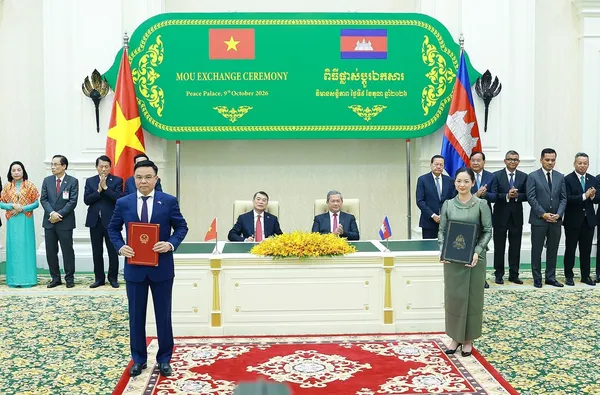
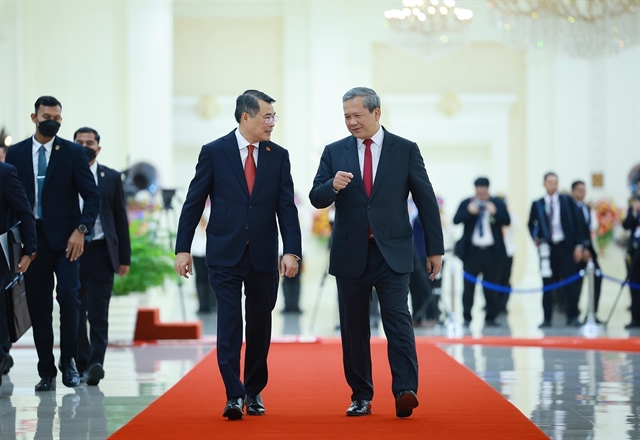
Vietnamese Prime Minister meets Cambodian National Assembly President
1.
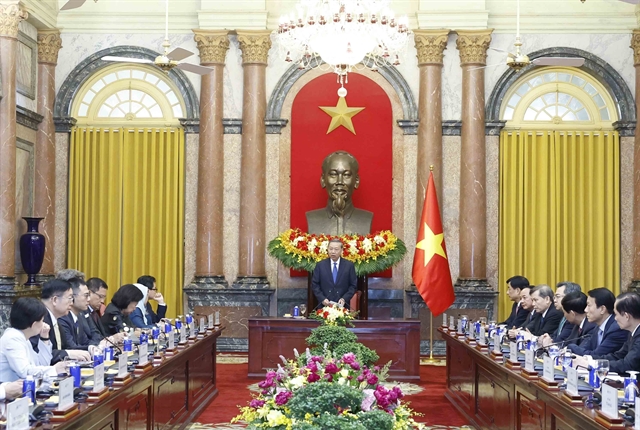 |
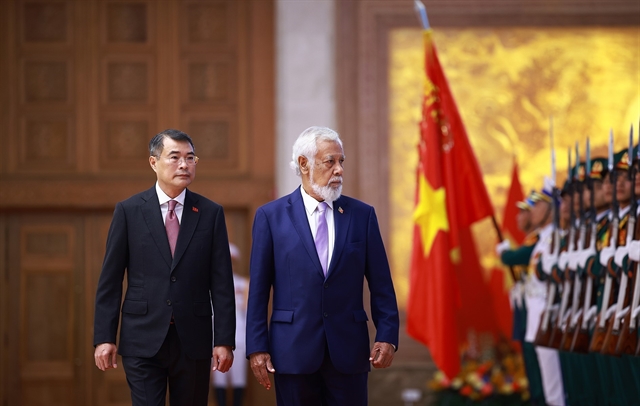
| Party General Secretary and State President Tô Lâm welcomes heads of delegations, experts, scholars and representatives of international organisations attending the ASEAN Future Forum 2026 at the Presidential Palace in Hà Nội on Tuesday. VNA/VNS Photo |
Việt Nam News presents remarks by Party General Secretary and State President Tô Lâm at a reception for heads of delegations attending the ASEAN Future Forum 2026.
Distinguished delegates,
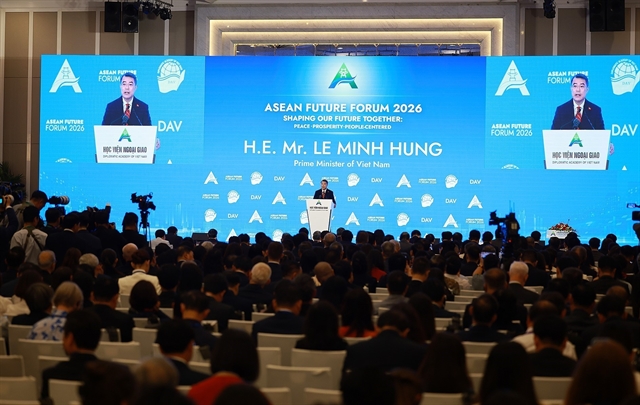
On behalf of the leaders of the Party and State of Việt Nam, I warmly welcome you to Hà Nội to attend the third ASEAN Future Forum. I am delighted that this year's Forum is attended by the Prime Ministers of Laos, Cambodia, Thailand and Timor-Leste, as well as leaders and representatives of ASEAN member states and dialogue partners, numerous international and regional organisations, scholars and research institutions. This demonstrates the shared interest in the future of the region and the desire to exchange views on the issues facing ASEAN in its new stage of development.
I fully share and agree with many of your insightful views. ASEAN is entering the first year of implementing the ASEAN Community Vision 2045, with new expectations and, at the same time, higher demands for greater proactivity, effectiveness and substance. This is also the spirit that I conveyed at the recent Shangri-La Dialogue.
For ASEAN, that spirit stems from unity, dialogue, trust and cooperation. It was also the starting point for our initiative to launch the ASEAN Future Forum, with the aspiration of contributing an additional channel for open and substantive exchanges to complement ASEAN's common cooperation processes, enabling us to share ideas, connect with one another and seek new and more practical avenues of cooperation for the future of the region.
On this occasion, I would like to share a few thoughts with you.
1. The world is changing, and the region must think differently
The world is entering a period of profound transformation. The three major crises of international order, development models and strategic trust that we are witnessing are not occurring somewhere far away. They are manifesting themselves very clearly in this very region.
Strategic competition among major powers is becoming increasingly intense and expanding into the foundational domains of the future, such as technology, data, supply chains and emerging governance standards. Artificial intelligence, big data and quantum technologies are opening up enormous development opportunities, but they are also creating many new risks. Meanwhile, challenges related to climate change, energy, water resources, population ageing, disinformation, information manipulation and human security are increasingly having a direct impact on social stability and the development capacity of each country.
Traditional development advantages no longer generate the same momentum as before. Many familiar approaches are no longer sufficient to meet new requirements. Population size, natural resources and capital remain important, but competitive advantages are increasingly determined by the capacity for innovation, adaptability and preparedness for emerging development trends.
This is a highly relevant challenge for ASEAN. Southeast Asia is where many major transformations converge. The region has opportunities to attract additional resources, benefit from shifts in supply chains, develop the digital economy, advance the green transition and foster new technology industries. However, opportunities do not automatically become advantages. Opportunities only become advantages when the region has the capacity to seize them, the determination to innovate and the resilience to maintain a stable environment for development.
2. ASEAN must preserve its strategic assets while renewing its methods of operation
With the ASEAN Community Vision 2045, ASEAN has clearly defined its direction for the decades ahead. However, this is only the starting point. In my view, what will determine success is ASEAN's ability to do two things simultaneously. On the one hand, it must continue to preserve and promote the strategic assets accumulated over many decades: unity, ASEAN centrality and the principles of consensus and unity in diversity. On the other hand, it must renew its value-based thinking so that these assets can be transformed into adaptive capacity, action-oriented capacity and implementation capacity.
ASEAN's strategic assets are the result of a long process of building trust, maintaining dialogue and consultations, managing differences and seeking consensus among member states. In the new era, ASEAN centrality can only be realised in a meaningful way if ASEAN maintains unity, strategic autonomy, an inclusive approach and the capacity to coordinate and shape the region's common agenda.
ASEAN's potential is enormous, but translating that potential into real strength will require greater efforts. Intra-regional integration needs to be deeper; infrastructure, logistics, digital and energy connectivity need to be more synchronised; development and technological gaps need to be narrowed further; and the implementation of commitments and agreements, as well as coordination in responding to common challenges, must be enhanced.
The world is changing rapidly, and the challenges facing ASEAN today are very different from those of the past. Value-based thinking must be renewed more vigorously through more flexible and effective methods of operation to better respond to emerging demands. First, ASEAN needs to shift from a process-oriented mindset to a results-oriented mindset, so that commitments move from documents into reality. It needs to move from consultation as the primary approach to more substantive coordination, enabling cooperation mechanisms to respond more quickly to cross-sectoral and interconnected issues. It also needs to move from consensus in perception to consensus in action, so that a common voice is reflected in concrete programmes, concrete resources and concrete outcomes.
In other words, I believe that in the years to come, the measure of ASEAN's success should not simply be how many additional documents, mechanisms or action plans it adopts, but more importantly, how effectively ASEAN's commitments are translated into reality, what changes they bring to the region and what benefits they deliver to people, businesses and each member economy.
Amid increasingly intense competition today, moving slowly may mean losing opportunities. Therefore, ASEAN needs to further promote a proactive spirit: strategic proactivity to identify trends early and shape priorities; adaptive proactivity to make the most of new trends and effectively address emerging challenges; and constructive proactivity to contribute positively to shaping regional norms and cooperation frameworks.
3. The ASEAN Future Forum contributes to and complements ASEAN's cooperation processes
Based on the discussions at this year's Forum, I believe that the ASEAN Future Forum can continue to play its role as an open, candid and substantive platform for exchanges on the region's long-term issues. As a complementary channel for dialogue, the value of the Forum lies in its ability to contribute additional perspectives, policy inputs and ideas to ASEAN's cooperation processes. In this regard, the ASEAN Future Forum may wish to place greater emphasis on several areas:
First, discussions at the Forum can help identify emerging issues and long-term trends that will have a direct impact on the future of the region. Many of today's challenges do not arise in isolation, but are increasingly interconnected: technological transformation is linked to employment and governance; the green transition is connected to energy, food security and livelihoods; and the information space is tied to social trust and governance capacity. The earlier these trends are recognised, the better prepared ASEAN will be.
Second, the Forum can help strengthen links among policymakers, scholars, research institutions and businesses. Regional issues today are becoming increasingly complex, cross-sectoral and beyond the scope of traditional approaches. ASEAN's processes therefore require a broader range of perspectives, experiences and initiatives from different channels to complement policymaking and implementation.
Third, the Forum can focus more on generating concrete and highly practical ideas. The ideas and discussions generated at the ASEAN Future Forum can provide fresh perspectives, identify new avenues for cooperation and offer recommendations that support relevant ASEAN processes. This includes promoting practical solutions in areas such as conflict prevention, artificial intelligence, energy, youth cooperation and the Mekong sub-region.
In this spirit, we hope to continue receiving the support, participation and contributions of ASEAN member states, partners, scholars, research institutions and businesses. It is your participation, insights and commitment that will help the ASEAN Future Forum further develop into a useful and practical platform for dialogue, complement ASEAN's processes and nurture the spirit of dialogue, cooperation and collective action for the common future of the region.
4. Việt Nam's contribution
Since joining ASEAN in 1995, Việt Nam has always regarded ASEAN as a central pillar of its policy of multilateralisation and diversification of external relations. Active and responsible participation in the ASEAN Community has played an important role in helping Việt Nam maintain a peaceful and independent environment, deepen economic integration to support national development and enhance its standing in the international arena. Việt Nam has consistently sought to work with other ASEAN members to build a united, resilient and sustainable community while preserving ASEAN's central role in the regional security architecture.
For its part, the profound transformations taking place around the world also require Việt Nam to undertake stronger reforms in development thinking, growth models and governance capacity. The challenges facing ASEAN are also those confronting Việt Nam: how to maintain peace and stability, safeguard major macroeconomic balances and achieve rapid yet sustainable development while making breakthroughs to enhance competitiveness. At the same time, strategic solutions are needed to narrow development gaps, strengthen resilience and proactively adapt to shocks arising from both internal and external sources.
The prevailing spirit in Việt Nam today is one of greater determination, faster implementation and a stronger focus on tangible results. Having the right direction is important, but in today's rapidly changing world, being on the right track without moving fast enough can still mean missing valuable opportunities. For this reason, Việt Nam is focused on removing bottlenecks, unlocking resources, advancing strategic and digital infrastructure, developing high-quality human resourcesand creating a more enabling environment for people, businesses and localities.
For Việt Nam, development is not merely an economic objective. It is also the foundation for strengthening social stability and improving people's living standards. This is also closely aligned with the requirements facing ASEAN in this new stage of development.
Alongside socio-economic development, Việt Nam is also pursuing a more substantive and effective foreign policy, one that is closely linked to the country's strategic objectives while contributing more responsibly to peace, cooperation and sustainable development in the region.
We consistently pursue the foreign policy of independence, self-reliance, self-strengthening, peace, friendship, cooperation and development, as well as multilateralisation and diversification of external relations. Việt Nam is a responsible member of the international community. We attach importance to relations with neighbouring countries, ASEAN, major partners and traditional friends; promote deeper, more stable, reliable and sustainable cooperation frameworks; and participate proactively and responsibly in addressing regional and global issues.
ASEAN remains a strategic priority in Việt Nam's foreign policy. We are committed to working wholeheartedly with fellow members of the ASEAN family to maintain unity, strengthen ASEAN centrality in a substantive manner and uphold rules, dialogue and cooperation.
In this spirit, Việt Nam seeks to contribute more effectively to practical areas of cooperation within ASEAN and between ASEAN and its partners in the years ahead, particularly in promoting strategic connectivity, green transition, digital transformation, workforce development and enhancing the capacity to respond to common challenges. These are all areas that are directly linked to national development, people's livelihoods and the collective resilience of the region.
We understand that contributing to ASEAN begins with doing our own work better, while also becoming more proactive and responsible in our shared endeavours. With that spirit, Việt Nam hopes that its own process of renewal and development will contribute to "a more dynamic Việt Nam, a more proactive Việt Nam, a more effective participant and a more substantive contributor", working together with ASEAN countries to build a Community that is more united, more resilient and more closely connected to its people.
After nearly six decades, ASEAN has established a solid foundation for cooperation and a broad network of connectivity. Our mission is to transform those foundational values into stronger and more effective capacities for action.
I firmly believe that, with a spirit of unity, innovation and action, ASEAN will continue to be a dynamic, resilient and trusted space for development in the region and the world, delivering tangible benefits to the people of every country. VNS
Politics & Law
 Politics & Law
 Politics & Law
 Politics & Law
 Politics & Law
 Politics & Law
 Politics & Law
 Politics & Law
 Politics & Law
 Politics & Law
 Politics & Law
 Politics & Law
 Politics & Law
 Politics & Law
 Politics & Law