 Politics & Law

Sơn La holds second coffee festival, targeting stronger businesses in future
1.
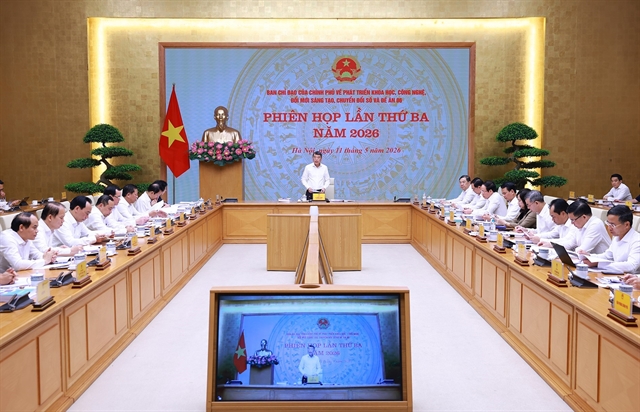 |
| Prime Minister Lê Minh Hưng speaks at the third meeting of the Government’s Steering Committee for Science and Technology, Innovation, Digital Transformation and Project 06 in Hà Nội on Monday. — VNA/VNS Photo |
HÀ NỘI — Prime Minister Lê Minh Hưng reiterated Party General Secretary and President Tô Lâm’s demand for breakthrough action delivering tangible and measurable results while chairing the third meeting of the Government’s Steering Committee for Science and Technology, Innovation, Digital Transformation and Project 06 in Hà Nội on Monday.
PM Hưng praised ministries and agencies for their proactive steps since the beginning of this year and especially from early April to follow the Politburo’s Resolution 57 and Conclusion 18, with clear, positive progress.
Despite the progress, a considerable number of tasks are still delayed, with fragmented and overlapping policies lacking clear guidance, while regulatory sandbox and task assignment mechanisms remain absent or unclear, he said.
Data construction, connection and sharing are lagging, with many specialised databases falling short of being “accurate, sufficient, clean, live, unified and shared”. Only 25.31 per cent of administrative procedures, or 201 out of 794, have been overhauled to replace paper with digital data.
The PM also flagged deficiencies in strategic and core technology development, digital infrastructure, cybersecurity, technical equipment, workforce quality and incentive mechanisms, along with weak discipline, administrative rigour, inter-sectoral and inter-level coordination.
He ordered heads of ministries, agencies and localities to personally lead and stay accountable, stressing that all tasks must be substantive and not perfunctory, and compliance with Resolution 57 and Project 06 will be used to evaluate their performance from 2026.
He called for integrated digital infrastructure and sweeping digital transformation with seamless data sharing to boost governance and convenience for citizens and businesses, identifying the data economy and artificial intelligence as central pillars.
The “tripartite model” linking the State, research institutes/universities and enterprises to free up resources for R&D and commercialisation should be widely spread, the PM said. He set a May deadline to clear all overdue tasks and prevent new delays, ordered faster data building, connection, sharing and cleaning with 2026 deadlines for national and specialised databases, and decisive administrative reform and business condition simplification in accordance with Conclusion 18.
At the same time, the Government leader stressed that strategic and core technology development must yield concrete 2026 results, not just symbolic efforts, and called for the tripartite model to shift from scattered research to mission-oriented projects targeting major problems, with specific products, identified markets, special financial mechanisms, and controlled risk-taking.
Key tasks and solutions were also outlined for May, the second quarter and beyond, including turning Party policies and guidelines into law through concrete mechanisms and policies, finalising a digital transformation architecture and technical standards, developing strategic technologies and technology products, building and completing interoperable data systems and data-sharing mechanisms, issuing comprehensive cyberspace regulations, training a quality workforce, solidifying digital infrastructure and cybersecurity, advancing administrative reform and online public services; and effectively utilising investment capital and resources.
Specific tasks were also assigned to relevant ministries to accelerate the agenda.
The sci-tech and digital transformation push has delivered some measurable gains. Authorities approved 10 key strategic technology groups and 30 strategic technology products, international publications rose 11.3 per cent, 2,441 standards and technical regulations were reviewed, and digital technology revenue hit an estimated US$24 billion in April.
Digital infrastructure has expanded, with 3G and 4G covering over 99 per cent of the population, 5G at 91.9 per cent and expected to hit 97 per cent by late 2026. Việt Nam ranked 11th among 104 countries for mobile internet speed and 12th out of 154 for fixed broadband.
Project 06 remains a driver of digital transformation: 27.7 million new-format citizen ID cards issued, 70.2 million electronic ID accounts activated, VNeID platform offering 50 utilities and integrating 20.2 million driver’s licenses, 7.4 million vehicle registrations and 26.4 million health insurance cards. More than 156 million bank customer records have been authenticated, and the ‘Digital Literacy for All’ platform has drawn 1.6 million learners.
Red tape reduction has been pursued alongside digitalisation. Eight Government resolutions issued on April 29 decentralised 136 procedures, abolished 186, simplified 396, and eliminated 890 business conditions. — VNA/VNS
Politics & Law
 Politics & Law
 Politics & Law
 Politics & Law
 Politics & Law
 Politics & Law
 Politics & Law
 Politics & Law
 Politics & Law
 Politics & Law
 Politics & Law
 Politics & Law
 Politics & Law
 Politics & Law
 Politics & Law