 Politics & Law
Vietnamese Prime Minister meets Cambodian National Assembly President
1.
|
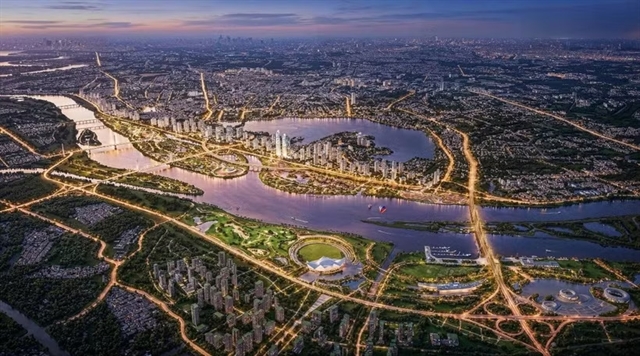
| Rendering of the Red River scenic boulevard project. — Photo vietnamplus.vn |
HÀ NỘI — The Hà Nội People’s Council on Monday approved the investment of the Hồng (Red) River scenic boulevard project running through 16 wards and with an investment of nearly VNĐ737 trillion (about US$29.35 billion)
Covering more than 11,400ha, it is one of Hà Nội's largest-ever infrastructure and urban renovation projects, playing a strategic role in shaping urban development space along the Red River for decades to come.
Permanent Vice Chairman of the municipal People’s Committee Dương Đức Tuấn said the project aims to develop and complete transport infrastructure, promote urban expansion along both banks of the Red River and align with sustainable development goals while improving the quality of Hà Nội’s central urban area.
The project is also intended to realise major orientations outlined in Politburo Resolution No 15-NQ/TW dated May 5, 2022, on Hà Nội’s development to 2030 with a vision to 2045, Resolution No 02-NQ/TW dated March 17, 2026, on building and developing Hà Nội in a new era and the capital city’s 100-year master plan, he said.
The project will span multiple riverside communes and wards, including Hồng Hà, Ô Diên, Thượng Cát, Đông Ngạc, Phú Thượng, Lĩnh Nam, Thanh Trì, Nam Phù, Hồng Vân, Mê Linh, Thiên Lộc, Vĩnh Thanh, Đông Anh, Bồ Đề, Long Biên and Bát Tràng.
It will include scenic boulevards, ecological and entertainment parks, urban development areas, technical infrastructure and water surfaces.
The transport component consists of two scenic boulevard routes running along both sides of the Red River, with a combined length of about 80km.
The right-bank route will stretch about 45.35km while the left-bank route will extend about 35km.
The park component will include a series of large parks along riverbanks.
The project also includes embankment works, riverbed and riverbank improvement, resettlement and urban redevelopment areas in Long Biên, Lĩnh Nam and Bát Tràng, as well as independent site-clearance projects.
The construction phase is set to last from 2026 to 2038.
During the 2026–30 period, Hà Nội will prioritise major components, including the two riverside boulevard routes, embankment and riverbank improvement systems, key public parks, 'urban living room' areas, resettlement urban zones in Lĩnh Nam and Long Biên and independent land clearance projects.
Preservation of craft villages
Discussing the project’s land clearance during the second session of the city People’s Council on Monday, many delegates said the project would not only affect transport infrastructure and urban renovation but also have a profound impact on cultural structures, livelihoods and community spaces along the Red River.
Phạm Tuấn Long, director of the Hà Nội Department of Culture and Sports, said the project stretches across both banks of the Red River and passes through many traditional craft villages, ancient villages, historical-cultural relics and characteristic community spaces of northern delta residents.
According to Long, the right-bank area passes through localities rich in cultural and tourism potential such as Đông Ngạc, Phú Thượng, Lĩnh Nam, Thanh Trì and Hồng Vân. Hồng Vân in particular has developed ecological agricultural tourism and bonsai production, while many areas still preserve ancient village systems, craft villages and dense concentrations of historical relics.
On the left bank, areas such as Mê Linh, Đông Anh, Bát Tràng and Long Biên retain many distinctive cultural values. Bát Tràng alone is home to around 1,000 ceramic production and business households, while many riverside areas have developed agricultural tourism, craft villages and experiential tourism linked to traditional beliefs and festivals.
Long stressed that project implementation should carefully balance urban redevelopment with preservation of cultural heritage, traditional crafts and community spaces.
“Resident relocation must go hand in hand with preserving cultural spaces and craft villages, minimising community fragmentation and ensuring land funds for maintaining local livelihoods,” he said.
He also proposed that the city develop cultural tourism, community tourism and eco-tourism routes along the river while establishing centres introducing craft village products, developing digital tourism maps and waterway tourism and prioritising preservation of representative heritage clusters.
Other delegates also said the project should encourage participation from residents, experts, artisans and social organisations during planning, landscape design and the organisation of riverside cultural spaces. VNS
Politics & Law
 Politics & Law
 Politics & Law
 Politics & Law
 Politics & Law
 Politics & Law
 Politics & Law
 Politics & Law
 Politics & Law
 Politics & Law
 Politics & Law
 Politics & Law
 Politics & Law
 Politics & Law
 Politics & Law