 Politics & Law
Vietnamese Prime Minister meets Cambodian National Assembly President
1.
|
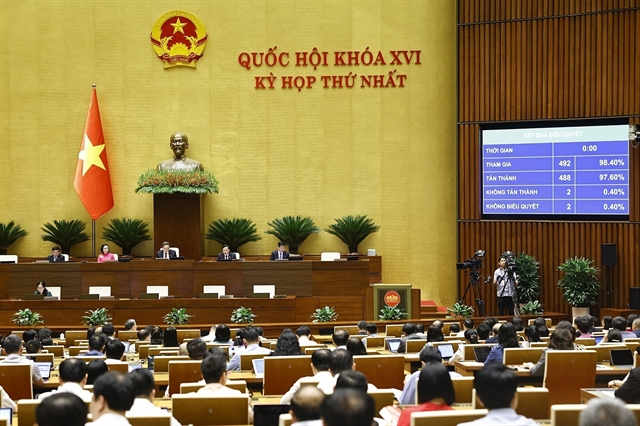
| Lawmakers vote to pass the revised Capital Law. VNA/VNS Photo Doãn Tấn |
HÀ NỘI — The National Assembly (NA) on Thursday afternoon passed the revised Capital Law, granting Hà Nội 199 special and outstanding powers while strengthening mechanisms for oversight, control and accountability.
Continuing the agenda of the first session of the 16th NA, lawmakers heard Minister of Justice Hoàng Thanh Tùng present reports on five draft laws: the revised Law on Access to Information, the revised Capital Law, the revised Law on Civil Status, the Law amending and supplementing a number of articles of the Notarisation Law and the Law amending and supplementing a number of articles of the Law on Legal Aid.
All five laws were adopted with overwhelming support.
For the revised Capital Law, 488 out of 492 deputies voted in favour, accounting for 97.06 per cent of total NA deputies, endorsing greater autonomy for the capital’s administration. The law revises several key provisions, emphasising the proactive role of Hà Nội authorities in formulating, issuing and implementing policies.
Notably, it does not apply fast-track procedures to the development of legal normative documents, clarifies the authority of the Chairman of the municipal People’s Committee in issuing legal documents and introduces enhanced mechanisms for inspection, supervision and accountability. It also sets a maximum five-year pilot period for new policies, alongside provisions allowing suspension in case of risks.
The revised law continues to refine specific mechanisms and policies aimed at promoting the capital’s comprehensive and sustainable development. It empowers the municipal People’s Council to decide on urban renovation and redevelopment policies and clarifies authority over planning management and development space, particularly underground space. It also adds policies in education and health care and allows special mechanisms for major key projects.
On finance and budget matters, the law maintains the principle of not introducing tax incentives beyond the general legal framework, ensuring the central budget’s leading role. At the same time, it introduces more flexible budget management mechanisms and targeted incentives to promote priority sectors.
A notable new provision concerns the Capital Region, adopting an open and flexible approach to facilitate inter-local development linkages. The law allows mechanisms under the revised Capital Law to be applied to regional linkage projects and permits the use of local budgets for inter-regional investment in infrastructure, environment and essential services.
The adoption of the revised Capital Law is expected to provide an important legal corridor to help Hà Nội develop in line with its role as the country’s political, economic and cultural centre.

|
| Minister of Justice Hoàng Thanh Tùng presents reports on five draft laws on April 23 afternoon. — VNA/VNS Photo Doãn Tấn |
Also passed with 492 out of 493 votes in favour, accounting for 98.4 per cent of the total, the revised Law on Access to Information strengthens citizens’ right to access information, particularly in the digital environment.
It improves provisions to ensure information is accurate, complete, timely, transparent and accessible while clearly defining the responsibilities of state agencies and public service units.
The law governs the exercise of citizens’ right to access information and outlines the responsibilities of state agencies and public service providers in ensuring this right.
At commune level, People’s Committees are responsible for providing information they generate, excluding information received from other agencies (except in specific cases), ensuring practicality amid ongoing administrative restructuring. The law also enhances decentralisation by allowing provincial and commune-level authorities to determine focal points for information provision.
Regarding partial access to records and documents, the law requires agencies to review and classify information before disclosure, clearly separating accessible and restricted content. Technical details will be guided in professional manuals to ensure consistent implementation.
Importantly, the law dedicates a specific article to information that must be publicly disclosed, expanding the scope to include key categories directly linked to daily life and business activities. For information not listed but required to be disclosed under specialised laws, such provisions will continue to apply, ensuring completeness while avoiding overlap and maintaining flexibility.
The law will take effect on September 1.
The revised Law on Civil Status was also passed, with 488 out of 492 deputies voting in favour, and will take effect on March 1, 2027.
Recent implementation of civil status registration independent of administrative boundaries under a two-tier local government model since July 1, 2025, has shown stable operations without major issues.
Regarding proactive birth and death registration, the Government has added a roadmap to implement this model nationwide by January 1, 2031. This marks a major reform, shifting from a citizen request model to a proactive public service approach, requiring synchronised digital infrastructure and data connectivity, particularly in the health care sector.
During the transition period, localities with sufficient conditions may implement the system early while the State continues to invest in infrastructure, human resources and communication to ensure feasibility and public consensus.
On the same day, the NA also adopted amendments to the Notarisation Law with 97.8 per cent approval (489 out of 491 deputies), including a roadmap for notarising real estate transactions regardless of administrative boundaries. — VNS
Politics & Law
 Politics & Law
 Politics & Law
 Politics & Law
 Politics & Law
 Politics & Law
 Politics & Law
 Politics & Law
 Politics & Law
 Politics & Law
 Politics & Law
 Politics & Law
 Politics & Law
 Politics & Law
 Politics & Law