 Politics & Law
MoIT to build system to flag unusual fuel price movements
1.
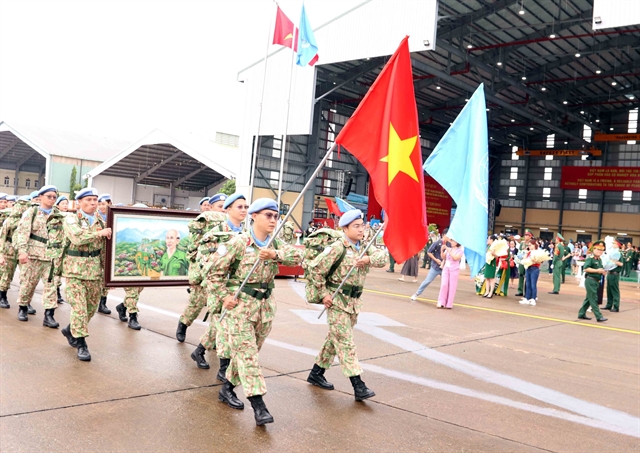 |
| The send-off ceremony for Việt Nam's peacekeepers to take on missions at Level-2 Field Hospital No. 7 and Engineering Company No. 4 departing in South Sudan and the Abyei Area in September 2025. — VNA/VNS Photo |
HÀ NỘI — Việt Nam is stepping up preparations to ensure its personnel are ready to take on senior roles in United Nations peacekeeping missions and at UN Headquarters, focusing on selecting high-quality officers who meet all necessary criteria.
Senior Lieutenant General Nguyễn Trường Thắng, Deputy Minister of National Defence, made the call on Tuesday while attending a conference to review the Việt Nam Department of Peacekeeping Operations’ missions and set tasks for 2026.
He praised the department and relevant units for their effective preparation and deployment of Vietnamese forces to UN peacekeeping missions, helping create a strong international impression and enhancing the standing of the country and the Việt Nam People’s Army.
Thắng noted that the department had performed well in managing, commanding, directing and operating forces both within and outside missions, ensuring strict discipline, security and safety while successfully completing assigned tasks.
The department had also coordinated with relevant agencies and units to provide sound advice to the Central Military Commission and the Ministry of National Defence on participation in UN peacekeeping activities.
It had worked closely with ministries, sectors and military units to help complete the legal framework for Việt Nam’s participation in UN peacekeeping operations, notably the adoption of the Law on Participation in UN Peacekeeping Operations.
To ensure effective implementation of peacekeeping tasks in the coming years, particularly through 2026, Senior Lieutenant General Thắng requested the department to continue taking the lead, in coordination with relevant agencies and units, in carrying out assigned tasks.
Priority should be given to training and comprehensive preparation for Engineering Company Rotation 5 and Level-2 Field Hospital Rotation 8 to ensure readiness for scheduled deployment, along with well-organised send-off ceremonies, he said.
He asked the External Relations Department under the Ministry of National Defence to coordinate with the Việt Nam Department of Peacekeeping Operations, the United Nations and international partners to support capacity building for Vietnamese peacekeeping forces and to promote the signing, renewal and upgrading of memoranda of understanding on UN peacekeeping cooperation with partner countries.
Relevant agencies and units were asked to prepare qualified personnel for peacekeeping participation and organise professional and specialised training, ensuring deployment readiness upon decision.
According to Major General Phạm Mạnh Thắng, director of the Việt Nam Department of Peacekeeping Operations, since May 2014, the Ministry of National Defence has deployed more than 1,300 officers and professional soldiers to UN peacekeeping missions in both individual and unit-based formats. All deployed personnel have performed well, maintained discipline and received high evaluations.
Under individual deployments, 149 officers have served in three UN peacekeeping missions, at UN Headquarters in the United States, the UN Liaison Office in Belgium and the European Union Training Mission.
Việt Nam has sent seven Level-2 Field Hospitals rotating annually to UNMISS (South Sudan) since 2018, and four Engineering Companies rotating annually to UNISFA (Abyei area) since 2022.
The Việt Nam Department of Peacekeeping Operations has advised on the signing of 11 international cooperation agreements, maintained effective cooperation with the UN, the European Union and partners, and received more than US$20 million in international support for training and capacity building. — VNS
Politics & Law
 Politics & Law
 Politics & Law
 Politics & Law
 Politics & Law
 Politics & Law
 Politics & Law
 Politics & Law
 Politics & Law
 Politics & Law
 Politics & Law
 Politics & Law
 Politics & Law
 Politics & Law
 Politics & Law