 Politics & Law
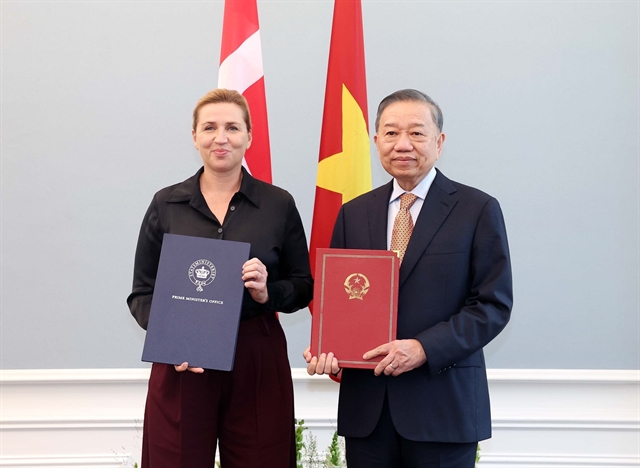
Việt Nam, Denmark issue joint statement on establishment of Comprehensive Strategic Partnership
1.
|
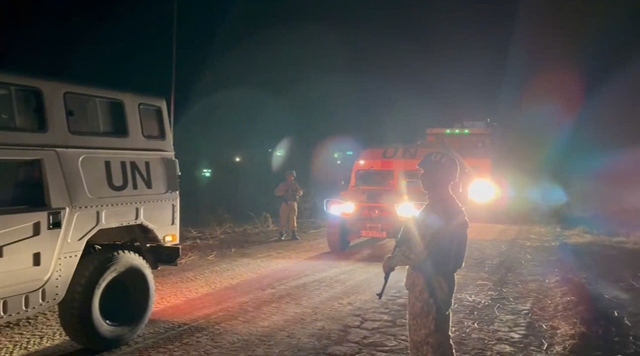
| Vehicles carrying Vietnamese UN peacekeepers head into the conflict hotspot to assist civilians, March 2. — Photo courtesy of The Engineering Unit 4 |
ABYEI — When ethnic violence erupted in the Abiemnom region (South Sudan) earlier this month, a Vietnamese engineering unit serving with the United Nations (UN) found itself at the centre of an overnight humanitarian response.
The Engineering Unit 4, deployed with the UN Interim Security Force for Abyei (UNISFA), worked through the night of March 2 to 3 to help protect civilians and support emergency relief operations after deadly clashes between local communities in the area.
Local authorities said armed men from Mayom County in Unity State crossed into Abiemnom and opened fire, triggering fighting between members of the Dinka and Nuer communities that lasted more than three hours.
At least 169 people were killed, including women, children, and elderly residents.
The violence forced large numbers of villagers to flee their homes. Around 1,000 civilians sought refuge in a UN base in the region, while more than 50 injured people were evacuated to medical facilities in Abyei and nearby Warrap State.
Late on March 2, the UN mission ordered the Vietnamese engineering contingent to assist emergency operations under its mandate to protect civilians.
A rapid-response team moved out during the night, deploying engineers and equipment to support medical facilities and logistical operations linked to the crisis response.
One of the unit’s first tasks was to help expand capacity at a field hospital run by Médecins Sans Frontières (Doctors Without Borders), which was receiving wounded civilians from the clashes.
|
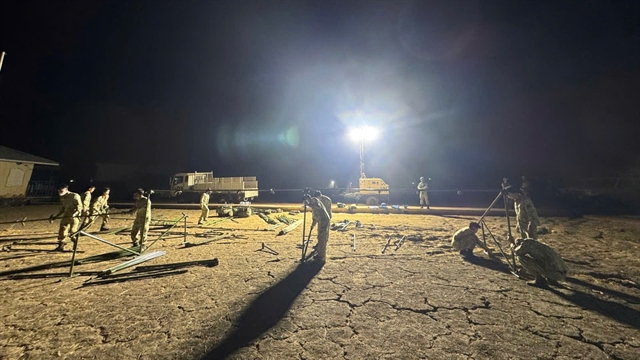
| Vietnamese peacekeepers assemble tents to provide emergency shelter at a Médecins Sans Frontières (MSF) field hospital. |
Working through the early hours, Vietnamese soldiers erected rows of large military tents in the hospital compound to provide temporary shelter for newly arriving patients and displaced residents.
By about 1.30am on March 3, the tents were in place, offering refuge for more than 60 people who had fled the violence.
At the same time, another Vietnamese team carried out a separate mission to move heavy engineering equipment to the conflict-affected area.
|
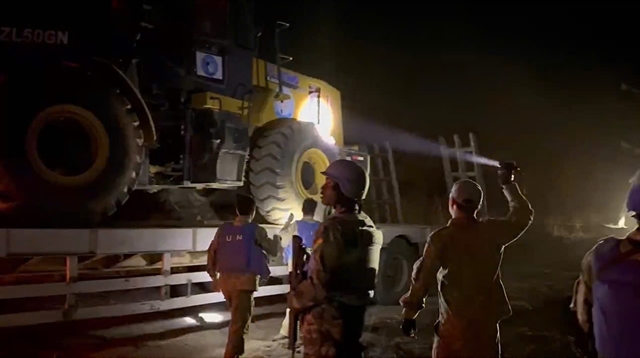
| A convoy transports a trailer and an excavator moves towards the conflict hotspot. |
Coordinating with other peacekeeping units, they transported an excavator and trailer from the mission headquarters towards the Rumamier–Abiemnom corridor.
The convoy travelled overnight under escort from the Chinese Quick Reaction Force and a Ghanaian peacekeeping battalion.
The equipment was delivered and unloaded shortly after 2.30am, allowing the mission to begin urgent engineering work to support relief operations.
But the humanitarian challenges did not end when the immediate emergency response was over.
Many displaced families are now sheltering in temporary sites under UN protection during the dry season, when access to drinking water becomes increasingly difficult.
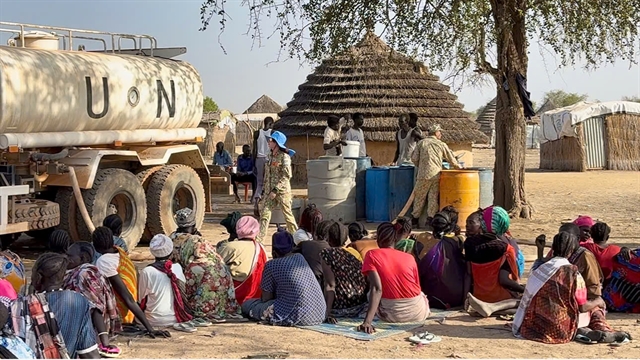
In response, the Vietnamese engineering unit has begun delivering clean water by tanker truck to several of these sites, supplying residents who lost homes and belongings in the violence.
|
| Vietnamese peacekeepers deliver clean water to civilians at a UN shelters. |
Lieutenant Colonel Trịnh Văn Cường, commander of Engineering Unit 4, said the soldiers had been instructed to treat humanitarian support as central to their mission.
“Every road we repair, every container of water we deliver, every evacuation we help with is driven by our sense of duty,” he said.
The unit’s swift response drew praise from the leadership of the UN mission.
UNISFA Force Commander Major General Ganesh Kumar Shrestha commended the Vietnamese engineers for their role in supporting humanitarian operations following the outbreak of violence. — VNS
Politics & Law
 Politics & Law
 Politics & Law
 Politics & Law
 Politics & Law
 Politics & Law
 Politics & Law
 Politics & Law
 Politics & Law
 Politics & Law
 Politics & Law
 Politics & Law
 Politics & Law
 Politics & Law
 Politics & Law