 Politics & Law

Solcis launches open compliance layer for AI agents on NVIDIA OpenShell
1.
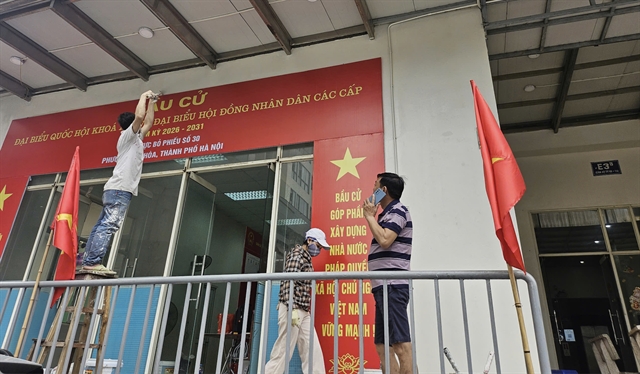 |
| A community house that is used as a polling place has been newly painted for election day. — VNS Photo Lan Hương |
Chu Lan Hương
HÀ NỘI — Every morning this week as residents go to work and school, Lại Ngọc Thuận, head of Yên Hoà Commune's Neighbourhood 25, has headed to polling station number 30 to supervise the preparations for March 15, election day.
The polling station, part of Electoral Unit 7, is located in the community house of apartment building E3, which is expected to receive about 2,000 voters on election day.
They will be voting to elect deputies to the 16th National Assembly (NA) and the People’s Councils at all levels for the 2026-2031 term.
The community house has been newly painted and its yard has been decorated with national and Party flags, banners and billboards, promoting messages about the rights and responsibilities of voters.
Such decorations lend a festival atmosphere to the apartment complex.
Thuận said: “The renovations made the polling area look nicer and more dignified, and the people feel more enthusiastic.”
“I've noticed that people, especially younger ones, are very interested in the election day,” he added.
Along with supervising the preparation work in the morning, Thuận has to check lists of voters in his neighbourhood.
Only 425 voters live in Neighbourhood 25, but polling station 30 includes two other neighbourhoods, adding up to nearly 2,000 voters, according to Thuận.
Checking the list of eligible voters is a time-consuming task that requires perseverance and meticulousness.
He has been working since January on this task, knocking on every apartment door to collect voters’ personal information.
Thuận set up Zalo groups to make the work run smoothly and to rapidly disseminate guidelines and information about the election to residents.
Digitised voter information
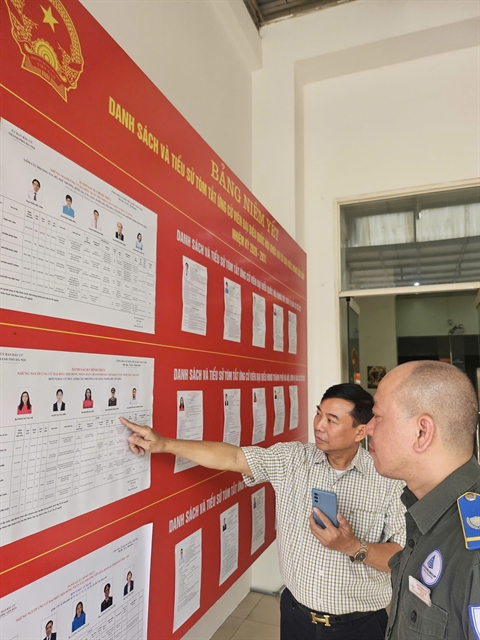 |
| Thuận checks the list of candidates. VNS Photo Lan Hương |
In preparation for the election day, Yên Hòa Ward has been implementing a series of coordinated measures since January.
Voters in the ward will choose 24 deputies for the ward People’s Council, allocated across eight electoral units. If all voters participate, a total of 54,282 ballots will be cast.
Trần Cẩm Anh, president of the Yên Hoà Fatherland Front Committee, said that preparations include publicly launching a digitised voter information system across 84 residential groups and finalising organisational plans at polling stations.
Every stage has been carried out seriously, ensuring full democracy and compliance with the law, ahead of the major national event.
One of the highlights of election preparations was the public release of the digitised voter information system across 84 residential groups, allowing voters to exercise their rights and civic duties on this important occasion.
This approach allows voters in the ward to easily look up their polling locations and access election information anytime, anywhere via mobile devices.
To complete this task, the ward’s People’s Committee directed the police and residential groups to review and update voter information on the population database platform.
According to the president, each residential group compared household data with digitised records, promptly adding newly arrived residents, adjusting information and removing from the list those who no longer reside in the area or will vote at their workplaces.
Digitisation not only saves time and effort, but also facilitates inspection and supervision in a more convenient and systematic manner.
Residential groups can quickly look up and cross-check information, ensuring that no eligible citizen is overlooked. At the same time, data is made public and transparent in accordance with regulations, strengthening public trust and consensus.
Alongside digitisation, Yên Hòa Ward has publicly posted voter lists on its official electronic information portal and at community venues and cultural houses of residential groups, to enable residents to easily verify their information.
Feedback and petitions relating to voter lists are received and handled promptly and in accordance with proper procedures.
Election communication has also been intensified through various forms, including notice boards, banners, posters, residential meetings and Zalo groups. These efforts help residents better understand their rights and responsibilities, raising awareness and encouraging them to participate actively in selecting worthy representatives, Cẩm Anh said.
Effectiveness of the two-tiered government operation
After operating under a two-tiered government model, the ward has gradually stabilised its organisational structure and clearly defined responsibilities. Officials and civil servants have become familiar with the procedures, functions, and duties; coordination between departments has become smoother; and citizens have gradually adapted to the new mechanism, Cẩm Anh said.
However, due to the elimination of the district level, which serves as an intermediate level, the workload at the ward level has increased, requiring greater initiative, flexibility, and responsibility in implementation.
"We recognise this as both a challenge and an opportunity to improve the quality of service to the people and to organise elections in a rigorous, effective, and compliant manner," Cẩm Anh said.
Currently, according to feedback from citizens at the grassroots level, the process of compiling voter lists based on the use of the National Population Database and the application of the National Identification System (VNeID) helps to modernise and reduce procedures, but faces difficulties due to fluctuating data and discrepancies in temporary/permanent residence information, she said.
Meanwhile, according to Thuận, implementing the two-tiered government model has helped provide election-related information to people more quickly.
"Documents or guidelines that are sent to heads of neighbourhood areas are passed to people on the same day. This is an advantage of the two-tiered government model," he said.
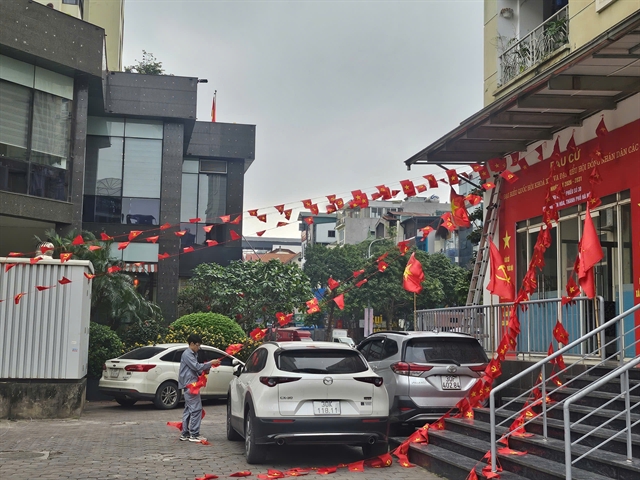 |
| Election Day flag decorations are put up at a polling station. — VNS Photo Lan Hương |
The 2026 election is an opportunity for every citizen to demonstrate their right to self-governance, responsibility and confidence in the development of the nation, Thuận said.
Resident Trần Thanh Hà, 53, said she felt the atmosphere of the election has spread to every corner of the city.
“I have been a Party member for 26 years. I am very excited and looking forward to election day, a national festival,” Hà said.
“Even though it is just one vote, I will contribute to choosing virtuous and talented individuals who will help the country develop and become stronger."
“I believe that it's not just me — many Vietnamese people share this sentiment,” she added. — VNS
Politics & Law
 Politics & Law
 Politics & Law
 Politics & Law
 Politics & Law
 Politics & Law
 Politics & Law
 Politics & Law
 Politics & Law
 Politics & Law
 Politics & Law
 Politics & Law
 Politics & Law
 Politics & Law
 Politics & Law