 Politics & Law
Vietnamese Prime Minister meets Cambodian National Assembly President
1.
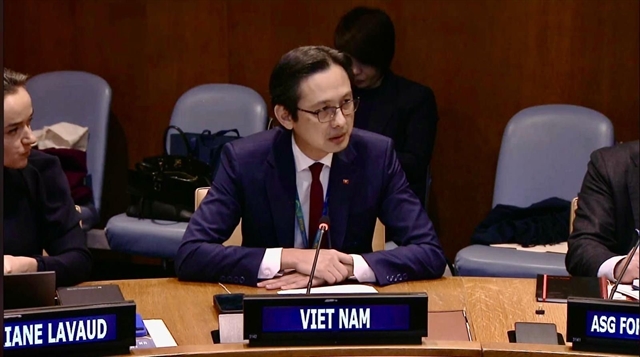 |
| Ambassador Đỗ Hùng Việt, head of Việt Nam’s Permanent Mission to the United Nations. — VNA/VNS Photo |
NEW YORK — The Treaty of Amity and Cooperation in Southeast Asia (TAC) continues to reinforce ASEAN’s central role in a rapidly evolving regional landscape, serving as a cornerstone for trust-building and cooperation among member states while helping shape a wider Asia–Pacific security architecture, Ambassador Đỗ Hùng Việt has said.
Addressing a symposium in New York on Wednesday (local time) on the treaty’s role as a regional arrangement under Chapter 8 of the UN Charter on the occasion of the 50th anniversary of the TAC signing, the head of Việt Nam’s Permanent Mission to the United Nations (UN) highlighted TAC’s contribution to deepening ASEAN’s engagement with dialogue partners through ASEAN-led platforms such as the ASEAN Regional Forum and the East Asia Summit.
He noted that the treaty’s principles and mechanisms have become firmly embedded in Southeast Asia’s political fabric, shaping norms of conduct, nurturing a culture of restraint, and promoting dialogue and consultation. These foundations, he said, have created favourable conditions for managing disputes, preventing risks and avoiding miscalculations, thereby strengthening trust and fostering amicable ties across the region.
On the interplay between regional and global security structures, Ambassador Việt underscored that mechanisms such as TAC are well-positioned to undertake preventive diplomacy thanks to their geographic proximity, contextual understanding and established communication channels. Early engagement at the regional level, he observed, can help defuse tensions before they escalate to the UN Security Council or other multilateral forums. In this regard, he described the treaty as a model of effective cooperation and a clear example of the mutually reinforcing relationship between the United Nations and regional frameworks under Chapter 8 of the Charter.
Participants at the event reviewed the treaty’s evolution and expanding membership, noting how it has translated the UN Charter’s core principles into the Southeast Asian context. These include respect for independence, sovereignty and territorial integrity; non-interference in internal affairs; the non-use or threat of force; and the peaceful settlement of disputes. Over the past five decades, TAC has played a pivotal role in sustaining peace, stability and cooperation in Southeast Asia.
ASEAN member states reaffirmed their commitment to advancing the treaty’s values and principles, stepping up dialogue, cooperation and confidence-building efforts in support of peace, stability and sustainable development in the region and beyond. The symposium once again highlighted ASEAN’s leadership in advancing TAC and regional initiatives, as well as broad support among UN member states for the treaty’s role in promoting international peace and security and strengthening trust in multilateralism anchored in international law. — VNA/VNS
Politics & Law
 Politics & Law
 Politics & Law
 Politics & Law
 Politics & Law
 Politics & Law
 Politics & Law
 Politics & Law
 Politics & Law
 Politics & Law
 Politics & Law
 Politics & Law
 Politics & Law
 Politics & Law
 Politics & Law