 Environment
Vietnamese scientist wins ASEAN-US Science Prize for Women
1.
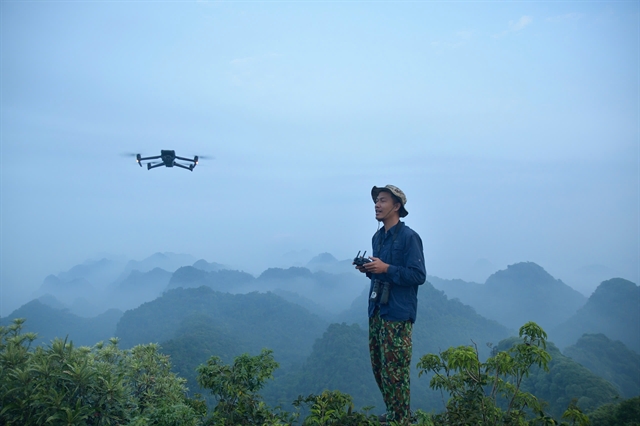 |
| A biologist uses a UAV in a survey on the population of wildlife species in a forest of Hương Sơn of Hà Tĩnh Province. Conservationists and scientists urged the application of new technological innovations in nature protection and research at national parks and nature reserves in nationwide. — Photo courtesy of CCD |
ĐÀ NẴNG — New technology applications are needed to improve conservation activities, supervision of wildlife species and forest protection, while providing accurate scientific data for masterplans and policy-decision making.
Lưu Hồng Trường, a scientist from the Southern Institute of Ecology, recently promoted the role of technological innovations in biodiversity research and protection at a conference on biodiversity protection and sustainable development in central Việt Nam and the Central Highlands.
He said that a series of new technologies have been offered to effectively manage and control scientific studies in forests, oceans and other challenging terrains where people can not reach.
Trường introduced some global trends of technological applications, including remote sensing for tracking on deforestation, biomass and forest structure, environmental DNA, AI-analysed acoustics in soundscape ecology, species distribution modeling, cameras, quantum computing and integrated decision-making platforms.
Đồng Anh Đài from the Việt Nam Forestry Administration has been promoting the use of the Spatial Monitoring Reporting Tool (SMART) for conservation and protection of nature reserves.
He said SMART is one of the most effective tools in supporting protection of forests and wildlife as it has been used by 60 management boards for forest protection at more than 33 nature reserves and national parks nationwide since 2010.
Đài said the tool helps support rangers to effectively manage patrols and data as well as the date and time of illegal logging and hunting cases.
He said the programme was conducted nationwide under a Government decision to launch SMART training programmes at the national parks and nature reserves.
Vũ Văn Thái from GreenField Consulting and Development Company said an unmanned aerial vehicle (UAV) was used to count the population of the endangered species of Delacour’s Langur (Trachypithecus delacouri) in karst landscapes in a manner that does not disturb wildlife, along with Caovit Gibbon (Nomascus nasutus) in Ninh Bình and Hà Nội.
The device was also used in elephant supervision by the Save Việt Nam’s Wildlife in Cát Tiên National Park, he said.
“An investment of VNĐ150 million (US$6,000) to VNĐ250 million ($10,000) is needed for UAV wild thermal drone technology that could help discover primate species in forest canopy, while an initial training course costs from VNĐ50 million ($2,500) to VNĐ100 million ($4,000),” Thái shared.
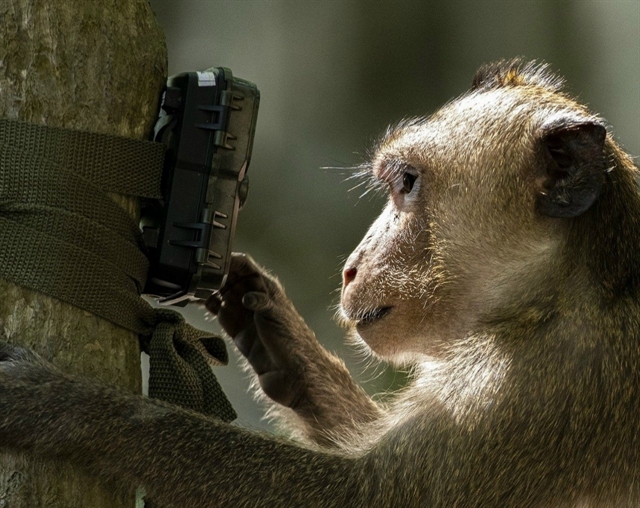 |
| A monkey is curious about a camera trap set by conservationists in a wildlife species monitoring project. A series of devices and technological applications have been used to improve conservation and protection of wildlife species and forest. — Photo courtesy of Bùi Văn Tuấn |
“The application of UAV would cut 25 to 50 per cent of the cost of current field studies and would have a higher accuracy rate. Meanwhile, UAV thermal drone technology can count each individual animal with an optical zoom camera for better classification than manual options and all-day jungle trekking trips,” he explained.
Nguyễn Văn Toàn, a biologist from Đà Nẵng-based GreenViet biodiversity conservation centre, emphasised the important role of science databases as they form a large ‘library’ for managers and biologists to study endangered wildlife species and their habitats.
Reef Cloud is an application that has been used in aquatic and reef check activities in the management of the Chàm Islands Marine Protected Area (MPA) since 2011.
The Chàm MPA reported the application helps collect images and data on the existence of coral reefs and their development, while an AI analysis provides information on coral reef composition and coverage.
It also recommended that the conservation of coral reefs and the aquatic environment in water off the Chàm Islands MPA also needs other applications including the Geographic Information System (GIS), remote sensing, automatic underwater monitoring systems and AI to improve the effectiveness and accuracy of research and surveys.
Trần Thị Phương Thảo, a staff member of Chàm Islands MPA, suggested that a national shared database on environment studies and biodiversity should be built for an overview of regional and national ecosystem protection.
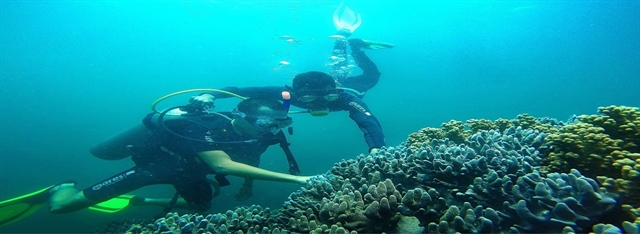 |
| Two divers check coral reef in water off the Chàm Islands Marine Protected Area. More new equipment and technological applications are needed in nature conservation. — Photo courtesy of Chàm Islands MPA |
She said the monitoring and supervision of the ecological system in the sea still requires updated technological innovations and equipment to facilitate field studies and research.
Lưu Hồng Trường also urged quick procedures among State agencies to approve UAV or new technology devices in wildlife and forest monitoring activities. — VNS
Environment
 Environment
 Environment
 Environment
 Environment
 Environment
 Environment
 Environment
 Environment
 Environment
 Environment
 Environment
 Environment
 Environment
 Environment