 Economy


Ascott Presents Its Fifth Edition of The Famous CFC in Kuala Lumpur, Drawing Fans from Across Southeast Asia
1.
|
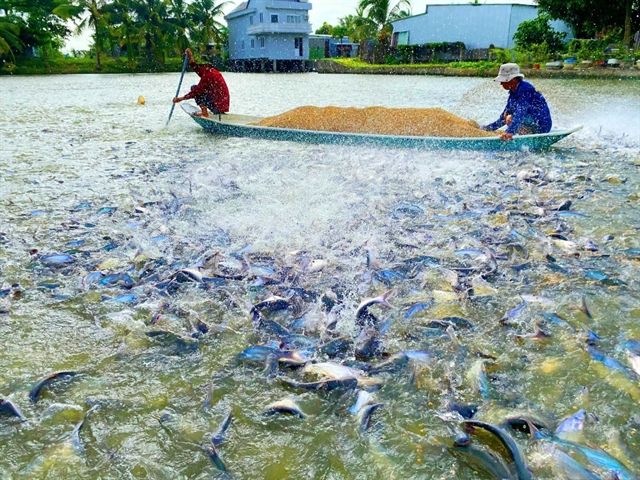
| Farmers feed pangasius catfish in a pond. Đồng Tháp is promoting science, technology and digital transformation to increase the value and sustainability of its pangasius sector. — VNA/VNS Photo |
ĐỒNG THÁP — Đồng Tháp Province is looking to move its pangasius catfish sector beyond a volume-driven model by using technology and innovation to develop higher-value products and make better use of every part of the fish.
The move comes as Việt Nam accelerates the implementation of the Party’s Resolution 57, which identifies science, technology, innovation and digital transformation as key drivers of socio-economic growth.
With more than 2,750ha of farming area and an annual output of nearly 600,000 tonnes, Đồng Tháp is one of Việt Nam’s largest pangasius production centres.
Many farming areas have been granted identification codes and certified as meeting standards such as VietGAP, GlobalGAP, ASC and BAP, helping local producers gain access to demanding export markets.
Pangasius catfish has long been an important contributor to the province’s agricultural growth, exports, employment and household incomes.
Đồng Tháp is also home to major processing and export companies with strong international competitiveness, the provincial Department of Science and Technology said.
In recent years, companies have invested in advanced technology and vertically integrated production.
Vĩnh Hoàn Corporation has, for example, invested in technology to extract collagen from pangasius skin, creating high-value products for the food, cosmetics and healthcare industries.
The approach demonstrates the potential to generate more value from the whole fish rather than relying mainly on fillets.
Skin, fat and bones can be processed into new products, reducing disposal costs while creating additional sources of revenue.
Companies are also building modern processing lines, improving traceability and quality management, and developing convenience foods, nutritional products and other products in response to changing consumer needs.
At the farming stage, environmental monitoring systems, biological products, production management software and electronic farming logs are increasingly being used.
Such technologies can help farmers monitor water quality, manage feed, control disease and improve traceability.
The province is also developing circular-economy approaches.
Mai Thiên Thanh Co Ltd has developed a process for producing organic fertiliser from pangasius by-products, with an annual capacity of about 10,000 tonnes.
In 2024, the company treated more than 19,000 tonnes of sludge and produced more than 6,000 tonnes of organic fertiliser.
The examples show how technology can increase economic value while reducing environmental impacts, the department said.
Beyond frozen fillets
But the industry still has room to improve. Exports remain heavily concentrated in frozen fillets, while high-value processed products account for a relatively small share, limiting the value that can be generated from each fish.
Producers are also facing tighter requirements in markets such as the US, EU, Japan and South Korea, particularly regarding environmental standards, social responsibility, traceability and carbon emissions.
At the same time, global demand is shifting towards health-focused foods, nutritional products and natural ingredients. This could allow pangasius producers to move beyond frozen fillets and compete in the food, nutrition, cosmetics and healthcare markets, the department said.
Pangasius skin can be processed into collagen and gelatin, fat into oil and omega-3 products, and bones into calcium supplements.
Proteins recovered from processing by-products can also be used as food ingredients and in nutritional products.
|
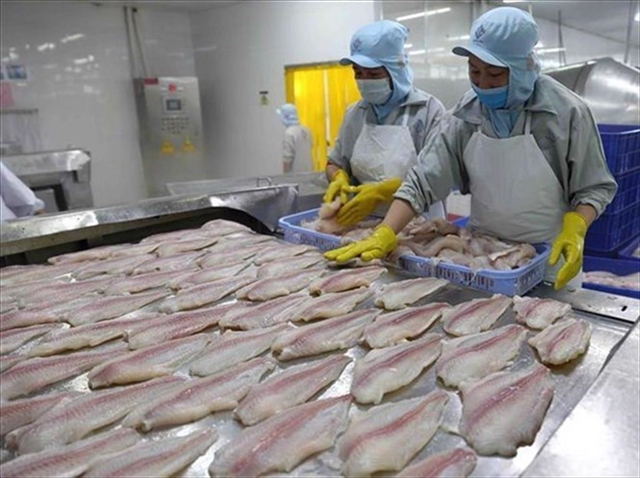
| The pangasius catfish sector still relies heavily on frozen fillets, highlighting the potential to expand production of higher-value processed products. — VNA/VNS Photo |
Overcoming bottlenecks
But several bottlenecks need to be addressed before the sector can realise this potential.
Broodstock quality is inconsistent, breeding is fragmented, and climate change and deteriorating water quality are increasing the risk of disease and driving up production costs.
Infrastructure for water supply, drainage and waste treatment also needs further investment in some farming areas.
The department said developing the pangasius value chain through science, technology and innovation in line with Resolution 57 would be important not only for increasing export value but also for supporting green growth, the circular economy and digital transformation.
One priority is to improve broodstock and fingerling quality through biotechnology, genetic technologies and better aquatic health management to develop strains with faster growth, greater disease resistance and greater adaptability to changing environmental conditions.
Đồng Tháp also plans to accelerate digital transformation by developing databases, digital maps of farming areas and electronic traceability systems, while expanding the use of the Internet of Things, artificial intelligence, big data and automated monitoring.
In processing, the focus will be on research and technology transfer to develop higher-value products such as collagen, gelatin, omega-3 products, hydrolysed proteins, nutritional foods and biological products, reducing reliance on traditional frozen fillet exports.
The province also wants to develop circular value chains in which one company's by-products become another company's inputs.
Greater use of fish skin, fat, bones and proteins could create additional value while reducing waste and environmental pressure.
If implemented effectively, the department said, science, technology and innovation could help Đồng Tháp increase the value of its pangasius sector and move it away from a reliance on production volume and primary processing towards a model based on higher-value processing, digital technology and circular-economy practices. — VNS
Economy
 Economy
 Economy
 Economy
 Economy
 Economy
 Economy
 Economy
 Economy
 Economy
 Economy
 Economy
 Economy
.jpg) Economy
 Economy