 Economy


Preserving heritage and harnessing cultural strength in a new era
1.
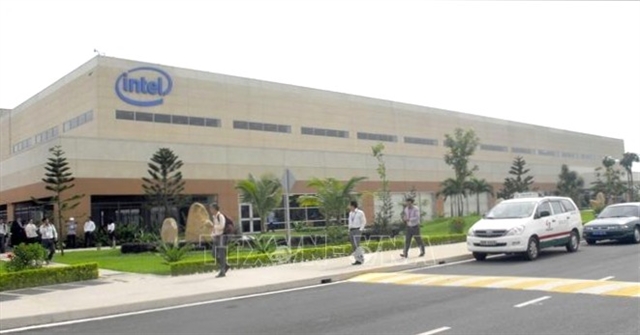 |
| Intel's chip assembly and testing plant at the Saigon Hi-Tech Park in HCM City. Data from the Ministry of Science and Technology shows the facility accounts for about half of the company's global chip assembly and testing output. — VNA/VNS Photo Hoàng Hải |
Bảo Hoa
HÀ NỘI — Australia can take advantage of Việt Nam’s critical position in the global semiconductor supply chain to produce chips on an industrial scale, and in turn, help Việt Nam reach its goals of training 50,000 engineers with its well-funded research institutes and universities, according to Nguyễn Khắc Lịch, an official from Việt Nam’s Ministry of Science and Technology.
The director general of the Department of Digital Technology and Artificial Intelligence was speaking at a panel discussion on Việt Nam-Australia cooperation in artificial intelligence (AI), semiconductors and innovation, part of an bilateral investment forum held in Hà Nội on Monday.
The forum was held to actualise high-level commitments, made during Party General Secretary and State President Tô Lâm’s official visit to Australia in August, into practical partnerships and investment opportunities.
Lịch, who had taken several working trips to Australia and most recently accompanied the top leader on the August trip, praised Australia’s research capabilities and strategic research funding allocation as he discussed areas with the highest potential for cooperation between the two countries’ semiconductor industries.
“The [Australian] Government assigns each university to study one specific segment of the supply chain, rather than having one study the entire chain,” he said.
“For example, they assign equipment production to one school, and packaging or testing to others. Then these institutions can share their work and get informed on the phases that are not their specialties.”
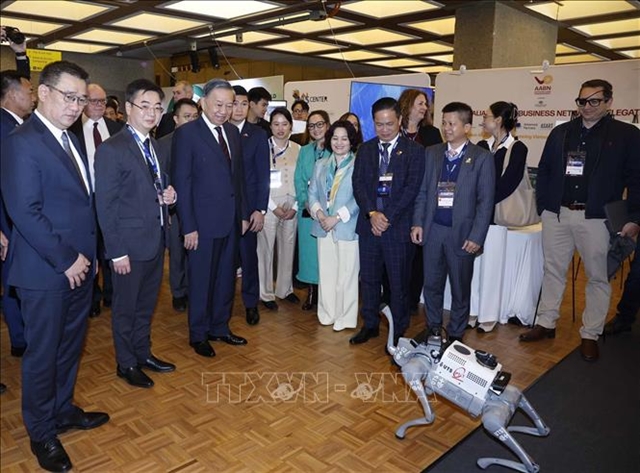 |
| Party General Secretary and State President Tô Lâm reviews tech products developed from the Việt Nam-Australia cooperation at the University of Technology Sydney, Australia on August 10. — VNA/VNS Photo Thống Nhất |
However, Australia does not have the same advantages in industrial semiconductor chip manufacturing as Việt Nam, and this is where the two countries can collaborate to reach their respective goals, according to the official.
“Việt Nam has emerged as a pivotal node in the global semiconductor supply chain, with 50 per cent of Intel’s global chip output packaged in the country,” Lịch said.
In the past two to three years, major chip packaging corporations such as Amkor and Hana Micron, and the world’s leading semiconductor design companies such as Synopsys, Cadence and Siemens have selected Việt Nam as a hub for their operations.
On June 26, Việt Nam launched the National Center for Semiconductor Chip Pilot Production and signed cooperation agreements with one of the world's largest chip manufacturers, TSMC.
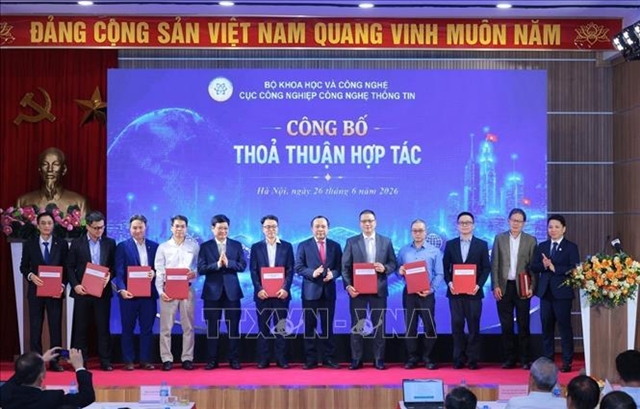 |
| Minister of Science and Technology Vũ Hải Quân (middle) at the signing ceremony of cooperation agreements between the ministry, research institutes and universities at the launch of the National Center for Semiconductor Chip Pilot Production on June 26. — VNA/VNS Photo Hoàng Hiếu |
“Australia and Việt Nam have engaged in joint research and semiconductor co-design before, but to transform those efforts into industrial-scale production, the process must definitely go through this centre, given that Việt Nam has signed a memorandum of understanding directly with TSMC," said Lịch.
In turn, Australia can use its existing workforce and laboratories to help Việt Nam train 50,000 semiconductor engineers, including 15,000 design specialists, by 2030, which are the goals outlined in Việt Nam's national strategy for developing the semiconductor industry, he said.
Furthermore, Việt Nam aims to participate in every stage of the chip manufacturing process, including the initial production of raw materials and components, which is an ambitious goal that has attracted several companies specialising in these phases such as Coherent and VDL ETG, Lịch added.
"Given these strategic directions from the Government, we are keen to foster a stronger and deeper collaboration between Việt Nam and Australia, one that actually results in tangible products," he said.
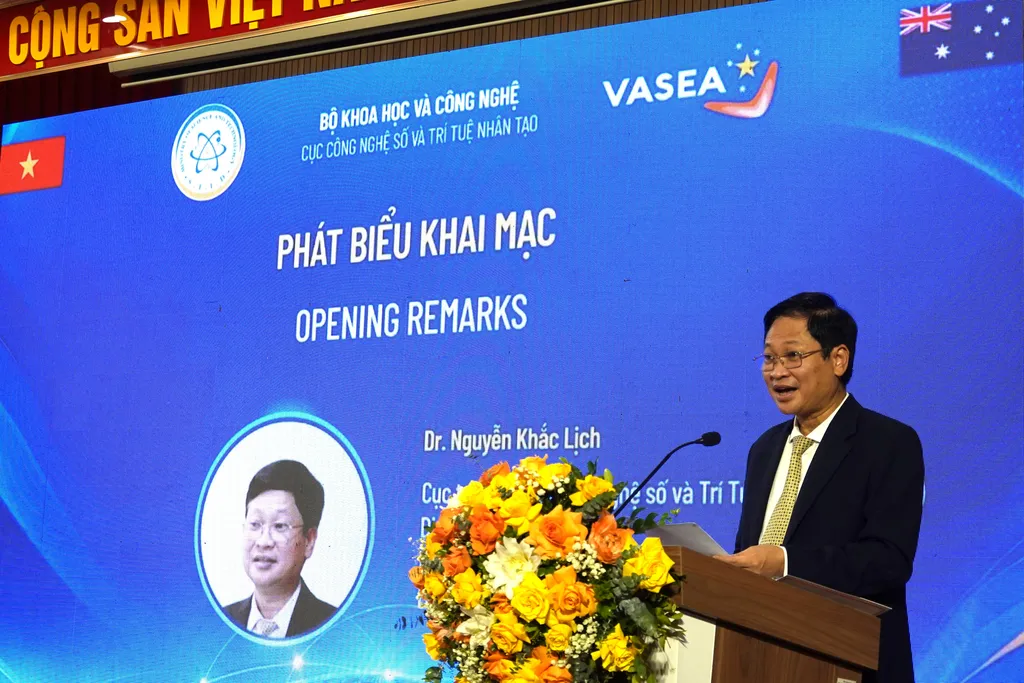 |
| Nguyễn Khắc Lịch, director general of the Department of Digital Technology and Artificial at the Ministry of Science and Technology addresses the forum in Hà Nội on Monday. |
Dương Minh Tiến, co-founder of VSAP LAB – a Vietnamese start-up specialising in advanced semiconductor packaging, who had studied and worked in Australia, also found that Australia has excellent research capabilities and a robust funding system, while Việt Nam has skilled engineers adept at grasping scientific knowledge.
“I hope that beyond merely sharing knowledge, Australia and Việt Nam can collaborate on product and technology development, transforming laboratory research into practical solutions or products so that the semiconductor industries in both countries can fully realise their potential,” he said during the panel discussion.
In her opening remarks delivered at the forum, Renee Deschamps, Chargé d'Affaires of the Australian Embassy in Việt Nam stressed Australia’s commitment to working with Việt Nam to build a ‘vibrant and innovative digital economy’.
“This collaboration is particularly important as Việt Nam pursues the ambition to become a leading digital economy in the region and towards double-digit economic growth,” she said.
Australia's Southeast Asia economic strategy to 2040 has recognised that rapid digital transformation in the region presents one of the greatest economic opportunities of the generation, with its digital economy projected to reach up to US$1 trillion by 2030, said Deschamps.
“Australian businesses have a strong interest in Việt Nam's digital future. We see opportunities spanning artificial intelligence, semiconductors, digital services, fintech and cybersecurity,” she added.
“Australian businesses look forward to supporting Vietnamese businesses, educators and entrepreneurs, while reinforcing Việt Nam's growing importance as a long-term partner for technology collaboration, investment and growth.” — VNS
Economy
 Economy
 Economy
 Economy
 Economy
 Economy
 Economy
 Economy
 Economy
 Economy
 Economy
 Economy
 Economy
 Economy
 Economy