 Economy


Japan-owned Kao Vietnam launches programme to improve women wokers’ reproductive health
1.
|
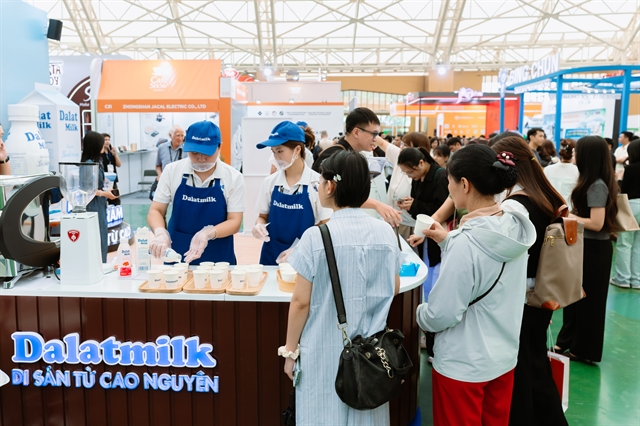
| Visitors sample products at a Dalatmilk booth during the Cafe Show & Tea Show Hanoi 2026 at the Vietnam Exposition Centre (VEC) in Đông Anh, Hà Nội. — Photo courtesy of the organiser |
HÀ NỘI — Việt Nam’s coffee and tea businesses are under pressure to turn their advantages in raw materials into higher-value products as competition intensifies and consumers become more selective.
The issue is highlighted at Cafe Show & Tea Show Hanoi 2026, taking place from October 8 to 10 at the Vietnam Exposition Centre (VEC) in Đông Anh, Hà Nội.
The event brings together more than 400 brands from 20 countries and territories at 250 booths and is expected to attract more than 30,000 visitors, according to organisers. It connects suppliers of ingredients, equipment and technology with F&B businesses, restaurant chains and investors.
The domestic food and beverage (F&B) market is recovering, but growth remains uneven.
A report by iPOS.vn and Nestlé Professional showed that F&B revenue reached an estimated VNĐ432.7 trillion (roughly US$17 billion) in the first half of 2026, up 6.55 per cent year-on-year. The number of food service establishments stood at about 329,200, almost unchanged from the end of 2025.
However, about 43 per cent of businesses reported lower revenue than a year earlier. Beverage businesses recorded a growth rate of only 15.82 per cent, below that of food businesses.
At the same time, 52 per cent of F&B businesses planned to expand their operations in the second half of the year, showing that businesses continue to see opportunities despite tougher competition.
Consumer spending is also shifting towards higher-priced drinks. The proportion of consumers spending less than VNĐ35,000 per drink fell from 41.64 per cent to 29.44 per cent, while the share spending VNĐ36,000-70,000 rose from 48.29 per cent to 61.78 per cent.
This suggests businesses need to compete on quality, taste, safety and customer experience rather than price alone.
For coffee, Việt Nam has a major advantage in production and raw materials, but higher output has not automatically translated into higher export value.
In the first eight months of 2026, Việt Nam exported about 1.33 million tonnes of coffee worth more than $6 billion. Export volume increased 13.7 per cent year-on-year, while export value fell 8.6 per cent due to lower prices.
The Japanese market shows a similar trend. Việt Nam’s coffee exports to Japan reached about 55,500 tonnes worth $248 million in the first half of 2026. Volume rose 5 per cent, but value fell 12.2 per cent. Meanwhile, Việt Nam’s share of Japan’s coffee import volume increased from 27.74 per cent to 32.1 per cent.
For tea, Việt Nam exported 136,952 tonnes worth nearly $238 million in 2025, with average export prices of about $1,737 per tonne. Both volume and value fell by more than 7 per cent year-on-year.
The figures point to the need for businesses to improve product consistency, traceability, branding and distribution while developing higher-value products.
At the exhibition, businesses are also looking for equipment and technology to improve operating efficiency, including coffee machines, roasting and processing equipment, water filtration systems, automated brewing solutions and management software.
The event also features three national competitions – Vietnam National Brewers Cup 2026. Dalamilk Vietnam National Latte Art Championship 2026 and Tea Master Cup Vietnam 2026 – attracting more than 180 contestants, with winners of the two coffee competitions to represent Việt Nam at international championships in 2027.
The exhibition is organised by Exporum in coordination with the Vietnam Coffee and Cocoa Association (VICOFA) and Vietnam Tea Association (VITAS). — BIZHUB/VNS
Economy
 Economy
 Economy
 Economy
.jpg) Economy
Economy
 Economy
 Economy
 Economy
 Economy
 Economy
 Economy
 Economy
 Economy
 Economy
 Economy