 Economy


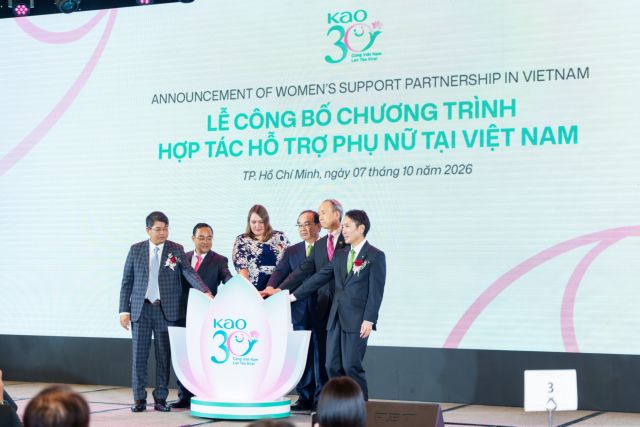
Japan-owned Kao Vietnam launches programme to improve women wokers’ reproductive health
1.
.jpg)
|
| Nguyễn Trọng Tường (centre) has spent years working alongside coffee farmers in a two-way learning journey, gaining insights from their experience while sharing practical knowledge to support their work. — Photo courtesy of ILO |
HÀ NỘI — Pruning coffee trees, carrying fertiliser, lifting sacks and transporting coffee from the farm to the home are all part of a coffee farmer’s routine.
Because they are done every season, these tasks can easily become second nature. But for Nguyễn Trọng Tường, they also raise a simple question: could they be done more safely?
Tường, an agricultural support officer with the NESCAFÉ Plan in Việt Nam, began asking that question more seriously in 2022, after taking part in training on the International Labour Organization (ILO)’s Work Improvement in Neighbourhood Development (WIND) approach.
The training gave him a different way of looking at the work he had seen farmers doing for years.
“It made me look again at things that seemed completely normal on a coffee farm and ask whether they could be improved,” Tường said.
WIND became part of the cooperation between the ILO and Nestlé under the Vision Zero Fund project in Việt Nam, which aims to improve occupational safety and health and working conditions in coffee-growing communities.
For Tường, learning did not end with the training course. He returned to learn from ILO experts and spent time studying the materials himself.
The challenge was then to make the knowledge useful to farmers.
“Technical terms are not always easy for farmers to apply in their daily work,” he said.
So, instead of simply presenting rules, Tường uses familiar situations from the farm as examples. He encourages farmers to look at their own working environment, identify risks and discuss what could be changed.
The timing of the training also matters.
Coffee farming follows a seasonal cycle, and different tasks bring different risks. During pruning season, Tường focuses on the safe use of tools and working at height. When the harvest begins, the focus shifts to lifting, carrying and transporting coffee.
The ILO’s WIND action checklist provides a framework for these discussions, covering practical improvements in cultivation, crop care, harvesting, transport, storage and processing.
Farmers are encouraged to decide for themselves what needs to be improved first and to put the changes into practice at their farms and homes.
They can then take 'before and after' photographs to record the results.
More than 2,000 improvements have been recorded so far. Some are simple, such as storing tools and materials more safely and neatly. Others involve improvements to electrical systems and working areas.
For Tường, the value lies not in the size of an individual change, but in whether it makes a difference to farmers’ daily lives.
“From one improvement, farmers can see what else can be changed,” he said.
The approach has also changed Tường’s own role. From a participant in the training, he has become a trainer himself, organising three WIND training courses for more than 150 farmers in three Central Highlands provinces.
It has been a two-way learning process. While sharing new knowledge with farmers, Tường has also learned from their practical experience of working on coffee farms.
As cooperation between the ILO and Nestlé continues, he is looking at other areas that could benefit farming communities, including first aid and social protection.
For Tường, the journey from learner to trainer is about more than passing on knowledge. It is about helping farmers recognise that small changes in familiar routines can make their work safer and healthier.
A single improvement on one farm may seem modest. But when similar changes spread across a community, they can gradually become part of everyday practice, making safety not an additional task but a normal part of coffee farming. — VNS
Economy
 Economy
 Economy
 Economy
 Economy
 Economy
 Economy
 Economy
 Economy
 Economy
 Economy
 Economy
 Economy
 Economy
 Economy