 Economy



HKSTP Partners with Leading Science and Technology Company Merck to Open a New Chapter in I&T Collaboration
1.
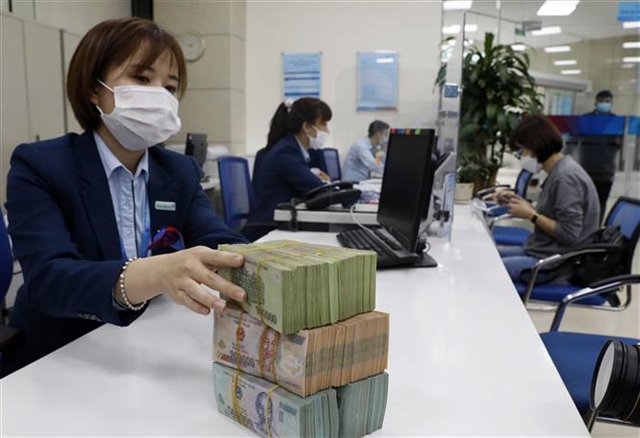 |
| A VietinBank staff member handles stacks of Vietnamese đồng banknotes at a transaction counter. — VNA/VNS Photo |
HÀ NỘI — Government bonds in major economies have come under heavy selling pressure in recent weeks, but Việt Nam’s bond market has remained relatively calm, largely because foreign investors play only a small role in it.
Yields on 10-year government bonds have climbed to multi-year highs in several major markets. Japan’s 10-year yield recently reached 3 per cent, its highest level since 1996, while the US 10-year Treasury yield has risen to about 4.8 per cent. UK and German government bond yields have also reached their highest levels in more than a decade.
In Việt Nam, the 10-year government bond yield stood at 4.43 per cent in early September, up about 0.4 percentage points from the beginning of the year. The increase is noticeable but has been far less dramatic than in some developed markets.
The market is largely protected by its domestic investor base, which holds most Vietnamese government bonds and limits the scope for sudden foreign selling.
“Việt Nam benefits from a large and relatively stable domestic investor base, which helps cushion the market from short-term international capital-flow volatility,” said Sana Ur Rehman, senior market analyst at EBC Financial Group.
At the end of last year, banks and insurers held 98.7 per cent of Việt Nam’s local-currency government debt at the end of 2025, with foreign ownership remaining marginal, according to the Asian Development Bank.
That share is far below those in several other emerging Asian markets, including Malaysia, Indonesia, Thailand and the Philippines.
The structure gives Việt Nam’s bond market a degree of protection when global investors rush to cut risk.
When bond yields rise sharply in major economies, international funds often reassess emerging-market holdings because safer assets, particularly US Treasuries, become more attractive. Some funds may also sell emerging-market bonds to reduce the average maturity of their portfolios.
Still exposed to global risks
But Việt Nam is not immune to global risks.
The global rise in borrowing costs is already beginning to affect the price at which Việt Nam can raise money. At a State Treasury auction on September 9, five-year bonds were sold at a yield of 4.26 per cent and 10-year bonds at 4.43 per cent. The 10-year yield was up from around 4.16 per cent at the end of April.
Demand remained strong enough for both offerings to be fully allocated, although there were no successful bids for three-year bonds and no bids for 15-year and 30-year bonds.
The results suggest investors are becoming more selective rather than abandoning the market.
Global yields affect Việt Nam mainly through the exchange rate, inflation and domestic interest rates. According to Rehman, when US Treasury yields rise, the US dollar can become more attractive, putting pressure on the đồng. If that pressure becomes strong, monetary authorities may need to manage liquidity or use foreign-exchange reserves, which can push domestic short-term rates higher.
Higher global yields also raise the return investors expect from other assets. For Vietnamese companies seeking foreign-currency loans, syndicated financing or international investment, the cost of capital can therefore rise even without a large-scale sale of domestic government bonds.
The effect is already more visible in the corporate bond market.
MB Securities Co estimates that corporate bond issuance reached about VNĐ322.3 trillion in the first seven months of 2026, up 2.7 per cent year-on-year, while the weighted average issuance rate rose to around 9.5 per cent, about 140 basis points higher than the beginning of the year.
Global demand for long-term capital is also rising, with five major US tech companies – Alphabet, Amazon, Meta, Microsoft and Oracle – issuing about US$220 billion in debt this year to fund data centres and AI infrastructure, according to LSEG data cited by Reuters. This is adding to competition for capital in emerging markets.
Việt Nam nevertheless enters this period with some advantages. Public debt was around 35-36 per cent of GDP at the end of last year, well below the statutory ceiling of 60 per cent. The country also has a large domestic institutional investor base, which provides relatively stable demand for government debt.
Rehman said a more liquid government bond futures market could give investors an additional tool to manage interest-rate risk and improve price discovery. While Việt Nam’s five-year and 10-year bond futures currently have no trading activity or open interest, he said such risk-management tools would become more important as the country develops a broader institutional investor base.
“Domestic demand provides an important foundation of stability for Việt Nam’s bond market," Rehman added.
"The next stage of development is to broaden the investor base and deepen the tools available for risk management, giving the market more channels through which to absorb volatility.” — VNS
Economy
 Economy
 Economy
 Economy
 Economy
 Economy
 Economy
 Economy
 Economy
 Economy
 Economy
 Economy
 Economy
 Economy
 Economy