 Economy



Vietnamese Prime Minister meets Cambodian National Assembly President
1.
|
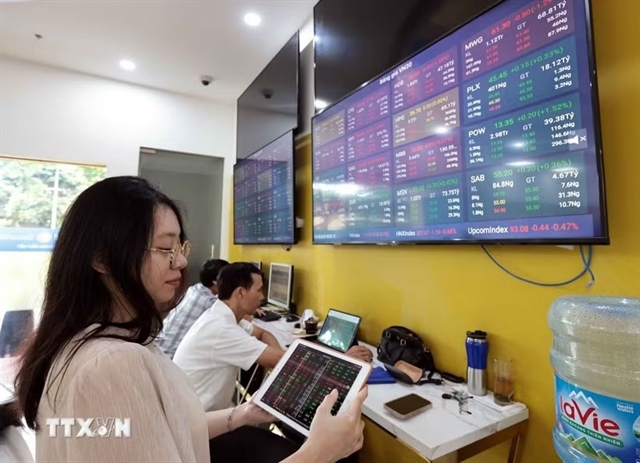
| Investors observe the market's performance in a trading room of a securities firm in Hà Nội. — VNA/VNS Photo |
HÀ NỘI — The expansion of Việt Nam's fund management industry and a larger institutional investor base are expected to play an increasingly important role in providing long-term capital as the stock market enters a new stage of development.
Nguyễn Công Minh, head of the State Securities Commission (SSC)'s Fund Management Companies and Securities Investment Funds Department, said digital technology, big data and artificial intelligence were increasingly changing how investors access information, analyse opportunities and manage investments.
In this environment, smart investing is not simply about pursuing returns but also requires better information, appropriate investment methods and effective risk management.
Investment funds, therefore, have an increasingly important role by giving investors access to professionally constructed and managed portfolios, backed by the research, analysis and risk-management capabilities of fund management companies, Minh said at recent conference organised by SSC.
Developing institutional investors is also part of broader financial-market reforms.
Việt Nam's comprehensive financial market reform scheme seeks to build a more sustainable investor base, prioritising institutional investors and gradually creating a better balance between institutional and individual participation, while modernising financial infrastructure, accelerating digital transformation and expanding the scale and liquidity of capital markets.
The country currently has 43 operating fund management companies and 142 securities investment funds, including 106 public funds.
Total assets under management (AUM) increased from around VNĐ124 trillion (US$4.8 billion) at the end of 2015 to more than VNĐ846 trillion by the end of June, representing a 6.8-fold increase and average annual growth of more than 20 per cent.
Despite the expansion, AUM is equivalent to only around 6 per cent of GDP, remaining well below levels in many regional and global markets.
Deputy Director of the Business Division at MB Capital Hà Anh Tùng said improvements in the stock market had been accompanied by increasing maturity among market participants.
Changes in investor awareness and behaviour provide favourable conditions for further development of the fund management industry, he said.
Given the industry's relatively small size compared with many emerging markets, together with improving investor awareness and rising demand for professional investment services, Tùng said its scale could gradually reach 15–20 per cent of GDP in the future.
Market upgrade opens new opportunities
Alongside the domestic fund industry's growth potential, Việt Nam's stock market upgrade is opening another channel for international capital.
Nguyễn Thị Hằng Nga, CEO of Vietcombank Fund Management (VCBF), said the significance of the upgrade lay first in international recognition of the quality and development of Việt Nam's market.
Meeting emerging-market criteria required Việt Nam to satisfy both quantitative and qualitative requirements, with the Government, Ministry of Finance and SSC implementing measures to address bottlenecks and gradually meet FTSE Russell standards.
According to Nga, Việt Nam could attract around $2 billion from investment funds. Foreign investors currently account for only around 10 per cent of the Vietnamese stock market.
Deeper inclusion in international indices could not only generate direct capital inflows but also put Việt Nam more prominently on the "radar" of global institutional investors, she said.
Greater international research coverage and assessment could, in turn, give Vietnamese companies more opportunities to access capital at reasonable costs.
However, Nga said attracting long-term capital following the upgrade would require improvements in the quality of listed investment opportunities.
Major equity indices remain heavily concentrated in banking, securities and real estate stocks.
For active funds, however, inclusion in an international index is not necessarily the determining factor in investment decisions.
Instead, active managers look for high-quality companies with sound governance and the ability to deliver sustainable growth.
This also distinguishes active investment flows from passive capital following the market upgrade. While passive funds allocate capital according to index weightings, active funds focus on the underlying quality of individual companies.
According to Nga, improving the quality and diversity of listed companies and raising corporate governance standards will therefore be important in attracting and retaining long-term investment capital. — BIZHUB/VNS
Economy
 Economy
 Economy
 Economy
 Economy
 Economy
 Economy
 Economy
 Economy
 Economy
 Economy
 Economy
 Economy
 Economy
 Economy