 Economy


Data centre market faces energy challenges
1.
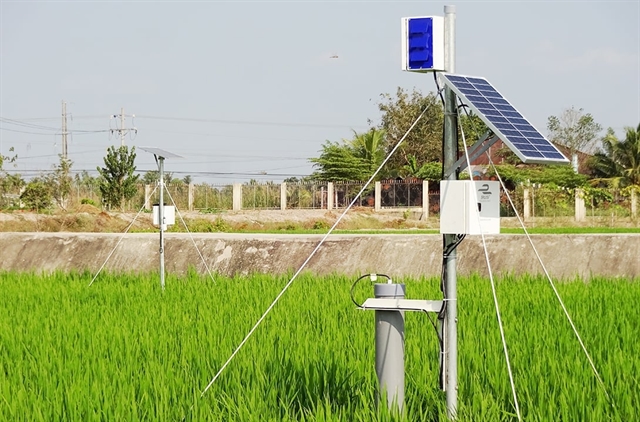 |
| A smart agricultural monitoring station equipped with solar-powered sensors is installed in a rice field in Bắc Ninh Province to collect real-time data for digital farm management. — VNA/VNS Photo |
BẮC NINH — Bắc Ninh Province will accelerate the application of science and technology and digital transformation in agriculture as it works towards building a smart, modern and sustainable farming sector, according to provincial authorities.
Vice Chairman of the provincial People's Committee Lê Xuân Lợi said the province aims to strengthen the use of advanced technologies across agricultural production, improve the quality of public services and state management, and enhance the productivity, quality and value of agricultural products.
Under the province's plan, all specialised agricultural databases are expected to be digitised and connected by 2030.
Production unit codes and packing facilities serving agricultural exports will also be managed on digital platforms.
The province targets more than 60 per cent of concentrated farming areas using electronic production diaries and digital traceability systems by the end of the decade.
More than 60 per cent of large-scale livestock farms are also expected to be integrated into the National Livestock Database.
Meanwhile, over 80 per cent of products under the One Commune, One Product (OCOP) programme will be promoted and sold through digital platforms, while all hi-tech, smart, circular and safe agricultural production models linked to value chains will be digitally managed.
To achieve these goals, Bắc Ninh will prioritise research, technology transfer and the application of artificial intelligence (AI), the Internet of Things (IoT), big data, blockchain, biotechnology, remote sensing, geographic information systems (GIS), drones, smart sensors, automation and robotics in agricultural production and management.
The province is encouraging enterprises, cooperatives and farmers to invest in technological innovation and adopt advanced production processes. It also plans to expand hi-tech, smart, precision, organic and low-emission farming models while developing concentrated production areas connected with agricultural value chains.
In crop production, authorities will promote the development and application of high-yield, high-quality crop varieties that are resistant to pests and better adapted to climate change.
Biotechnology will be expanded in plant breeding and propagation, while smart irrigation systems, precision fertiliser application, drones, AI and IoT will be used to improve crop management and pest control.
The province will also continue developing digital databases for crops, pests, production unit codes and export packing facilities, alongside electronic production diaries and digital production maps to support management and product traceability.
In livestock and aquaculture, Bắc Ninh plans to build integrated digital databases covering farms, livestock populations, breeding facilities, slaughterhouses, disease-free zones and aquaculture areas.
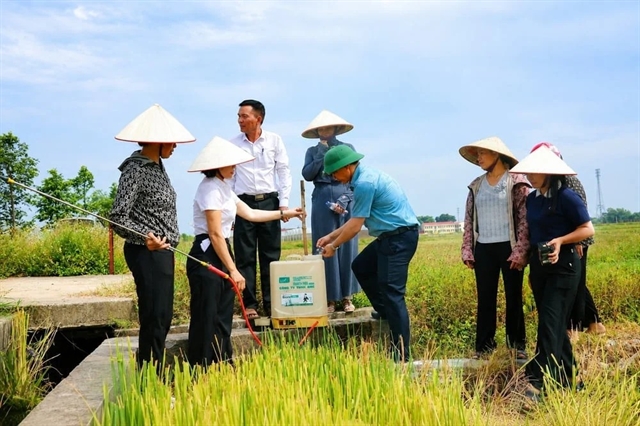 |
| Farmers are trained to use biological products to treat rice straw and improve soil fertility. — Photo nongnghiepmoitruong.vn |
AI, IoT and automated sensors will be deployed to monitor animal health, disease outbreaks, food safety and environmental conditions, while providing early warnings of epidemic and pollution risks.
The programme also covers expanding smart livestock farming, circular farming and hi-tech aquaculture, together with greater use of digital technologies in animal quarantine, slaughterhouse inspection and product traceability.
The provincial programme supports the implementation of Politburo Resolution No. 57-NQ/TW, issued in December 2024, which identifies science, technology, innovation and national digital transformation as strategic drivers of Việt Nam's long-term socio-economic development.
Among its priorities, the resolution calls for wider adoption of digital technologies, AI, IoT, big data and smart production across key economic sectors, including agriculture.
According to the provincial Department of Agriculture and Environment, agricultural production remained on schedule during the week of August 17–22.
Early-season rice, accounting for 27.3 per cent of the cultivated area, was at the heading and flowering stage, while the main crop, covering 67.4 per cent, had reached stem elongation and panicle initiation. Late-season rice, representing 5.3 per cent of the area, remained in the tillering stage.
Fruit growers have also benefited from favourable market conditions. Longan, cultivated on 3,550 hectares, is expected to produce about 21,000 tonnes this year.
Around 9,700 tonnes have been harvested, with prices ranging from VNĐ20,000-30,000 (US$0.76-1.14) per kilogram, up VNĐ15,000-20,000 from the same period last year.
Custard apple production, covering 2,100 hectares, is estimated at 16,000 tonnes, of which 6,850 tonnes have been harvested. Prices range between VNĐ20,000 and VNĐ50,000 ($0.76-1.9) per kilogram.
Guava production is expected to reach 8,800 tonnes from 1,028 hectares. About 5,100 tonnes have been harvested and are selling for VNĐ15,000-20,000 (US$0.57-0.76) per kilogram.
The livestock sector has produced 270,000 tonnes of live-weight meat so far this year, equivalent to 68.3 per cent of the annual target.
Live hog prices currently range from VNĐ53,000 to VNĐ58,000 ($2.02-2.21) per kilogram, while commercial chickens are selling for VNĐ50,000-65,000 ($1.90-2.47) per kilogram. Ducks are priced at about VNĐ46,000 ($1.75) per kilogram and Muscovy ducks at VNĐ66,000 ($2.51) per kilogram.
Commercial fish production has reached 68,871 tonnes, equivalent to 68.8 per cent of the province's annual target. — VNS
Economy
 Economy
 Economy
 Economy
 Economy
 Economy
 Economy
 Economy
 Economy
 Economy
 Economy
 Economy
 Economy
 Economy
 Economy