 Economy

Vietnam Post harnesses technology to transform postal-logistics network
1.
|
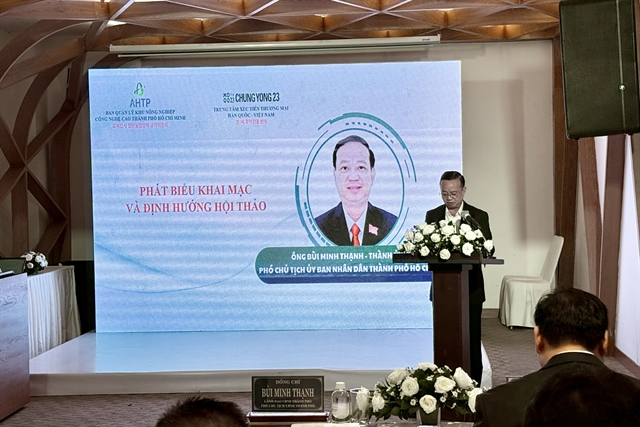
| Bùi Minh Thạnh, Vice Chairman of the HCM City People’s Committee, speaks at the conference. — VNS Photo |
HCM CITY — HCM City is shifting from conventional agricultural production towards an urban agricultural economy, with science and technology, innovation and commercialisation identified as key drivers for generating greater value from increasingly limited land, a conference in the city heard on August 28.
Speaking at the international conference “Connecting the High-Tech Agriculture Value Chain: From Technology to Commercialisation and Investment Attraction”, Bùi Minh Thạnh, deputy chairman of the HCM City People’s Committee, said the city was renewing its growth model and moving towards a modern, green, smart and sustainable urban area.
“The Law on Urban Development, passed by the National Assembly on August 24, 2026 and taking effect on October 1, 2026, provides an important legal foundation for this development direction. Under this approach, urban agriculture is not viewed as a residual part of the city, but as an integral component of a modern urban ecosystem,” Thạnh said.
The city aims to develop an urban agricultural economy focused on high value, advanced technology, low emissions and efficient resource use, while linking production with processing, logistics, trade, ecotourism and international markets.
Thạnh outlined four priorities for the sector.
First, science, technology and innovation should become key drivers, with greater application of biotechnology, automation, artificial intelligence (AI), data, precision agriculture and post-harvest technologies.
However, he stressed that technology should not be pursued for its own sake.
“Technology must create better products, more competitive costs and broader markets,” he said.
Second, the city needs to narrow the gap between research and commercialisation. The Agricultural High-Tech Park of HCM City (AHTP) should serve as a hub connecting scientists, research institutes, universities, businesses, investors and markets.
Third, high-tech agriculture must be integrated into green urban development, linking agriculture with urban planning, infrastructure, logistics, processing, green spaces, the circular economy and climate-change adaptation.
Fourth, HCM City needs to strengthen international cooperation and attract investment, particularly from South Korea, moving beyond simple technology transfer towards joint research, investment, commercialisation and market expansion.
He called on the AHTP management board and relevant departments to develop a list of promising technologies, products and projects and proactively connect them with domestic and international businesses and investors.
“The city is not only calling for investment in individual projects, but wants to work with investors to build a high-tech agricultural ecosystem where technology is put into production, products reach the market and value is created in the city,” he said.
Nguyễn Thanh Hiền, deputy head of the AHTP management board, said high-tech agricultural zones should become “strategic infrastructure for the city’s high-tech agriculture and innovation ecosystem”.
They should serve not only as production sites but also as hubs connecting government agencies, research institutes, universities, businesses, farmers and markets, while supporting technology development, testing, commercialisation, training and agricultural data management.
Given differences in land, ecosystems, water resources, infrastructure and agricultural strengths following the city’s expansion, Hiền proposed a “network of specialised zones linked by technology, data and value chains” rather than a single multi-sector zone.
The existing high-tech agricultural park in Nhuận Đức Commune would remain a hub for research, demonstration and technology transfer, while new zones could specialise in particular sectors.
By 2030, the city aims to establish a regional high-tech agricultural ecosystem spanning technology development, business incubation, training, production, commercialisation, market access and reinvestment in research and innovation, Hiền said.
|
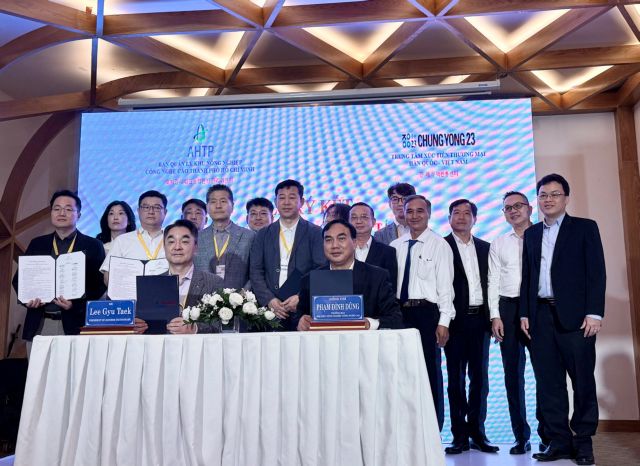
| The Agricultural High-Tech Park of HCM City’s management board and its partners sign memoranda of understanding at the conference. — VNS Photo |
As part of the conference, the AHTP management board and its partners also signed memoranda of understanding to expand cooperation and investment programmes in the coming period.
South Korea proposes joint development
Gyu Taek Lee, president of Jeonbuk Techno Park, said South Korea’s high-tech agriculture began with research into greenhouse automation and standardisation in the 1980s.
Technologies for controlling temperature, humidity, water and nutrients were later combined with sensors, information and communications technology (ICT), big data and AI to create today’s smart farms.
According to Lee, an important lesson is that technology should not remain in the laboratory, but should be developed into practical models that can be widely adopted and transferred to farmers.
For HCM City, he said: “Rather than expanding agricultural land, HCM City should focus on urban high-tech agriculture, which means generating greater value from limited space. Above all, instead of applying South Korean or European technologies as they are, we need to adapt and improve them to suit Việt Nam’s hot and humid climate and its specific crops.”
Financial resources are also needed to support initial investment in infrastructure and equipment, while a skilled workforce is required to operate and repair equipment on site. Other priorities include quality certification systems, cold-chain supply chains, processing capacity and stable market outlets for agricultural products, he said.
Lee proposed moving Việt Nam–South Korea cooperation beyond a model in which South Korea sells equipment and Việt Nam buys it, towards joint research and development.
The two sides could establish pilot farms in HCM City to test Korean technologies, including sensors, environmental controls and AI, under local conditions. Proven technologies could then be manufactured in Việt Nam in collaboration with Vietnamese businesses, while the two sides jointly train personnel in operation and maintenance.
In the longer term, they could develop joint brands and distribution networks to serve the Vietnamese market and expand into ASEAN markets, he added. — VNS
Economy
 Economy
 Economy
 Economy
 Economy
 Economy
 Economy
 Economy
 Economy
 Economy
 Economy
 Economy
 Economy
 Economy