 Economy
SBV to curb property price inflation, enforce lending rate rules
1.
|
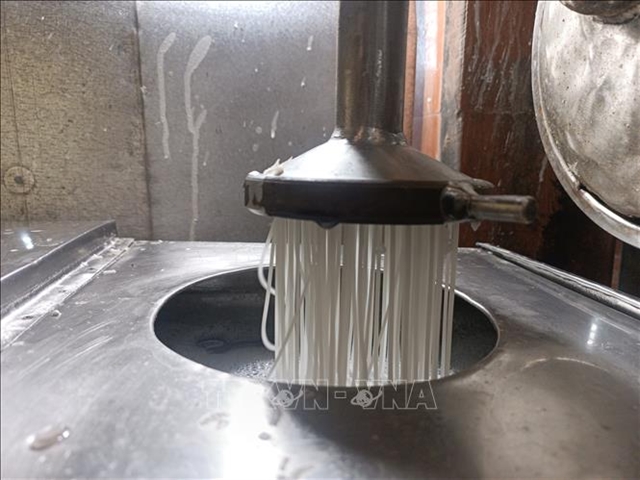
| Machinery replaces manual methods to produce Vân Cù rice noodles with more even thickness and a better look. — VNA/VNS Photo |
HÀ NỘI — The central city of Huế is accelerating the implementation of the Politburo's Resolution No. 57-NQ/TW by developing a digital ecosystem that strengthens collaboration among government agencies, research institutions, universities and businesses.
The move is part of efforts to turn science, technology, innovation and digital transformation into new drivers of socio-economic development.
Local authorities believe that effectively connecting the three pillars of the State, scientists and enterprises will help bring research outcomes into practical application, commercialise new technologies and address development challenges facing the city.
The story of Vân Cù noodle village in Kim Trà Ward illustrates both the opportunities and challenges facing traditional industries as Huế advances its innovation agenda.
The village is home to around 160 households engaged in noodle production and trading, creating stable employment for approximately 400 workers. The centuries-old craft has been preserved through generations under a family-based production model.
However, the industry is confronting mounting challenges.
Workers under the age of 40 account for only about 30 per cent of the village's workforce, reflecting declining interest among younger generations in traditional occupations.
Without measures to improve incomes and enhance the attractiveness of the profession, the village could face a shortage of skilled successors.
Production also remains fragmented. Manufacturing processes have yet to be standardised through scientific research, resulting in inconsistent product quality among households and limiting opportunities for scaling up production.
Although existing facilities are capable of producing significantly higher volumes, only about half of their capacity is currently being utilised.
Châu Viết Thành, secretary of the Party Committee of Kim Trà Ward, said one of the biggest obstacles is the product's short shelf life of only around 24 hours, making it difficult to expand into wider markets.
"Scientists are expected to help extend the shelf life of Vân Cù noodles while preserving their traditional taste and ensuring absolute food safety," Thành said.
He also called for research to standardise production processes and develop technical standards covering raw materials, water quality and food hygiene.
Beyond production technology, the ward hopes to work with researchers to digitise the entire value chain of the traditional craft village.
"We hope every Vân Cù noodle product will carry a QR code so consumers can trace its origin and learn the cultural story behind the product," he added.
Three-party cooperation
Experiences from Vân Cù underscore the importance of building an effective mechanism linking government agencies, scientists and businesses, a model that Huế considers central to implementing Resolution No. 57.
Associate Professor Trương Tấn Quân, rector of the University of Economics under Huế University, said the resolution has fundamentally reshaped the governance model for science and technology.
"The partnership among businesses, scientists and the State is the key to bringing science and technology into practice, transferring research outcomes to enterprises and commercialising innovations," Quân said.
He added that such collaboration would enable science, technology and innovation to generate tangible socio-economic benefits rather than remaining confined to laboratories.
Đặng Thanh Phú, vice chairman of the Huế Union of Science and Technology Associations, noted that the city has consistently ranked among Việt Nam's leading localities in digital transformation.
He highlighted Hue-S, the city's integrated digital platform, as an example of digital infrastructure supporting public services, citizen engagement and interaction among government agencies, businesses and residents.
"When the two-tier local government model came into operation, the digital infrastructure that had already been built enabled Huế to adapt quickly. This demonstrates that the city's digital foundation has reached a certain level of maturity," Phú said.
He proposed leveraging Hue-S to establish a digital platform matching technology supply with market demand.
"Businesses could post technological challenges, scientists could propose solutions and government agencies could publish support policies. The 'three-party' model can only create broad impact when micro-enterprises, cooperatives and traditional craft villages, those with the weakest technological capacity, are able to participate effectively," he said. — VNS
Economy
 Economy
 Economy
 Economy
 Economy
 Economy
.jpg) Economy
Economy
 Economy
 Economy
 Economy
 Economy
 Economy
 Economy
 Economy
.jpeg) Economy
Economy