 Economy


Data centre market faces energy challenges
1.
.jpg)
|
| Panel discussion on air pollution control and greenhouse gas emissions reduction held within the framework of the National Environment and Climate Forum 2026. — Photos courtesy of organisers. |
HÀ NỘI — As Việt Nam accelerates efforts to achieve its net-zero emissions target by 2050, dairy producer Vinamilk has emerged as one of the businesses leading the transition toward low-carbon growth through long-term investments in sustainable development.
Vinamilk was the only dairy company invited to participate in a panel discussion on greenhouse gas emissions reduction at the National Environment and Climate Forum 2026, held under the theme 'From Policy to Action'.
The forum was jointly organised by the Ministry of Agriculture and Environment and the People’s Committee of Nghệ An Province in response to World Environment Day (June 5), World Oceans Day (June 8), the National Month of Action for the Environment and Việt Nam Sea and Islands Week 2026.
As a national-level policy dialogue platform, the forum brought together policymakers, experts and businesses to discuss practical solutions for environmental protection and climate change response in the country’s next stage of development.
Speaking at the event, Nguyễn Tuấn Quang, deputy director general of the Department of Climate Change under the Ministry of Agriculture and Environment, said Việt Nam’s commitment to achieving net-zero emissions by 2050 is being translated into action through an increasingly comprehensive legal framework and concrete projects at both central and local levels.
Alongside Government agencies and local authorities, many businesses have proactively carried out greenhouse gas inventories, developed emissions reduction plans and implemented mitigation measures.
Among the enterprises highlighted at the forum was Vinamilk, which has established a roadmap towards net-zero emissions by 2050 and joined the Science Based Targets initiative (SBTi).
The company’s emissions reduction targets are aligned with SBTi methodologies and international standards, covering both near-term goals and long-term net-zero commitments.
“Vinamilk’s net-zero target is now publicly available on the SBTi website,said Lê Hoàng Minh, executive director of Production and head of Vinamilk’s net zero project.
"Participation in the initiative helps us set scientifically grounded emissions reduction targets and align our actions with international best practices.”

|
| Lê Hoàng Minh, executive director of Production and head of Vinamilk’s net zero project, speaks at the forum. |
As part of this journey, Vinamilk has become one of the first companies in Việt Nam to have operational units certified carbon neutral under ISO 14068-1 for Scope 1 and Scope 2 emissions. Notably, its first carbon-neutral factory and dairy farm are located in Nghệ An Province, the host of this year’s forum.
From measurement to reduction: a data-driven approach
Việt Nam is preparing to pilot a domestic carbon trading exchange this month as part of broader efforts to manage national emissions while encouraging businesses to invest in cleaner technologies and low-carbon production models.
Currently, 2,166 facilities are required to report greenhouse gas emissions, with emissions quotas already allocated to the 110 largest emitters, accounting for around 40 per cent of the country’s direct emissions.
Guided by the principle that 'what cannot be measured cannot be managed', Vinamilk began conducting greenhouse gas inventories several years ago. The company’s factories and farms now regularly monitor emissions, enabling it to identify key emissions sources and develop targeted reduction measures rather than relying solely on qualitative commitments.
This approach aligns with the direction set out in the Law on Environmental Protection 2020 and Decree No. 06/2022/NĐ-CP, which provide the foundation for greenhouse gas inventories, emissions reduction activities and the development of a domestic carbon market.
“Taking proactive steps and staying ahead of regulatory requirements allows Vinamilk not only to reduce pressure when emissions quotas and carbon trading mechanisms come into operation, but also to capture opportunities for cost optimisation throughout the transition process,” Minh said.
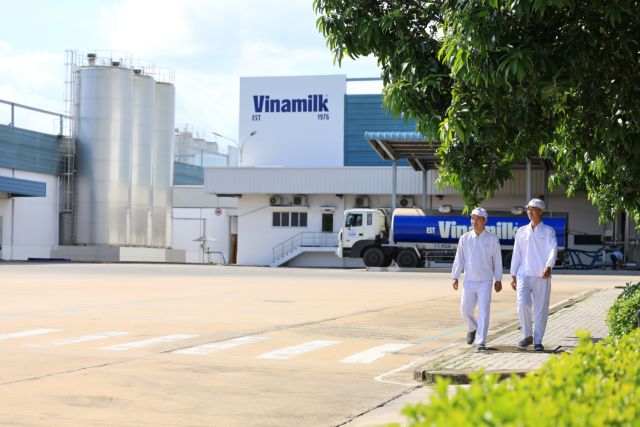
|
| Vinamilk’s network of dairy farms and factories is implementing greenhouse gas inventories to identify major emissions sources. — Photo courtesy of Vinamilk |
According to Minh, many emissions reduction initiatives also deliver tangible operational savings through lower energy and material consumption.
For example, four automated smart warehouses have helped reduce emissions by nearly 1,900 tonnes of CO₂ annually while cutting energy consumption by 70 per cent compared with diesel-powered systems and conventional warehouse management methods.
The use of solar energy to provide hot water for farm sanitation processes avoids approximately 278 tonnes of CO₂ equivalent emissions each year while reducing electricity costs.
Meanwhile, packaging optimisation initiatives – including reducing the thickness of Probi drinking yoghurt bottles, redesigning plastic straws and switching export yoghurt products to easier-to-use caps – have cut around 135 tonnes of CO₂ equivalent emissions while reducing the use of virgin plastic by 48 tonnes.
“Each solution may appear modest on its own, but together they generate significant environmental and economic benefits," Minh said.
"More importantly, they help create momentum for the business community to work alongside the Government in achieving Việt Nam’s net-zero target by 2050.” — VNS
Economy
 Economy
 Economy
 Economy
 Economy
 Economy
 Economy
 Economy
 Economy
 Economy
 Economy
 Economy
 Economy
 Economy
 Economy