 Economy


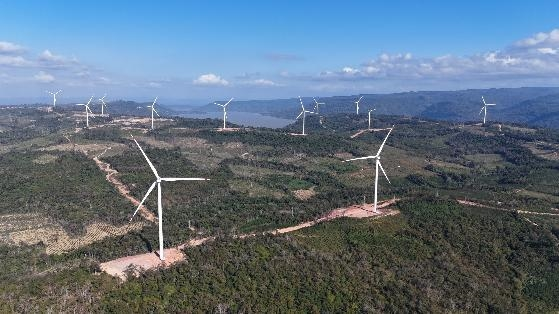
T&T Group to develop $768 million wind power project in Laos
1.
 |
| Vietcombank headquarters in Hà Nội. Bank credit has reached around 145 per cent of GDP, putting pressure on the banking system. — VNA/VNS Photo |
HÀ NỘI — Việt Nam’s push for double-digit growth is exposing deep structural strains in a credit-heavy economy, intensifying calls to expand capital markets and improve investment efficiency.
Bank credit has reached around 145 per cent of GDP, placing growing pressure on the banking system and heightening financial stability risks, even as capital demand surges.
According to estimates presented by the Ministry of Finance at the National Assembly, total investment needs for the 2026-30 period are estimated at VNĐ38.5 quadrillion (US$1.5 trillion), while the State budget can cover only about 20 per cent, leaving the bulk to be mobilised from the private sector.
The strain is increasingly visible in the structure of the financial system. Banks, traditionally designed to provide short-term funding, are financing a growing share of medium- and long-term projects, creating maturity mismatches and liquidity risks. Around 40 per cent of total outstanding loans fall into this category, equivalent to roughly 60 per cent of GDP.
Data from the State Bank of Vietnam also shows a widening imbalance between credit growth and deposit mobilisation. By the end of 2025, credit had risen by 19.01 per cent, compared with deposit growth of 14.11 per cent. The gap widened further in the first quarter of 2026, with credit up 2.15 per cent against deposit growth of just 0.44 per cent.
Economists say the imbalance highlights an underdeveloped capital market.
According to Nguyễn Bá Hùng, chief economist at the Asian Development Bank in Việt Nam, the gap between bank credit and the corporate bond market is “unreasonable”.
In more advanced economies, bond markets play a central role in supplying long-term capital and reducing risks for commercial banks.
In Việt Nam, the corporate bond market accounts for only about 10 per cent of GDP, far below levels seen in developed markets.
Against this backdrop, policymakers have warned that current credit policies could further constrain growth if not adjusted.
Trịnh Xuân An, a National Assembly deputy from Đồng Nai City, said strict credit caps could become a bottleneck to expansion.
“If credit growth is capped at around 15 per cent, it will be very difficult to create sufficient room for GDP growth of 10 per cent or more,” An said.
He called for a more flexible approach, including selectively raising credit limits for banks with strong asset quality and low non-performing loan ratios, to better channel capital into productive sectors.
While short-term adjustments to credit policy may ease pressure, experts said long-term solutions would lie in diversifying funding sources.
FiinGroup Chairman Nguyễn Quang Thuân said Việt Nam could unlock substantial long-term capital if reforms are implemented decisively.
He pointed to a potential upgrade of the country’s stock market from frontier to emerging status as a key catalyst, which could attract stronger inflows from foreign institutional investors through IPOs and mergers and acquisitions.
“This is real, long-term capital that the economy is in need of,” Thuân was quoted as saying on vnbusiness.vn.
Investment efficiency
Beyond financial reforms, policymakers are also looking to unlock idle domestic resources.
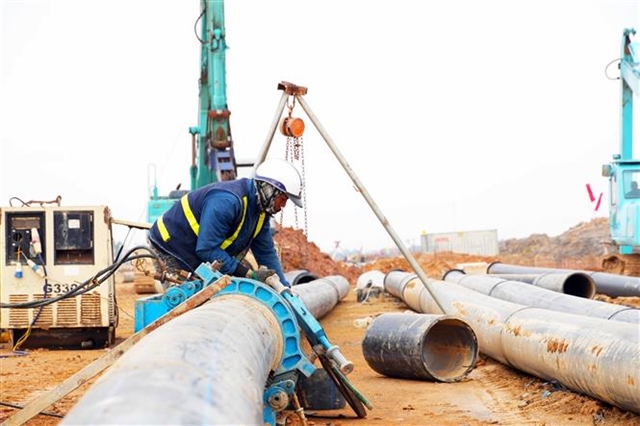 |
| Workers install infrastructure at the VSIP Industrial Park in Hà Tĩnh Province. Officials say improving the incremental capital-output ratio (ICOR) could boost capital supply and support growth. — VNA/VNS Photo |
An estimated VNĐ3.3 quadrillion ($127 billion) tied up in stalled projects and unused land could be mobilised, nearly three times the planned public investment for 2026.
Officials said resolving these bottlenecks would provide an immediate boost to capital supply and support growth.
Improving investment efficiency is another key priority.
Minister of Finance Ngô Văn Tuấn said that without improvements in the incremental capital-output ratio (ICOR), total social investment would need to rise to as much as 70 per cent of GDP to sustain double-digit growth.
“This is not a sustainable path,” he said, adding that bringing ICOR down to under 4.5 would be essential.
However, he noted that even this target would remain relatively high compared to other Asian economies during their rapid growth phases, such as China (2.7), Japan (3.2) and South Korea (3).
As Việt Nam aims to become a high-income economy by 2045, analysts say the transition from a bank-dependent system to a more balanced financial model – supported by deeper capital markets and more efficient investment – will be critical. — BIZHUB/VNS
Economy
 Economy
 Economy
 Economy
 Economy
 Economy
 Economy
 Economy
 Economy
 Economy
 Economy
 Economy
 Economy
.jpg) Economy
Economy
.jpg) Economy
Economy