 Economy


European higher education week opens new opportunities
1.
|
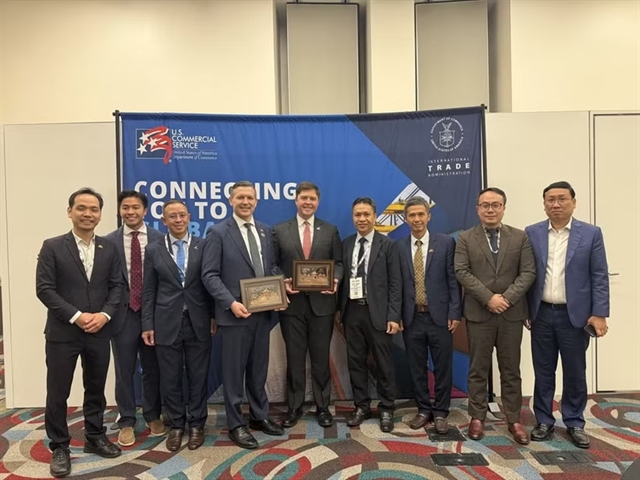
| The Vietnamese delegation and senior US officials at their meeting. — Photo Ministry of Industry and Trade |
HÀ NỘI — A Vietnamese delegation has held a working session with senior US officials on the sidelines of the Offshore Technology Conference in Houston to explore opportunities for US energy investments in Việt Nam and discuss trade and investment policy issues, the Ministry of Industry and Trade said.
The US side, led by Deputy Assistant Secretary for the US Commercial Service Bradley A. McKinney and Assistant Secretary for the US Department of Energy Kyle Haustveit, along with representatives from trade and energy agencies, underscored the US Commercial Service’s role in supporting international market access and signalled it would act as a bridge to draw US firms deeper into Việt Nam’s energy sector.
Priorities include liquefied natural gas (LNG), gas-fired power, import infrastructure and the supply of equipment, technical services and integrated technological solutions.
They also affirmed the readiness to deploy the full US business ecosystem and financial support tools to meet Việt Nam’s energy development needs.
Việt Nam laid out its growing energy demand, highlighting the urgent need to to lock in supply amid fast economic growth, which surpassed 8 per cent in 2025, and surging electricity consumption.
The country is fast-tracking energy infrastructure development, targeting an additional 22.5 gigawatts of LNG-to-power capacity by 2030, with annual LNG imports expected to top 18 million tonnes.
LNG is viewed as a critical transition fuel to gradually reduce dependence on coal and underpin a sustainable energy transition.
On concrete cooperation, the Vietnamese delegation provided updates on recent engagements between the State-run Vietnam National Industry – Energy Group (Petrovietnam) and its subsidiaries with US partners.
Several memoranda of understanding have been signed or are under discussion with major US energy groups, including Cheniere Energy, ExxonMobil, ConocoPhillips and Excelerate Energy, particularly in LNG supply and gas value chain development.
The delegation also met with consulting firm McKinsey to explore technical and financial solutions for large-scale energy projects and discussed cooperation with industrial groups like GE Vernova, particularly in power generation technology and energy equipment.
In the oil and gas sector, Việt Nam noted that its two refineries, with a combined processing capacity of around 350,000 barrels per day, are diversifying crude sources.
The US is considered a potential supplier alongside traditional Middle Eastern and other sources. Vietnamese companies have already signed contracts to import crude oil and petrochemical feedstocks such as ethane from US partners, with annual values reaching hundreds of millions of US dollars.
The US side also devoted time to bilateral trade policy, underscoring the importance of concluding a comprehensive reciprocal trade agreement as a foundation to expand economic and trade ties, including in energy.
It welcomed Việt Nam’s moves to open its market and steeply cut import tariffs on US goods, with many energy-related products now entitled to near-zero duties, and encouraged further commitments to help address the US trade deficit and move toward a more balanced trade relationship.
US representatives noted that recent tariff measures are subject to adjustment, with more favourable treatment expected for partners that demonstrate cooperation goodwill and work to increase imports from the US.
On financing, the US introduced mechanisms such as the Export-Import Bank of the United States (EXIM Bank) and energy export financing schemes, particularly for LNG and energy infrastructure.
Việt Nam was encouraged to tap these instruments to lower capital costs, improve project feasibility, and bring in more US companies.
Highly valuing US businesses' capabilities, Việt Nam also raised several challenges.
Notably, higher costs and logistical constraints tied to geographical distance make US energy supplies less competitive in the short term compared with other sources. The delegation expressed hope that the US could offer more competitive financial solutions, including export credits, guarantees and risk-sharing mechanisms.
Citing the recently established Comprehensive Strategic Partnership, Việt Nam suggested the US consider recalibrating its approach to reflect the current level of trust and cooperation, thus facilitating more substantive joint projects, especially in hi-tech and high-value-added sectors.
Both sides agreed that Việt Nam – US energy collaboration holds ample potential and could become a crucial pillar of economic ties.
The US reaffirmed its commitment to supporting business connections, spurring investment and delivering integrated solutions for energy projects in Việt Nam.
Việt Nam, in turn, pledged to continue improving its investment climate, create supportive conditions for US firms, and advance long-term contract negotiations to secure a stable and sustainable energy supply. — VNA/VNS
Economy
 Economy
 Economy
 Economy
 Economy
 Economy
 Economy
 Economy
 Economy
 Economy
 Economy
 Economy
 Economy
 Economy
 Economy