 Economy


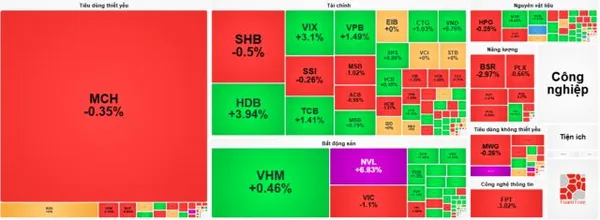
VN-Index ends lower despite liquidity hit over $1 billion
1.
|
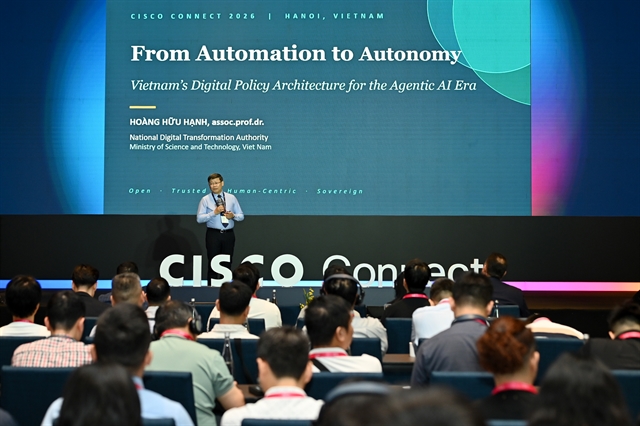
| Hoàng Hữu Hạnh, deputy director of the National Agency for Digital Transformation under the Ministry of Science and Technology, delivering a speech at the event. — Photo courtesy of Cisco |
HÀ NỘI — Cisco has unveiled its vision to serve as the critical infrastructure backbone for the AI era at the event Cisco Connect Vietnam held in Hà Nội on Tuesday.
AI has the potential to contribute up to US$130 billion to Việt Nam’s GDP by 2040. However, realising this opportunity will require overcoming key challenges, including infrastructure bottlenecks like data silos and fragmented governance, as well as a shortage of skilled talent.
Currently, 62 per cent of Vietnamese organisations risk losing value from their AI investments due to 'AI infrastructure debt', the accumulation of shortcuts, gaps and compromises that arise when companies deploy AI without a robust foundation.
Cisco showcased its latest innovations designed to address these challenges, including Cisco Unified Edge, its AI-ready secure network architecture, and the Silicon One G300 chip, which powers gigawatt-scale AI clusters. By expanding its partnership with NVIDIA on the Secure AI Factory architecture and implementing Zero Trust Access for AI agents, Cisco is helping businesses deploy AI with a strong foundation of trust and resilience.
“Việt Nam is at a pivotal moment,” said Hoàng Hữu Hạnh, deputy director of the National Agency for Digital Transformation under the Ministry of Science and Technology.
“As businesses move from experimentation to real-world AI applications, security and governance become critical. We are developing the national infrastructure needed to scale this vision and look forward to working with partners like Cisco to position Việt Nam as a regional AI hub within the next four years,” he added.
Cisco is also working closely with organisations across Việt Nam to modernise digital infrastructure and support practical AI applications.
At Phương Đông Hospital, a partnership with Cisco has enabled the development of a secure digital foundation using Cisco Meraki, ensuring uninterrupted operations with 95 per cent network uptime and 24/7 secure access to critical medical records, allowing medical teams to focus on delivering high-quality patient care.
Meanwhile, Viettel has built on its decade-long collaboration with Cisco by leveraging innovations, such as the Cisco 8000 Series routers, to expand network capacity and deliver the secure connectivity required for AI and 5G adoption.
In Hà Nội, Cisco’s 5G Routed Optical Networking Lab is providing a space for telecom operators and enterprises to experiment with next-generation networking technologies critical to the AI era, with early users already testing interoperability, refining AI use cases and accelerating their network transformation.
“The path to AI readiness begins with the network,” said Dzung Nguyen Nhu, Managing Director of Cisco Vietnam, Cambodia and Laos.
“Over the past year, Cisco has worked closely with Vietnamese enterprises to modernise infrastructure for the agentic AI era. Our vision is to provide the secure, critical foundation that enables the country to unlock its full potential and empowers organisations to adopt AI with confidence.”
Beyond technology, Cisco continues to invest in Việt Nam’s long-term digital development through its Country Digital Acceleration programme. The Cisco Networking Academy has also trained more than 160,000 students across Việt Nam in AI, cybersecurity and networking, helping to build a workforce ready to lead in the digital economy. — VNS
Economy
 Economy
 Economy
 Economy
 Economy
 Economy
 Economy
 Economy
 Economy
 Economy
 Economy
 Economy
 Economy
 Economy
 Economy