 Economy



LANDMARK Launches ‘Destination CENTRAL’: A District-Wide Invitation to Explore the Dynamism, Luxury, and Soul of Central
1.
|
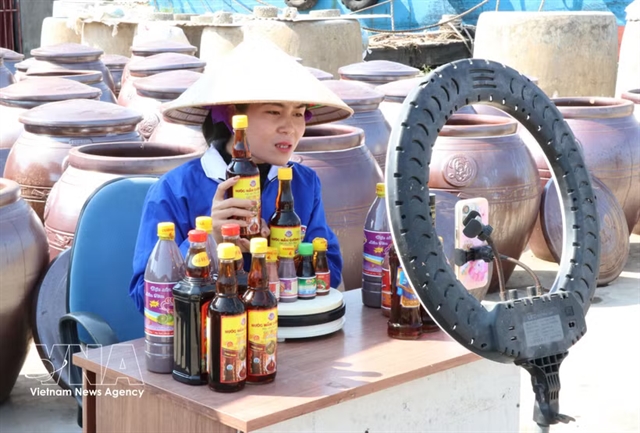
| A livestream sales session on an e-commerce platform by the Cường Là Co., Ltd. in Hải Thịnh commune, Ninh Bình province. — VNA/VNS Photo |
HÀ NỘI — Digital transformation is emerging as a key driver helping OCOP (One Commune, One Product) stakeholders optimise value and expand development space.
From enhancing transparency in production processes to boosting sales on digital platforms, technology is not only reshaping traditional business models but also promoting a shift in the rural economy toward sustainable value-chain linkages.
After more than a decade farming snakehead fish, Hồ Thị Xuân Mai, owner of the Ngọc Nhi dried fish facility in Bình Hòa Commune, southern An Giang Province, has successfully upgraded her products to meet three-star OCOP standards in 2024.
She has diversified offerings, including semi-dried and shredded fish, priced at around VNĐ 200,000–250,000 (US$7.6–9.5) per kilo. By selling on e-commerce platforms such as Shopee and TikTok Shop, her facility now distributes nearly one tonne of products monthly and provides jobs for dozens of local workers.
Similarly, in Nam Lý Commune of northern Ninh Bình Province, braised fish producers are leveraging Facebook, Zalo and TikTok to expand their market. A TikTok channel operated by Trần Thị Thu Hường has attracted more than 94,000 followers, with some videos reaching millions of views, helping boost monthly sales to about 1,500 clay pots.
As of mid-April 2026, Việt Nam had more than 20,000 OCOP products rated three stars or above, including 126 five-star products, according to the Ministry of Agriculture and Environment.
Deputy Minister of Agriculture and Environment Trần Thành Nam said digital technology not only supports promotion but also enhances product value through traceability systems and market data, helping producers build trust and better meet consumer demand.
Digital transformation is also creating more equal market access for rural and remote communities. With basic digital skills and smart devices, local products can reach wider domestic and international markets while increasingly serving as cultural ambassadors representing Việt Nam’s identity.
The ministry is drafting new OCOP criteria with higher quality requirements and reformed evaluation methodology to give a stronger boost to the OCOP programme during 2026–35. — VNA/VNS
Economy
 Economy
 Economy
 Economy
 Economy
 Economy
 Economy
 Economy
 Economy
 Economy
 Economy
 Economy
 Economy
 Economy
 Economy