 Economy



Hoàn Kiếm Lake abuzz as capital marks 72nd Liberation Day anniversary
1.
|
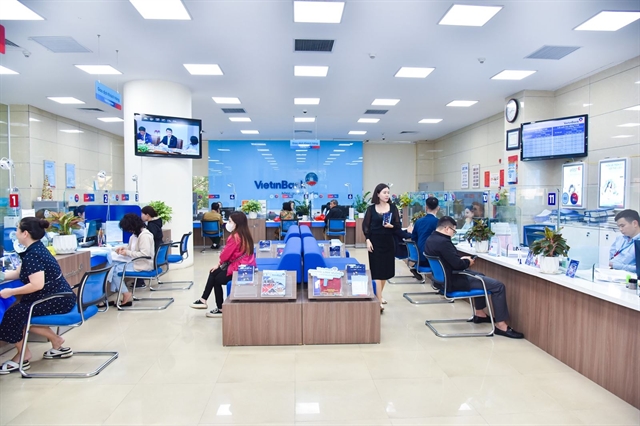
| Customers at a transaction office of Vietinbank. — Photo courtesy of the bank |
HÀ NỘI — Capital raising plans worth tens of trillions of đồng and long-term transformation strategies dominated discussions at the annual general meetings of Việt Nam’s three largest state-controlled banks on April 24.
Vietcombank, VietinBank and BIDV, institutions that collectively hold assets in quadrillions of đồng and play a central role in the financial system, all presented shareholders with proposals centred on charter capital increases, profit distribution, growth targets, and digital transformation.
A key common theme across the three banks is pressure to strengthen capital buffers to meet regulatory requirements and sustain credit expansion. All three lenders are prioritising capital increases through retained earnings and share issuance rather than cash dividend payouts.
At Vietcombank, the bank plans to issue more than one billion shares from its capital reserve fund, equivalent to an increase of nearly VNĐ10.7 trillion (US$406 million) in charter capital. If completed, its charter capital would rise from VNĐ83.56 trillion to around VNĐ94.24 trillion.
At the same time, the bank continues to pursue a private placement of up to 6.5 per cent of its shares to strategic investors, including foreign partners, during the 2025–26 period. Currently, Mizuho Bank Ltd holds a 15 per cent stake in Vietcombank. If both capital-raising plans are executed, Vietcombank’s charter capital could approach VNĐ100 trillion.
BIDV is implementing a multi-layered capital strategy. In addition to retaining more than VNĐ13.2 trillion in profit to pay dividends in shares, the bank is also advancing plans to increase capital from accumulated retained earnings and private placements.
If fully implemented, BIDV could also join the group of banks with charter capital exceeding VNĐ100 trillion.
Similarly, VietinBank plans to use nearly VNĐ16.21 trillion in retained earnings, after appropriations to funds, to issue stock dividends. The lender had completed a significant capital increase in late 2025 and further implementation of its plans could lift its charter capital beyond VNĐ105 trillion, the highest among state-owned banks.
The preference for stock dividends over cash payouts reflects the sector’s need to reinforce capital adequacy ratios (CAR) under increasingly stringent Basel standards while maintaining sufficient capacity to support credit growth.
Alongside capital plans, the banks’ 2026 business targets indicate a cautious growth outlook aligned with credit quotas set by the State Bank of Vietnam (SBV).
Vietcombank targets total asset growth of around 8.5 per cent and net profit growth of 3.5 per cent to 3.7 per cent while keeping its non-performing loan (NPL) ratio below 1.5 per cent.
The bank said it will continue to prioritise lending to production and business sectors, small- and medium-sized enterprises and retail clients while expanding fee-based income and accelerating digital transformation.
A notable proposal from Vietcombank is the establishment of a wholly owned subsidiary at the Vietnam International Financial Centre (VIFC), with an initial charter capital of VNĐ3 trillion.
The move is expected to support the bank’s participation in international financial services, including payments, foreign exchange and fintech-related activities.
VietinBank has set an asset growth target of 5 per cent to 10 per cent and aims to keep its NPL ratio below 1.8 per cent.
It enters 2026 following a year in which profit grew by more than 35 per cent and its loan loss coverage ratio reached nearly 159 per cent, providing a buffer for more measured expansion.
Meanwhile, BIDV continues to position itself as the largest bank by assets in the system with plans to grow total assets by 5 per cent to 10 per cent and maintain NPLs below 1.6 per cent. The bank has also highlighted its ambition to become a large, strong and green financial group in Southeast Asia, underscoring a strategic focus on sustainable finance and green transformation. — BIZHUB/VNS
Economy
 Economy
 Economy
 Economy
 Economy
 Economy
 Economy
 Economy
 Economy
 Economy
.jpg) Economy
Economy
 Economy
 Economy
 Economy
 Economy