 Economy


University of Economics HCM City hosts international student research conference
1.
|
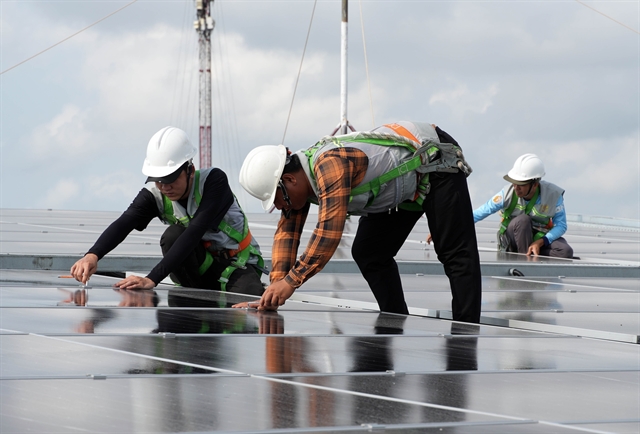
| Workers check the solar panels in Cà Mau Province. Clean energy and green finance play a pivotal role in the green transition. — VNA/VNS Photo Trung Hiếu |
HÀ NỘI — Enterprises are at a critical turning point in adopting environmental, social and governance (ESG) standards to enhance competitiveness, with clean energy and green finance playing a pivotal role in the transition, experts have said.
Participants Friday's forum held by Tạp chí Kinh tế - Tài chính (Economics – Finance Magazine) said as global markets increasingly prioritise sustainability, ESG is no longer optional but a key determinant of access to capital, supply chains and export opportunities.
Experts say the shift requires businesses to accelerate the use of clean energy sources while tapping into green finance instruments such as green bonds, sustainable loans and climate funds to support long-term investment.
Trần Thị Quỳnh Nga, deputy director of the Department of Sectoral Finance and Economics under the Ministry of Finance, said clean energy and green finance should not be treated as separate pillars.
“Finance is the lifeblood," she said.
"We cannot green the economy with polluting fossil energy, and we cannot ensure a just transition without flexible financial mechanisms to support affected groups.”
Clean energy projects, including wind, solar and hydropower, require long-term, preferential financing to be viable, while green finance instruments such as green bonds, credit and investment funds need credible projects to deploy capital effectively.
“Without green finance, clean energy remains expensive plans on paper. Without clean energy, green finance has capital but nowhere effective to invest,” Nga added.
Tô Quốc Hưng, country director of ACCA Vietnam, said ESG has evolved from a voluntary concept into a global standard.
He cited findings of a survey covering 5,800 enterprises across 18 countries that ESG adoption is widespread, with mandatory disclosure requirements already in place in developed markets such as the UK and increasingly integrated into regulations in developing economies.
In Việt Nam, financial institutions and banks have moved quickly to align with international green finance standards, he said, stressing that ESG is becoming a critical factor influencing access to capital and long-term competitiveness.
Mạc Hoàng Anh, chief financial officer of OSI Holdings, said ESG is no longer a matter of choice but a determinant of long-term competitiveness.
She added that strong ESG practices can help companies improve transparency, manage risks more effectively and expand access to funding and international markets.
However, some small- and medium-sized enterprises in Việt Nam remained confused on how to begin ESG implementation and face constraints in resources and measurement frameworks.
According to Nga, the Ministry of Finance is working with relevant ministries and agencies to develop policies that support green transition, including incentives for green projects and financial packages from banks and financial institutions.
Key priorities include establishing a comprehensive legal framework for green finance, developing domestic green bond markets linked to international capital markets and building a carbon market.
Other measures include refining environmental tax policies, strengthening financial mechanisms for public-private partnerships in green infrastructure and mobilising international climate finance through co-financing and technical support schemes, Nga added. — VNS
Economy
 Economy
 Economy
 Economy
 Economy
 Economy
 Economy
 Economy
 Economy
 Economy
 Economy
 Economy
 Economy
 Economy
 Economy