 Economy


MoIT to build system to flag unusual fuel price movements
1.
|
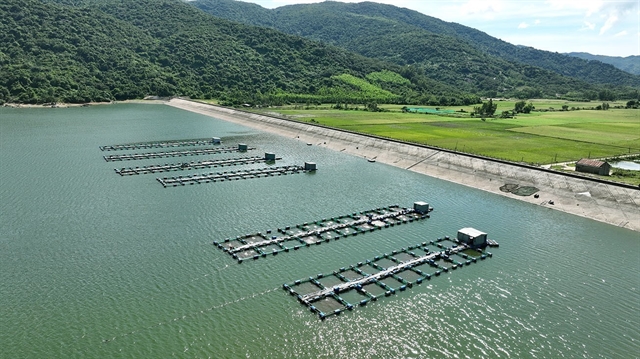
| Tilapia are raised in floating cages in Gia Lai Province. — VNA/VNS Photo Vũ Sinh |
HÀ NỘI — Việt Nam is accelerating efforts to diversify its tilapia export markets as global volatility, driven by geopolitical tensions, rising fuel prices and higher logistics costs, reshapes trade dynamics.
Strong triple-digit growth in several new destinations in early 2026 underscores both the sector’s momentum and the challenges ahead.
Tilapia exports are entering a high-growth phase, reaching US$99 million in 2025 (up more than 140 per cent year-on-year) and $35 million in the first quarter of 2026 (up nearly 190 per cent).
Growth is no longer confined to traditional markets, with sharp increases recorded in the Dominican Republic (over 600 per cent), the Netherlands (over 200 per cent), the Middle East (above 2,300 per cent) and ASEAN (nearly 400 per cent), reflecting rising global demand for alternatives to conventional whitefish.
Despite these gains, structural risks persist. Exports remain heavily concentrated in key but distant markets such as the US and Brazil. Brazil, one of the world’s leading tilapia producers and a major investor in aquaculture technology, accounts for nearly half of export value in early 2026, exposing the sector to potential policy and demand shifts. Meanwhile, shipments to the US are trending downward.
External factors, including tariff changes, geopolitical instability in the Middle East, and escalating fuel and logistics costs, continue to weigh on the industry, underscoring the need for greater resilience and diversification.
To address these challenges, exporters are pivoting towards markets with logistical advantages, making better use of free trade agreements and tailoring products to consumer demand.
The domestic market of over 100 million people is also emerging as a strategic anchor.
Nguyễn Đăng Ngọc, deputy CEO of Viet Nhat Group, said the company is pursuing a dual-track strategy, developing both domestic and export markets to enhance value and strengthen the Vietnamese tilapia brand.
Under the fisheries development strategy to 2030, the Ministry of Agriculture and Environment has identified tilapia as a high-potential species alongside shrimp and pangasius, promoting industrial-scale farming, high-tech applications and sustainable standards.
Trần Đình Luân, director general of the Department of Fisheries and Surveillance, noted that with around 1.3 million hectares of aquaculture water surface and favourable natural conditions, the sector has ample room to grow.
Global demand for tilapia is projected to increase by about 13 per cent annually, reaching $20 billion by 2030. Authorities are stepping up efforts to manage farming areas, improve seed quality and expand VietGAP, GlobalGAP and other internationally recognised standards, with stable raw material zones seen as key to export expansion.
From a familiar staple in Vietnamese households, tilapia is steadily moving up the global value chain and is poised to become a “third pillar” of the fisheries sector alongside shrimp and pangasius.
While recent export performance highlights strong potential, sustaining momentum will depend on leveraging natural advantages, upgrading technology and boosting value-added production to meet the sector’s export target of $14-16 billion by 2030. — VNA/VNS
Economy
 Economy
 Economy
 Economy
 Economy
 Economy
 Economy
 Economy
 Economy
 Economy
 Economy
 Economy
.jpg) Economy
Economy
 Economy
 Economy