 Economy



Top leader’s visit to open new chapter in Việt Nam–Denmark relations
1.
|
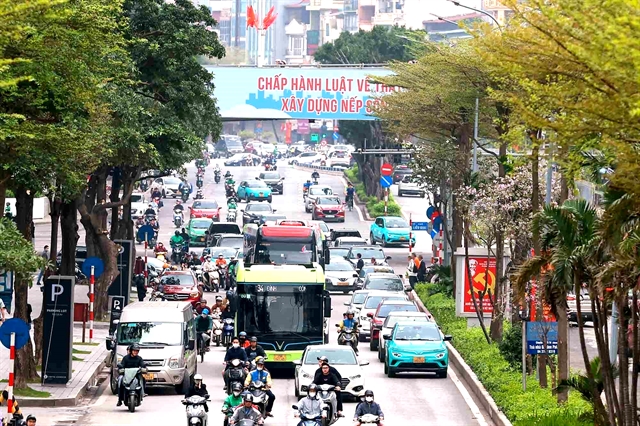
| Hà Nội's streets now carry a mix of internal combustion engine and electric vehicles. — VNA/VNS Photo Phạm Tuấn Anh |
HÀ NỘI — Shifting to green transport will require not only clear policies but also long-term planning and cross-sector coordination, according to experts.
As major cities grapple with worsening pollution, the transition is increasingly viewed as critical to cutting emissions, improving environmental quality and supporting sustainable growth in the country.
At a recent seminar co-organised by the Centre for Chinese Economic and Strategic Studies and the Hà Nội Association for Communication and Public Relations (HANICA) in Hà Nội, academics and officials said that as Việt Nam learns from international experience in green transition, ensuring policy feasibility in alignment with national and local development conditions is especially important.
As the capital of Việt Nam and one of the cities with an alarmingly high air quality index (AQI) recently, Hà Nội is rolling out pilot measures to support the green transition starting this July, including the establishment of low-emission zones (LEZs).
The objective of establishing these zones is to control emissions from transport by adjusting traffic arrangements in a more appropriate and effective manner.
Under the LEZ framework, gas-fueled vehicles that fail to meet emission requirements will be restricted from travelling in the city’s inner areas during specific timeframes. Non-emission vehicles, environmentally friendly vehicles, priority vehicles and those with valid permits will be allowed to operate.
Lê Thị Thanh Thủy, deputy head of the Environmental Management Division under the Hà Nội Department of Agriculture and Environment, noted that support mechanisms will be introduced alongside technical measures and traffic planning policies.
Accordingly, state management agencies in the construction, environment, and industry and trade sectors are working together to ensure that the policies introduced serve multiple objectives.
|
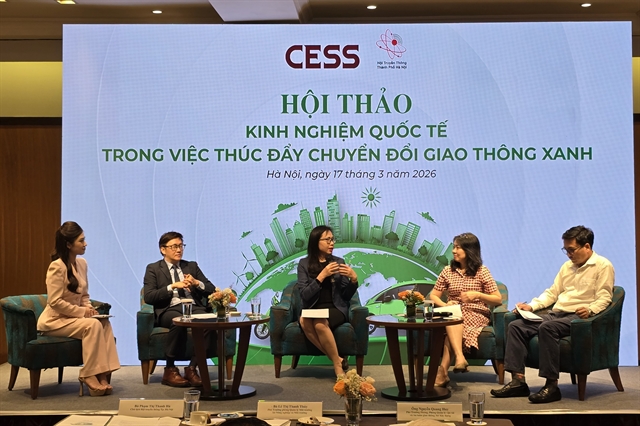
| Experts engage in a panel discussion at the recent seminar on green transport organised by the Centre for Chinese Economic and Strategic Studies and the Hà Nội Association for Communication and Public Relations. — VNS Photo Nhật Hồng |
Nguyễn Thị Xuân Thúy, lecturer at the University of Economics and Business (Việt Nam National University–Hà Nội) and senior industrial policy expert at UNIDO Việt Nam, also stressed the inclusiveness and sustainability of policymaking, which she said should not only target consumers but also vehicle manufacturers.
She cited examples of France, where policies take into account whether low-income groups are able to make the transition, offering them higher levels of support than higher-income groups. Meanwhile, in Norway, incentives are applied selectively, targeting vehicles within certain price ranges.
“In Việt Nam, the automotive industry is a key sector, so while these may be transport policies, they inevitably affect vehicle manufacturers,” she said.
“For such businesses and the large number of workers they employ, it is important to assess the potential impacts and take them into account in policymaking. Ultimately, the goal is to change both consumer behaviour and business practices.”
CESS director Dr Phạm Sỹ Thành, who has conducted extensive policy studies on China’s green transport, emphasised that a phased roadmap is critical for a successful transition.
“In the short term, applying emissions standards, as we have already pursued, is clearly a critical requirement," he said.
"Basing both incentives and restrictions on emissions performance is, in our view, a scientifically grounded approach.”
Thành noted that Hà Nội is aiming for ambitious goals, with plans to apply level 4 emissions standards citywide. Strengthening vehicle inspection and providing transition incentives are seen as effective measures in shaping public behaviour.
The medium-term focus should be placed on public transport and new energy vehicles, alongside a well-coordinated and optimised network of charging and battery infrastructure, he said. During this period, the development of national standards regarding green transport is essential to effectively guide the transition.
“In the long term, the priority should be developing smart transport systems that integrate different modes of transport into a unified ecosystem involving multiple stakeholders. This represents the most advanced stage of development and is the direction that major global cities and megacities are increasingly pursuing,” said Thành. — VNS
Economy
 Economy
 Economy
 Economy
 Economy
 Economy
 Economy
 Economy
 Economy
 Economy
 Economy
 Economy
 Economy
 Economy
 Economy