 Economy


Business incubator helps SMEs enhance competitiveness
1.
HCM CITY — HCM City has emerged as the nation’s central hub for integrating digital tools into all aspects of life, experts said.
Nguyễn Thanh Hoà, deputy director of the HCM City Digital Transformation Centre (HCMC-DXCentre) under the HCM City People’s Committee, said: “Entering 2026, a new phase has officially begun with the National Party Congress, requiring accelerated, results-driven efforts."
"Việt Nam is on track to become a high middle-income country by 2030. To achieve this goal, we must maintain GDP growth of around 10 per cent from now until 2035, and at least 7 per cent for the next ten consecutive years.”
 |
| HCM City is expected to become one of the key regions driving digital transformation. — Photo Courtesy of tphcm.chinhphu.vn |
In 2025, Việt Nam’s GDP grew by 8.02 per cent, with record highs in budget revenue and foreign investment. This year also served as a pivotal period for legislative and policy development, laying the groundwork for the implementation phase in 2026.
Priorities in 2025 centred around digital transformation, administrative reform, and the two-tier government model.
In addition, a large number of legal documents related to science, technology, innovation, and digital transformation were issued, including several breakthrough policies aimed at removing institutional bottlenecks, such as Resolution 57 on breakthroughs in science, technology, innovation, and digital transformation at the national level; Resolution 59 on international integration; Resolution 66 on policy reform; and Resolution 68 on developing the private sector.
HCM City has emerged as the nation’s central hub for integrating digital tools into all aspects of life.
In parallel, the HCMC-DXCentre has been tasked with overseeing digital transformation and cybersecurity, platforms, applications and, most importantly, data protection.
Additionally, the city established a Steering Committee for the Development of Science, Technology, Innovation, and Digital Transformation to foster regional growth, focusing on research commercialisation, infrastructure upgrades, and digital economy development. The year 2026 is expected to deliver breakthroughs with initiatives such as establishing the second National Data Centre, an information security monitoring centre, and enhancing digital citizenship pillars through the Citizen Digital application.
Businesses as catalysts for technological convergence
Success can only be achieved through close collaboration between the public and private sectors.
“Digital Government is the top priority among the three pillars of digital transformation, as effective policymaking and implementation will drive the digital economy and digital society,” Hoà said.
At a recent summit in HCM City entitled “the Scaling Business Summit: From Global Trends to Growth Drivers of HCM City", global technology consulting firm Gradion, headquartered in Germany, shared insights on emerging AI trends.
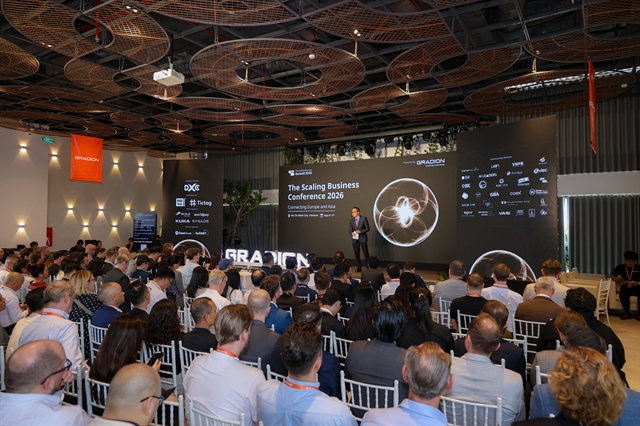 |
| Experts discussed technology trends in the future at a recent summit in HCM City. — Photo Courtesy of Gradion |
Lars Jankowfsky, founder of the company, remarked: “As you know, in 2024 - we ask, AI answers. Moving into 2025 - you work, AI assists. By 2026, Agent Skills - new standards that expand the specialised capabilities of AI agents, will become the next major trend. We define tasks and goals, and technology will execute and deliver.”
This reflects the current landscape in Việt Nam, where the number of AI-adopting enterprises has grown sharply with 170,000 in 2025, up 39 per cent from the previous year.
In 2024 alone, an average of five new enterprises adopted AI every hour. However, 74 per cent of businesses remain at basic operational optimisation, and only 9 per cent make AI their core business driver.
This shows that agent skills will likely become the next target for businesses, allowing AI to perform tasks while humans take on roles as supervisors and quality controllers.
Lars Jankowfsky further noted: “The limitations in integrating AI into business models also stem from employee reluctance. Seventy per cent of AI integration projects underperform due to a lack of cooperation and mindset change among staff, making operations challenging.”
Technology companies play a crucial role by providing technology consulting, helping expand markets, optimising resource costs, and advising on appropriate AI investments.
The essence of effective AI adoption lies in understanding business needs and incorporating them into suitable models through training sessions, clear process explanations, preventing misuse, and consistently performing “quality checks” on outputs.
At the event, experts highlighted how AI agents have successfully turned century-old ideas into decade-ready innovations. The AI market is expected to advance significantly, especially in healthcare, addressing mental health treatment and cancer therapy within the next ten years.
The Scaling Business Summit 2026 is an annual event organised by Gradion, a leading German technology company. In its seventh year, the event attracted more than 1,000 attendees, bringing together 40 senior leaders from various nations to share experiences in international markets and Việt Nam through topics on technology, AI adoption, and market expansion. — VNS
Economy
 Economy
 Economy
 Economy
 Economy
 Economy
 Economy
 Economy
 Economy
 Economy
 Economy
 Economy
 Economy
 Economy
 Economy