 Economy



AIMCONNECT 2026 Held in Singapore, Bringing Global Automotive Leaders Together to Explore the Future of AI, Trust and Connected Mobility
1.
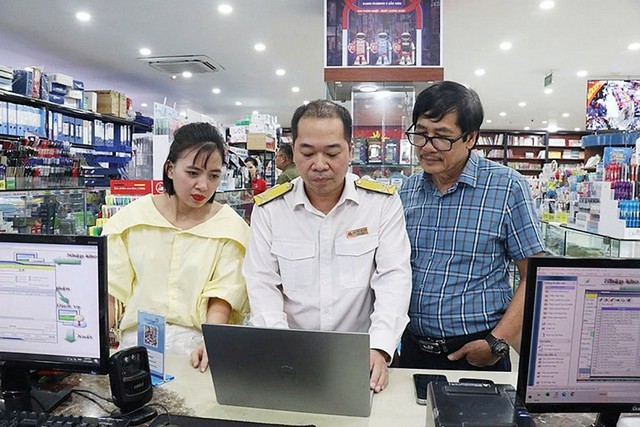 |
| A tax official helps a retail household business set up electronic tax systems in Phú Thọ Province. — VNA/VNS Photo Nguyễn Thảo |
HÀ NỘI — More than 5.2 million households and individuals will move to a declaration-based tax system starting from January 1, 2026. Under the reform, taxes will be calculated on actual revenue or income rather than fixed, negotiated amounts.
According to the Ministry of Finance (MOF), the move aims to increase transparency, reduce arbitrariness in tax collection, and gradually integrate household businesses into the formal economy.
However, the transition has also generated confusion, particularly around new requirements for electronic invoicing and the way value-added tax (VAT) is applied once revenue thresholds are crossed.
Under current proposals of the MOF, business households and individuals with annual revenue of VNĐ1 billion (US$38,000) or more would be required to issue authenticated electronic invoices, including invoices generated from point-of-sale systems connected directly to the tax authority.
Those with revenue below VNĐ1 billion would not be subject to this obligation.
The Việt Nam Chamber of Commerce and Industry (VCCI) has supported the move towards electronic invoicing, viewing it as an essential tool to improve transparency and prevent tax fraud.
However, it has raised concerns about the proposed VNĐ1 billion threshold, arguing that it does not align well with existing tax benchmarks, such as the VNĐ3 billion threshold for profit-based tax calculation or the VNĐ50 billion threshold used in other regulatory contexts.
A survey conducted by VCCI in June suggests that implementation challenges remain significant. Even among households earning more than VNĐ1 billion a year, the adoption of electronic invoices remains difficult.
Lack of investment capital accounted for 32 per cent of reported difficulties in rural areas and 23 per cent in urban areas, while insufficient digital skills affected 77 per cent of rural respondents and 67 per cent of urban ones.
The chamber has therefore proposed raising the mandatory electronic invoicing threshold to VNĐ3 billion a year, corresponding to the point at which profit-based tax methods apply.
For smaller households, it suggests that tax authorities rely more on data from multiple sources to enhance oversight, rather than imposing a uniform technical requirement that could overwhelm limited resources.
Another area of concern relates to buyer information on electronic invoices.
Under Decree 70/2025/NĐ-CP, invoices are generally required to include the buyer’s tax code or personal identification number, except in certain retail contexts, such as supermarkets, shopping centres, petrol stations, casinos and prize-based electronic gaming venues.
VCCI warns that applying this requirement rigidly could create significant difficulties for small retail businesses like grocery shops, mini-supermarkets, food and beverage outlets and accommodation services. These businesses share similar characteristics with large retail chains: a high volume of walk-in customers, low transaction values, and fast transaction speeds.
Requiring full buyer identification for every transaction would increase staffing costs, slow operations and potentially deter consumers concerned about privacy. The chamber recommended exempting invoices issued to non-business individuals from mandatory buyer identification requirements.
Separate from invoicing requirements, lawmakers have also adjusted VAT liability thresholds. The National Assembly has taken a step widely seen as supportive of small businesses by raising the revenue threshold for VAT liability to VNĐ500 million per year. Households and individuals earning below this level will be exempt from VAT, reducing compliance costs and easing pressure on micro-scale operators.
Confusion has arisen, however, over how VAT is calculated once this threshold is exceeded. Under the draft decree on tax administration prepared by the Ministry of Finance, households with revenue of VNĐ500 million or more become subject to VAT under the Law on Value-Added Tax 48/2024 and existing implementing regulations.
Some have interpreted this as unfair or inconsistent with personal income tax, where only income above the exemption threshold is taxed.
Tax experts said this comparison is misleading. VAT is an indirect tax, built into the price of goods and services and paid by the final consumer. Business households merely collect and remit the tax on behalf of the State. Once an entity falls within the VAT regime, the tax is applied to all taxable transactions; there is no technical mechanism for partial exemptions based on thresholds.
Personal income tax, by contrast, is a direct tax levied on the taxpayer’s own income. In this case, the VNĐ500 million threshold determines whether a household is subject to tax at all, rather than acting as a deductible amount. The different treatment reflects the fundamentally different nature of the two taxes, not a policy inconsistency.
Tax experts warned that without clear communication and transitional support, some households may be tempted to underreport revenue or split business registrations to stay below thresholds, undermining transparency, and increasing enforcement costs.
To address these risks, they have called for clearer guidance, simplified procedures in the first year after crossing thresholds, and continued support to help business households gradually adopt electronic invoices and basic accounting. —VNS
Economy
 Economy
 Economy
 Economy
 Economy
 Economy
 Economy
 Economy
 Economy
 Economy
 Economy
 Economy
 Economy
 Economy
 Economy